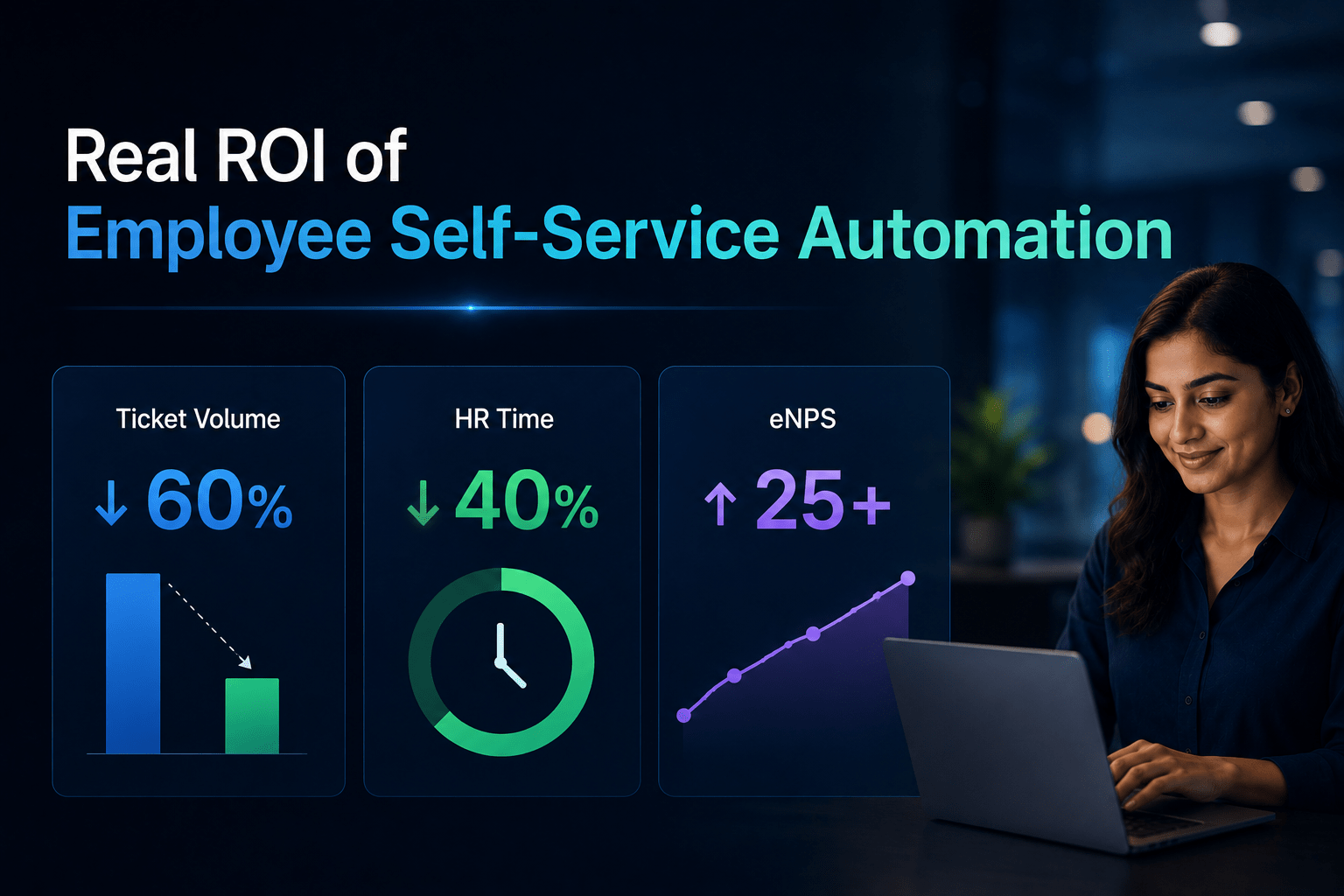
Most ROI calculations for employee self-service automation that Indian HR functions see during vendor evaluations focus on a single metric - HR team headcount reduction through query volume reduction. The vendor projects that automation handles X% of queries, removes Y HR helpdesk positions, and saves Z lakh per month. Show that, declare ROI.
This framing misunderstands what good HR teams should be doing and quietly produces deployments where the released capacity stays unallocated. The full ROI picture requires four metrics, used together.
Metric 1 - HR ticket volume
Count of routine HR queries handled per period. The primary input metric for measuring the depth of automation.
Indian baselines vary by company size and HR team operating model. A 500-employee company with helpdesk-heavy HR culture might see 800-1,500 HR queries per month. A more self-service-cultured company might see 300-500. Mature ESS automation deployments reduce this by 50% to 75% across both starting points.
Tracking discipline matters. Measure queries actually resolved by automation, not queries that started in automation and escalated to human. Escalations are appropriate but should be counted separately. The deflection rate - queries handled fully by AI - is the core metric.
Metric 2 - Employee response time
Time from an employee query to a meaningful response. The metric that determines employee experience.
HR-handled queries through email or Slack typically resolve in hours to days depending on HR team workload. Channel-native ESS automation resolves routine queries in seconds (informational) to minutes (transactional, requiring approval). The improvement is large and visible to employees.
Track both averages and tails. The average response time matters, but the 90th percentile matters more - the experience of the employee who waits 3 days for a leave balance answer is what shapes their view of HR, not the average across all queries. Automation eliminates the long-tail wait time, which is often the actual problem.
Metric 3 - HR team strategic time shift
The share of HR team time allocated to strategic work - talent strategy, performance management, organisation design, learning and development, culture, leadership coaching - versus operational work - query handling, transaction processing, document chasing, manual approval routing.
Most Indian HR teams in mid-market companies allocate 70-85% of time to operational work. The CHRO's strategic ambitions are constrained by this allocation. The team that the CHRO wants to be doing talent strategy is in fact doing helpdesk.
Good ESS automation shifts this allocation measurably. The released capacity from handling fewer routine queries can flow to strategic work if the CHRO actively directs it there. If the released capacity is simply absorbed into casual work and managed-down headcount, the strategic shift does not happen and the largest part of the ROI does not materialise.
Tracking discipline. Quarterly HR team time allocation review. What share of hours went to strategic versus operational. The number is rarely tracked formally before ESS deployment; estimating it explicitly surfaces the change the deployment is supposed to produce.
Metric 4 - Employee experience score
eNPS, internal CSAT on HR services, or whatever the company uses to measure employee sentiment. The lagging metric that shows whether ESS automation is actually changing employee experience or just shifting metrics around.
Indian baselines vary widely by industry and company. The trend matters more than the absolute number. ESS automation done well moves eNPS measurably over 6 to 12 months - typically 8 to 20 points of improvement on common scales, depending on starting baseline.
Bad automation moves it the wrong direction. Chatbots that frustrate, AI that gets stuck in loops, channel-native that does not actually work - these produce worse employee experience than the HR-team-handled baseline. The vendor that promises ROI without the experience layer being designed properly is often delivering automation that erodes the experience score even while reducing helpdesk volume.
Hidden costs the vendors do not mention
Three.
Implementation effort. Quoted license fees exclude integration cost. Real implementation includes HRMS integration (Keka, Darwinbox, Zoho People, GreytHR, SAP, Workday - each has its own integration realities), channel deployment (Slack apps, MS Teams apps, WhatsApp Business API setup), policy ingestion and tuning, vernacular language configuration, approval workflow design with managers, HR team training, employee communication. For an Indian mid-sized company, this is typically 150 to 300 hours of internal effort plus INR 4 to 12 lakh of consulting in the first 90 days.
Ongoing tuning. ESS automation needs continuous tuning based on actual employee usage. New policies require policy library updates. New transaction types get added. Edge cases that surface in production need handling. Plan for 10 to 14 hours per month of internal effort on platform tuning, typically the HR operations lead with vendor support.
Channel and platform costs that scale. WhatsApp Business API conversation pricing scales with volume. Slack/Teams app costs may include per-seat fees. License fees for the underlying HRMS may have to scale with API call volume in some pricing models. TCO over 18 months at projected scale is the right framing.
Payback period
For Indian companies with 250 or more employees, typical payback is 5 to 10 months. Variance comes from current baseline ticket volume (more volume means faster amortisation), HRMS integration complexity (Indian-built platforms typically integrate faster than global platforms), and workforce composition (blue-collar workforce inclusion requires WhatsApp-native deployment but produces large adoption gains).
Below 100 employees, the orchestration overhead typically exceeds the value. A small HR team with strong process discipline handles small-team query volume effectively. Between 100 and 250, ESS automation pays off if there is a strategic case for releasing HR capacity to specific strategic priorities. Above 250, automation becomes essential for any kind of consistent employee experience and HR team productivity.
About the Author

Ankur Singh
Ready to orchestrate your AI future?
Converiqo AI helps you design, deploy, and scale automation workflows that move your business faster, leveraging specialized solutions like our AI bot platform for lead generation, customer self-service AI bot platform, employee self-service AI bot platform, retail omnichannel automation, and our detailed guides on how agentic AI bot platforms work in enterprises and cost structure of enterprise AI bot platforms. Connect with our team to see the platform in action and co-create the next chapter of intelligent operations.
Read More Blogs
Discover more insights and product updates curated by the Converiqo AI team.
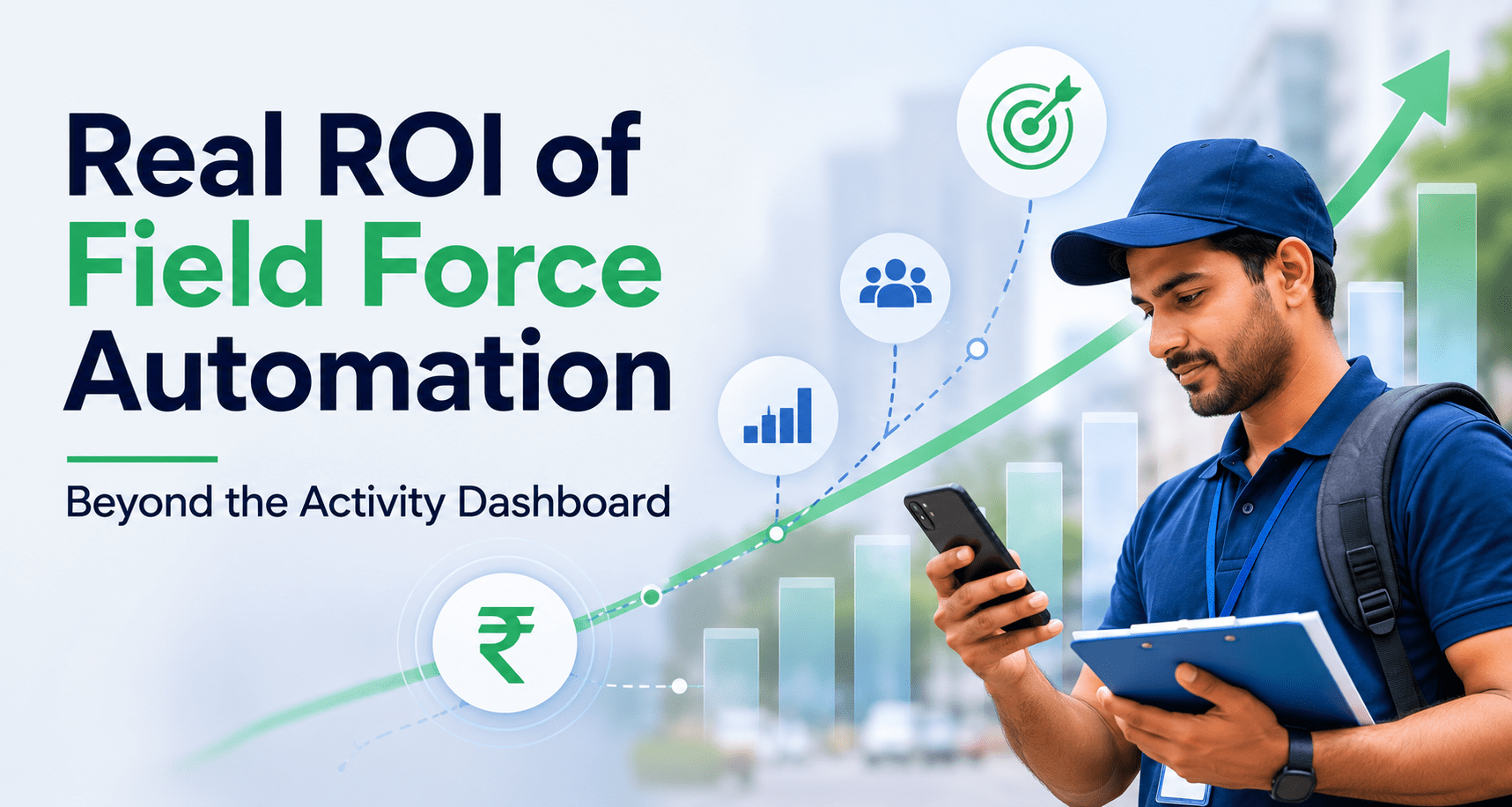
Real ROI of Field Force Automation - Beyond the Activity Dashboard
Four metrics that show real field force automation ROI in India - productivity, data reliability, throughput, and field attrition - not just the activity dashboard.
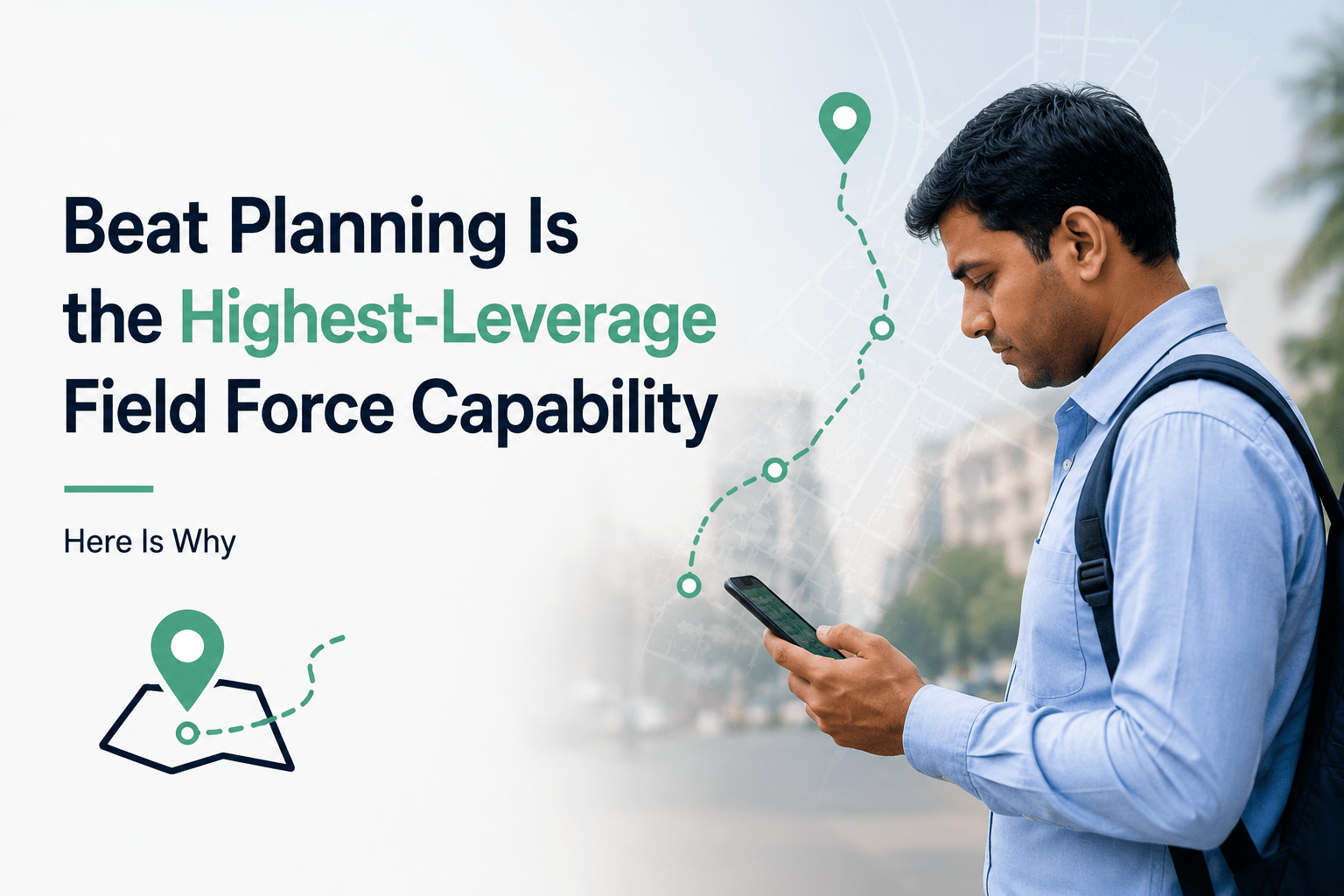
Beat Planning Is the Highest-Leverage Field Force Capability - Here Is Why
Beat planning decides coverage, call frequency, and whether field time is productive. Why it is the single highest-leverage field force automation capability.
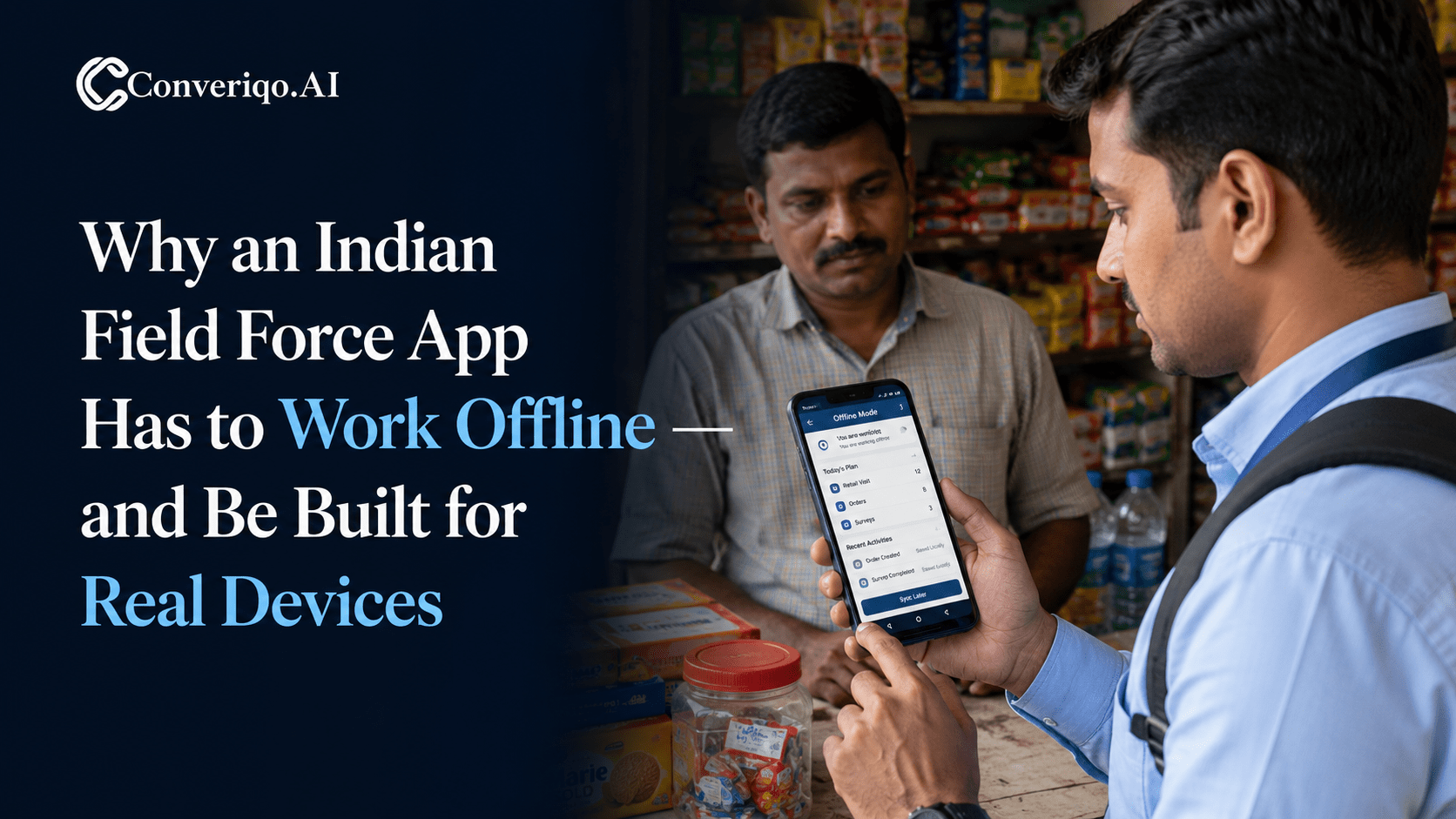
Why an Indian Field Force App Has to Work Offline - and Be Built for Real Devices
Field work in India happens where connectivity is intermittent. A field force app that assumes constant connectivity fails exactly where field work is done.