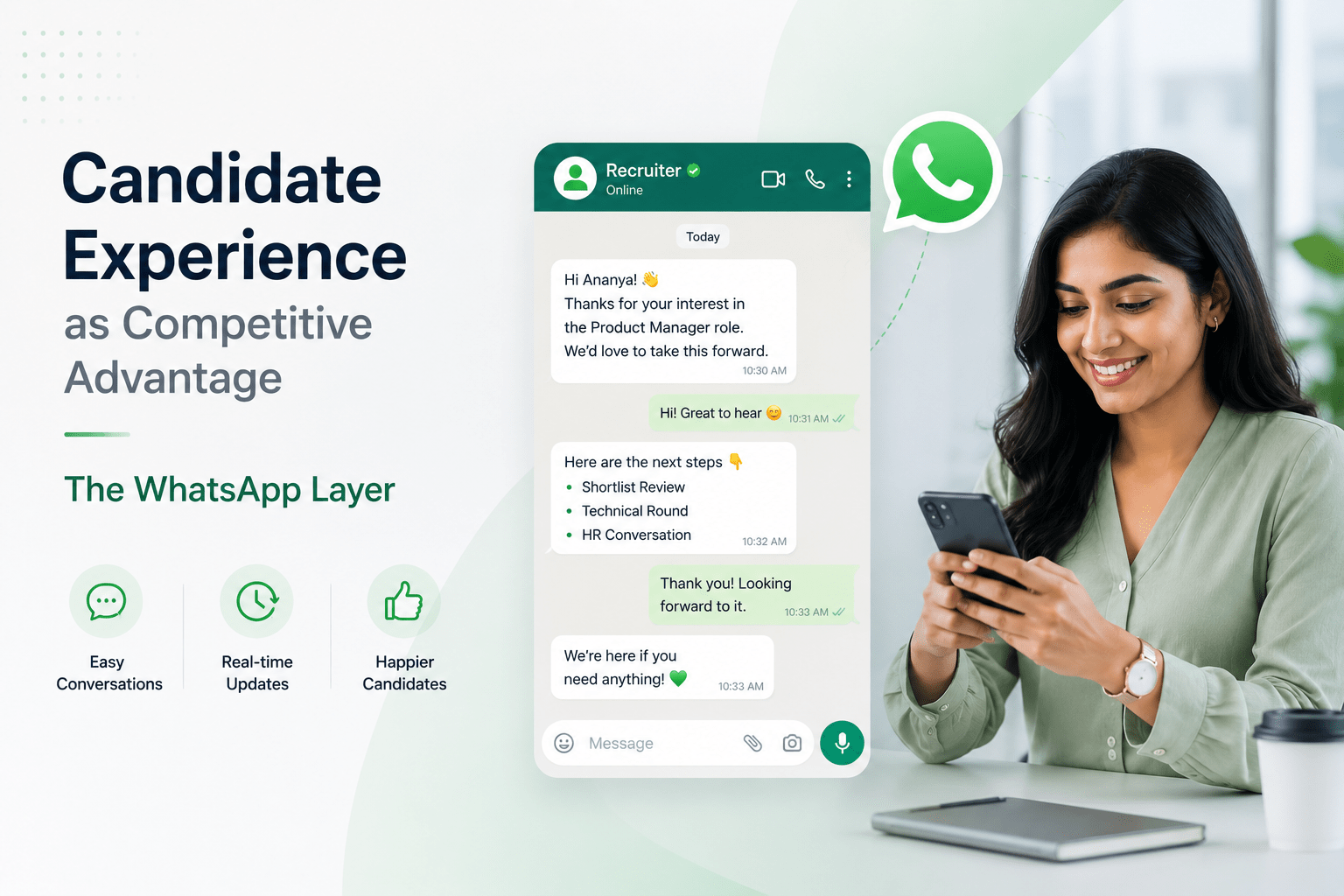
Indian candidate networks are visible in ways most HR functions underestimate. Glassdoor reviews. AmbitionBox ratings. LinkedIn posts from rejected candidates who write about being ghosted. WhatsApp groups where candidates compare notes on which companies respond, which companies disappear, which companies make competitive offers. The candidate experience a company delivers in 2026 becomes the employer brand it carries into 2027 and beyond.
Most Indian companies treat candidate experience as a soft factor. Something nice to have when there is time. The hiring KPIs measure time-to-hire and cost-per-hire; candidate experience does not show up in the quarterly review. The result - candidate experience erodes silently because nothing in the operational system is built to protect it.
Hiring automation, if built correctly, makes candidate experience a measurable and defensible factor. The WhatsApp layer is the most visible part of that.
Why WhatsApp matters for candidate communication
Three structural reasons specific to Indian hiring in 2026.
Response rate. Indian candidates respond to WhatsApp messages faster and more reliably than to email. For non-elite roles particularly, email response rates can be under 30%. WhatsApp response rates often exceed 75%. The same recruiter effort produces materially more candidate engagement on WhatsApp than on email.
Channel familiarity. WhatsApp is where most Indian candidates already conduct most of their digital communication. Asking them to engage by email imposes a context switch. Asking them to engage on a careers portal imposes another context switch. WhatsApp meets them where they already are.
Conversational depth. WhatsApp is conversational by nature. Status questions, follow-up clarifications, scheduling, document collection, even informal expectation-setting all flow naturally. Email transactions require formality that slows the lifecycle. WhatsApp transactions can be brief, frequent, and timely.
What WhatsApp candidate communication looks like when it works
A candidate applies on Naukri. Within 30 minutes, they receive a WhatsApp message acknowledging the application by name and role. The message asks one or two qualifying questions and offers next steps based on their answer. If they pass initial qualification, they receive a brief description of the role and an offer to schedule a screening conversation at their convenience. The scheduling happens in WhatsApp via a slot picker. The conversation happens on WhatsApp at the agreed time. If they progress, the next steps - interview scheduling, document submission, status updates - also happen on WhatsApp.
If they do not progress at any stage, they still receive a message - clear, respectful, with the specific reason if appropriate, and a thank-you for their time. No ghosting. No silence. The candidate finishes the process knowing where they stand and how the company treated them.
Some of these candidates were never going to be hired for this role. Many of them will apply again for a different role, or refer friends. The candidate experience accumulates as employer brand equity.
The discipline WhatsApp requires
WhatsApp candidate communication is not the same as WhatsApp marketing communication, but the same discipline framework applies. The 24-hour window. Template categories. Quality rating monitoring. Opt-in handling.
For hiring specifically, the 24-hour window is usually inside the active candidate conversation - the candidate has messaged in the last 24 hours, and the company can respond freely. Outside the window, communication moves to template messages - interview reminders (utility category), document collection requests (utility or service depending on framing), offer-stage notifications. Marketing templates are rarely used for hiring; the communication is utility-class.
Quality rating matters because a WhatsApp Business Account flagged or suspended takes down the entire candidate communication infrastructure. The discipline that protects quality - clean opt-in (the application implies consent for hiring-related communication; explicit consent for retention beyond is captured separately), respected opt-out, conservative frequency, relevant content - is the same discipline that protects candidate experience generally.
What candidate experience metrics show
Four candidate experience metrics worth tracking alongside the hiring KPIs.
First-response time. From application to first meaningful candidate communication. Target - under one hour for the acknowledgement, under four hours for the first qualifying touch. Indian baseline often runs at days. Automation can collapse this without recruiter additional effort.
Decline rate. Of offers extended, how many are declined. A rising decline rate is often a candidate experience signal - process took too long, offer stage was sloppy, competing offers got there first. Decline rate is a leading indicator that does not appear in time-to-hire metrics.
Post-process NPS. A short survey to all candidates regardless of outcome - application acknowledged, screened, interviewed, offered, hired. The score from non-hired candidates matters as much as from hired ones; it is the rejected candidates whose stories shape employer brand most.
Ghost rate. Of candidates who entered the active pipeline, how many disappeared between stages. Ghost rate is partly candidate behaviour, partly communication speed. Faster, clearer communication on WhatsApp materially reduces ghost rate in most Indian hiring contexts.
These four metrics, viewed alongside time-to-hire, cost-per-hire, and quality-of-hire, give a complete picture. Companies that track only the hiring KPIs without the candidate experience metrics optimise for velocity while their employer brand erodes invisibly.
About the Author

Yash Soni
Ready to orchestrate your AI future?
Converiqo AI helps you design, deploy, and scale automation workflows that move your business faster, leveraging specialized solutions like our AI bot platform for lead generation, customer self-service AI bot platform, employee self-service AI bot platform, retail omnichannel automation, and our detailed guides on how agentic AI bot platforms work in enterprises and cost structure of enterprise AI bot platforms. Connect with our team to see the platform in action and co-create the next chapter of intelligent operations.
Read More Blogs
Discover more insights and product updates curated by the Converiqo AI team.

Real ROI of Field Force Automation - Beyond the Activity Dashboard
Four metrics that show real field force automation ROI in India - productivity, data reliability, throughput, and field attrition - not just the activity dashboard.

Beat Planning Is the Highest-Leverage Field Force Capability - Here Is Why
Beat planning decides coverage, call frequency, and whether field time is productive. Why it is the single highest-leverage field force automation capability.
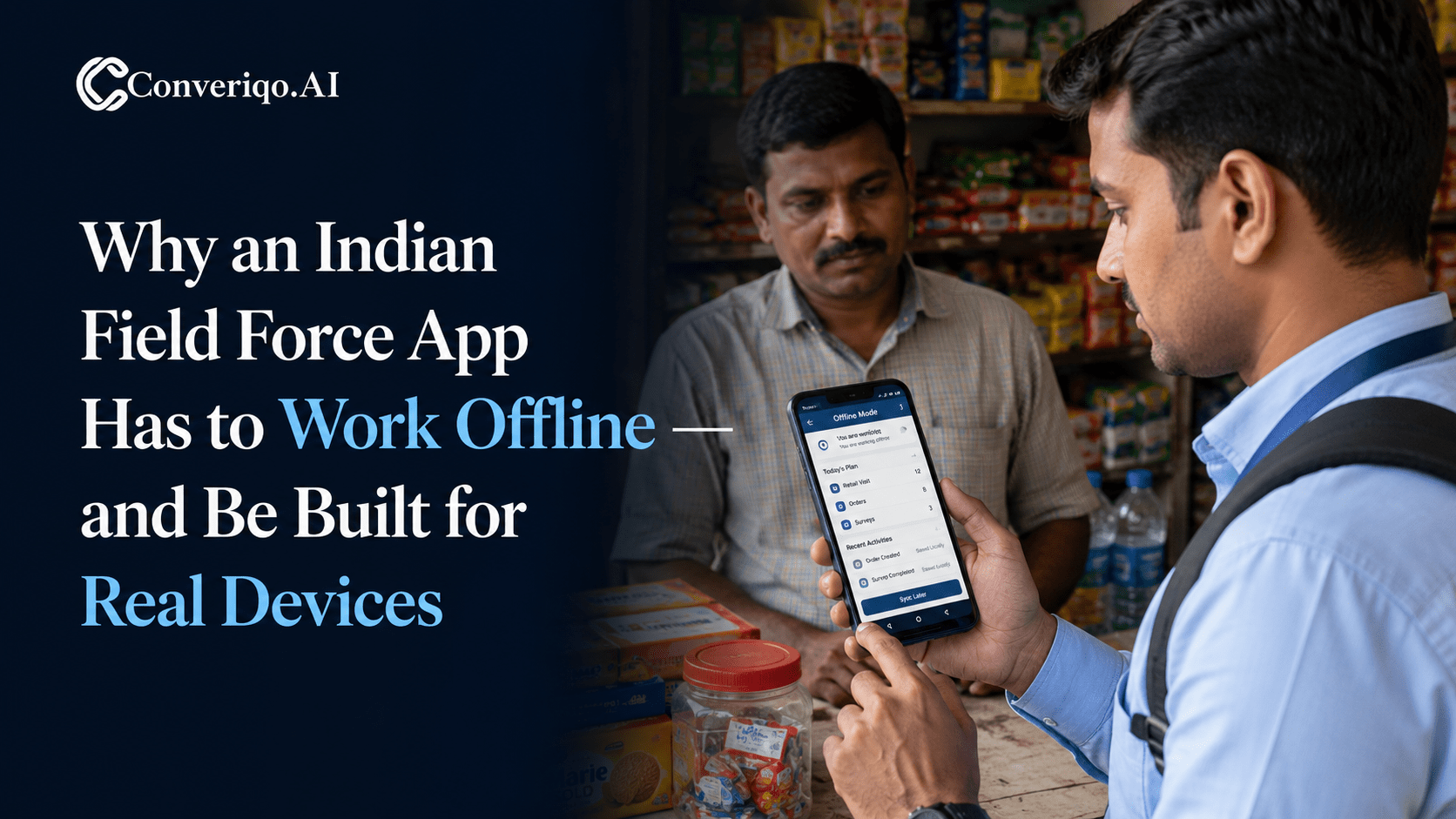
Why an Indian Field Force App Has to Work Offline - and Be Built for Real Devices
Field work in India happens where connectivity is intermittent. A field force app that assumes constant connectivity fails exactly where field work is done.