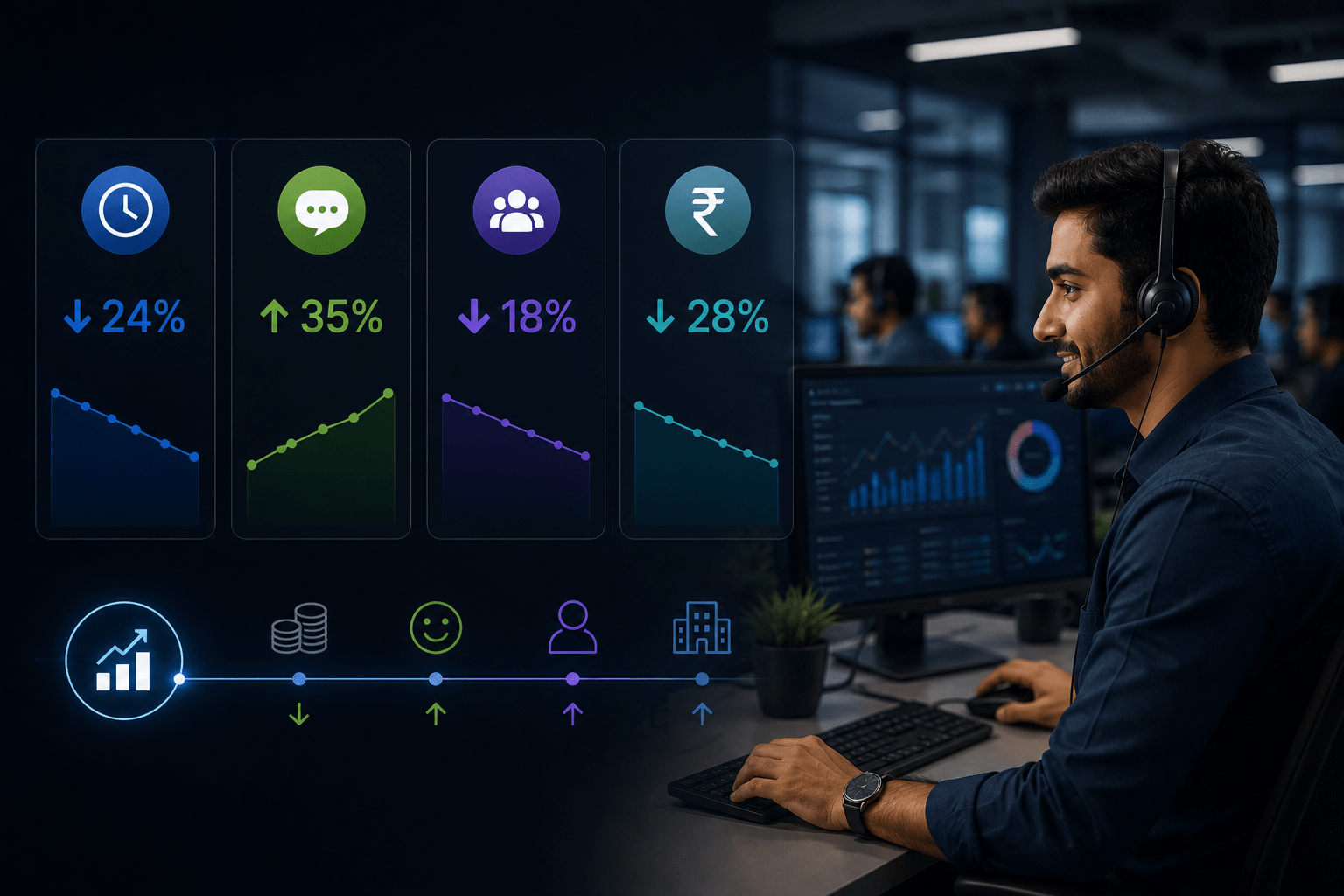
Most ROI calculations for call center automation that Indian operations see during vendor evaluations focus on one metric - cost reduction through agent headcount reduction. The vendor projects that automation handles X% of calls, removes Y agent positions, and saves Z lakh per month. Show that, declare ROI.
This framing is incomplete in a specific way. It treats automation purely as a substitution exercise - fewer agents needed to handle the same calls - and misses three other ROI dimensions that often matter more over 12 to 24 months. The full ROI picture requires four metrics, used together.
Metric 1 - Deflection rate
The share of inbound call volume handled fully by AI agents without escalation to human agents. The primary metric for measuring the depth of automation.
Indian baselines vary by domain. Routine-heavy operations (telecom, e-commerce, utilities, basic banking) achieve 40% to 70% deflection in mature deployments. Complex domains (advisory banking, healthcare, insurance complaint handling) see 20% to 40%. The variance comes from how much of the call mix is genuinely routine versus genuinely complex.
Tracking discipline. Deflection rate should be measured on what AI agents actually completed without human intervention, not on what they started. Calls that escalated mid-conversation are not deflected. Tracking this strictly avoids the optimistic accounting that vendors sometimes encourage.
Metric 2 - Average Handle Time (AHT) on human-handled calls
Two AHT signals matter. The blended AHT across all calls (which drops as more calls become AI-handled with shorter handle times). And the AHT on the calls that still reach human agents.
Blended AHT improvement is partly composition - shorter AI calls in the mix pull the average down. This is real and shows up in cost savings, but it is not the metric that shows the automation is making humans more effective.
Human-handled AHT is the more interesting metric. With AI agents removing routine calls, human agents now handle a higher complexity mix. Without real-time agent assist, human-handled AHT often increases (harder calls take longer). With agent assist, human-handled AHT can stay flat or improve despite the harder mix - which is the signal that the automation is making the humans more effective, not just freeing them.
Metric 3 - Agent attrition trend
The lagging metric most Indian operations heads under-track because it shows up over 12 to 18 months rather than in the first quarter.
Indian contact center agent attrition typically runs 30% to 80% annually depending on segment. BPO segments tend higher; in-house segments tend lower. Hiring cost, training cost, and ramp-up productivity loss are all directly downstream of attrition. The hidden cost of high attrition is often larger than the visible cost.
Most attrition is driven by the daily experience of taking the same call hundreds of times. Call center automation that removes routine calls from human queues addresses the root cause. Typical attrition reduction in mature deployments is 10 to 25 percentage points over 12 to 18 months. The cost saving from reduced attrition often equals or exceeds the headcount substitution savings - but it shows up later, and only operations heads who track the metric see it.
Metric 4 - Cost per contact (CPC)
Total contact center cost - salaries, infrastructure, telephony, automation platform fees, training, attrition replacement - divided by total handled contacts. The unit economics number that combines everything.
Indian baselines vary widely by segment. In-house BFSI contact centers might run INR 80 to 200 per contact. BPO operations 25 to 80 INR per contact depending on client SLA. Specialty operations (insurance advisory, wealth management) can run INR 300+ per contact. The number itself matters less than the trajectory.
Good automation should reduce CPC by 20% to 40% over 18 months once deployment matures and the secondary effects (attrition reduction, FCR improvement reducing repeat calls) accumulate. Flat CPC despite increasing automation suggests the automation is adding cost without commensurate work displacement - a warning sign that the deployment scope is too narrow or the integration is incomplete.
Hidden costs the vendors do not mention
Three.
Implementation effort. Quoted license fees rarely include the actual integration work - telephony platform integration, CRM integration, knowledge base ingestion, intent design and tuning, language coverage configuration, sector-specific compliance setup, agent training, supervisor training. For an Indian mid-sized contact center (50 to 200 seats), this typically runs 250 to 500 hours of internal effort plus INR 6 to 18 lakh of consulting in the first 90 to 120 days.
Ongoing tuning. AI agent flows need adjustment based on actual call data - failure modes that emerge in production, edge cases, new product launches that change the call mix. Plan for 16 to 24 hours per month of internal effort on platform tuning, typically the contact center operations lead with vendor support.
Channel and platform costs that scale. AI conversation costs scale with volume. Speech analytics cost scales. Telephony minutes still get charged. The license fee is a base; the variable costs are often larger over 18 months. TCO modelling at projected volume is the right framing.
Payback period
For Indian contact centers above 30 seats, typical payback is 6 to 14 months. Variance comes from current baseline metrics (worse baseline means bigger improvement), domain complexity (routine-heavy domains see faster payback), and how aggressively the operation can act on the released agent hours (redeploy to revenue work, reduce headcount, or accept the work-life improvement for retained agents).
Below 30 seats, the fixed implementation cost is harder to amortise. Traditional infrastructure with strong agent training often delivers better unit economics. Between 30 and 100 seats, automation pays off if the call mix is sufficiently routine-heavy to make deflection meaningful. Above 100 seats, automation is generally essential for any kind of consistent quality and competitive cost structure.
About the Author

Ankur Singh
Ready to orchestrate your AI future?
Converiqo AI helps you design, deploy, and scale automation workflows that move your business faster, leveraging specialized solutions like our AI bot platform for lead generation, customer self-service AI bot platform, employee self-service AI bot platform, retail omnichannel automation, and our detailed guides on how agentic AI bot platforms work in enterprises and cost structure of enterprise AI bot platforms. Connect with our team to see the platform in action and co-create the next chapter of intelligent operations.
Read More Blogs
Discover more insights and product updates curated by the Converiqo AI team.
Real ROI of Field Force Automation - Beyond the Activity Dashboard
Four metrics that show real field force automation ROI in India - productivity, data reliability, throughput, and field attrition - not just the activity dashboard.
Beat Planning Is the Highest-Leverage Field Force Capability - Here Is Why
Beat planning decides coverage, call frequency, and whether field time is productive. Why it is the single highest-leverage field force automation capability.
Why an Indian Field Force App Has to Work Offline - and Be Built for Real Devices
Field work in India happens where connectivity is intermittent. A field force app that assumes constant connectivity fails exactly where field work is done.