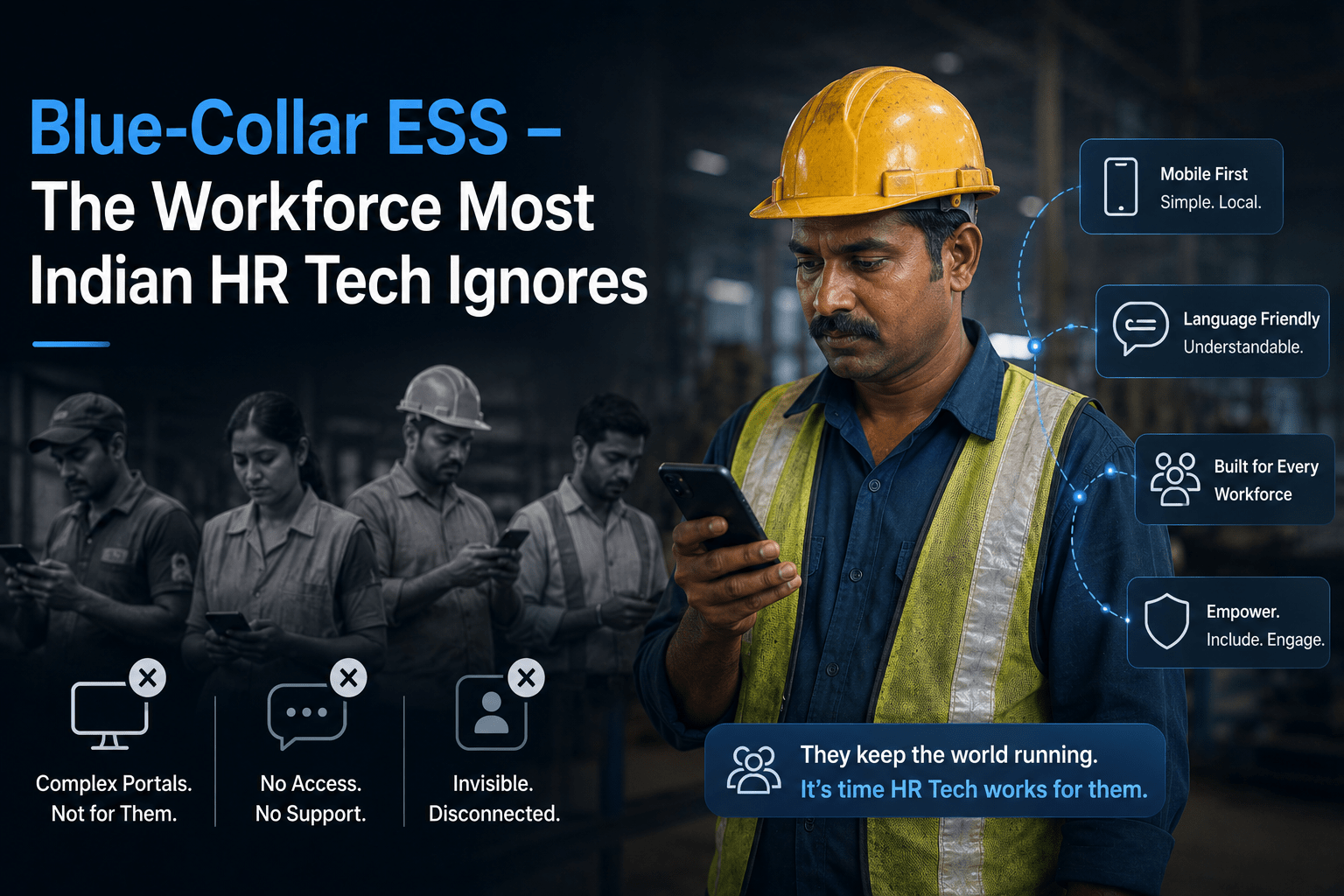
Most discussion of employee self-service in India is implicitly about a specific segment - corporate-laptop workforce in metropolitan offices. The HRMS deployment, the portal launch, the change management training all assume the employee has a laptop, a company email, comfortable English literacy, and works in a setting where logging into a portal is a normal part of the day.
This is a minority of the Indian workforce. The majority is factory workers, field operations, retail staff, drivers, security personnel, healthcare orderlies, hospitality staff, manufacturing workers, contractors. They have phones. They use WhatsApp. They often have limited English. Many do not have company email addresses. Some do not have laptops at all.
ESS that requires app installation, portal login, or email-based delivery excludes this segment structurally. The HR team that handles a 1,500-employee workforce of which 1,100 are blue-collar finds that the HRMS deployment serves 400 people and the other 1,100 still call or visit the HR office for everything - leave application, payslip access, document requests, policy clarification. The 'self-service' that was deployed is self-service for the corporate-laptop segment only.
What blue-collar ESS looks like when it works
Five characteristics distinguish working blue-collar ESS from approaches that fail.
WhatsApp-native, not app-based. The employee already has WhatsApp installed and uses it daily. Asking them to download a company app is asking for a behaviour change that most will not make. ESS that lives inside WhatsApp meets them where they already are without behaviour change.
Voice and informal text equally handled. Blue-collar employees often communicate via voice notes, partial-grammar text, code-switched messages, and abbreviations. The AI agent needs to understand intent across these input forms. Hindi voice notes, Tamil typed messages, voice notes that switch between Hindi and English mid-sentence - all need to work without breaking.
Vernacular as the primary mode. English-language ESS responses to a worker who is comfortable in Telugu produces no value. The responses need to be in the worker's language, retrieved from policy versions that may exist only in English on the corporate side but get delivered in the worker's language through translation that is verified by HR for accuracy.
Simple language structure. Even when the language is right, complex sentence structures and bureaucratic vocabulary lose the worker. Responses should be short, direct, and use the words the worker actually uses. The maternity leave policy is not 'eligibility per Section 4.2 of the relevant document' - it is 'you can take 26 weeks of paid leave when you have a baby.' Brevity respects the worker's time and attention.
Transactional, not just informational. Blue-collar workers need to apply for leave, request payslip access, raise attendance corrections, claim reimbursements, submit grievances. ESS that only answers questions but cannot execute transactions on their behalf forces them to come to the HR office for the actual action. The transaction layer is where blue-collar ESS proves its value.
Why this matters beyond inclusion
Inclusion is the right ethical frame, but the business case for blue-collar ESS is also clear once measured.
HR team capacity. In workforces with significant blue-collar segments, HR helpdesk volume is dominated by routine queries from that segment. Reaching them with self-service releases HR capacity that the corporate-only deployment did not.
Compliance audit risk. Blue-collar workforce involves significant compliance obligations under Indian Labour Codes, ESI, PF, factory acts. The recordkeeping for this segment is often the most exposed in audits because manual handling produces gaps. WhatsApp-native ESS that writes back to the HRMS produces cleaner audit trails.
Attrition reduction. Blue-collar attrition in many Indian industries runs higher than corporate attrition. Employee experience for this segment - including the daily friction of accessing routine HR services - contributes to retention or to attrition. ESS that respects the blue-collar reality is part of the employee value proposition that affects retention.
Worker safety and welfare. For workers in hazardous environments, accessible self-service for grievance reporting, attendance corrections, and welfare queries is not a productivity feature - it is a safety and welfare requirement. WhatsApp-native ESS enables faster surfacing of issues that matter for worker safety and welfare.
What most HR tech vendors get wrong
Three common patterns that look like blue-collar ESS but fail in production.
Mobile apps. Vendors propose a 'mobile-first' app for blue-collar ESS. The app gets installed during onboarding by HR, then never opened by the worker. The app does not become a habit. The worker continues to use WhatsApp. The app metrics show low DAU and the vendor recommends gamification.
Translated portal. Vendors translate the existing employee portal into Hindi and call it blue-collar coverage. The translation does not solve the structural issues - the portal is still a portal, still requires login, still uses corporate-language structure with translated words. Translation alone does not produce usable ESS for this segment.
Generic chatbots. Vendors deploy a chatbot that handles a narrow set of questions in English with token Hindi support. The chatbot breaks on voice notes, breaks on code-switching, breaks on regional dialect, breaks on informal text. Workers stop using it after the first two failed interactions. The chatbot metrics show declining usage and the vendor recommends adding more flows.
Working blue-collar ESS is structurally different from these approaches. WhatsApp-native, vernacular-first, voice-and-text equally, simple language, transactional capability - all as design principles rather than features. Vendors that have built for the corporate-laptop segment and then adapted to blue-collar typically miss the structural requirements; vendors that have designed for blue-collar from the start tend to land closer to what actually works.
About the Author

Yash Soni
Ready to orchestrate your AI future?
Converiqo AI helps you design, deploy, and scale automation workflows that move your business faster, leveraging specialized solutions like our AI bot platform for lead generation, customer self-service AI bot platform, employee self-service AI bot platform, retail omnichannel automation, and our detailed guides on how agentic AI bot platforms work in enterprises and cost structure of enterprise AI bot platforms. Connect with our team to see the platform in action and co-create the next chapter of intelligent operations.
Read More Blogs
Discover more insights and product updates curated by the Converiqo AI team.
Real ROI of Field Force Automation - Beyond the Activity Dashboard
Four metrics that show real field force automation ROI in India - productivity, data reliability, throughput, and field attrition - not just the activity dashboard.

Beat Planning Is the Highest-Leverage Field Force Capability - Here Is Why
Beat planning decides coverage, call frequency, and whether field time is productive. Why it is the single highest-leverage field force automation capability.
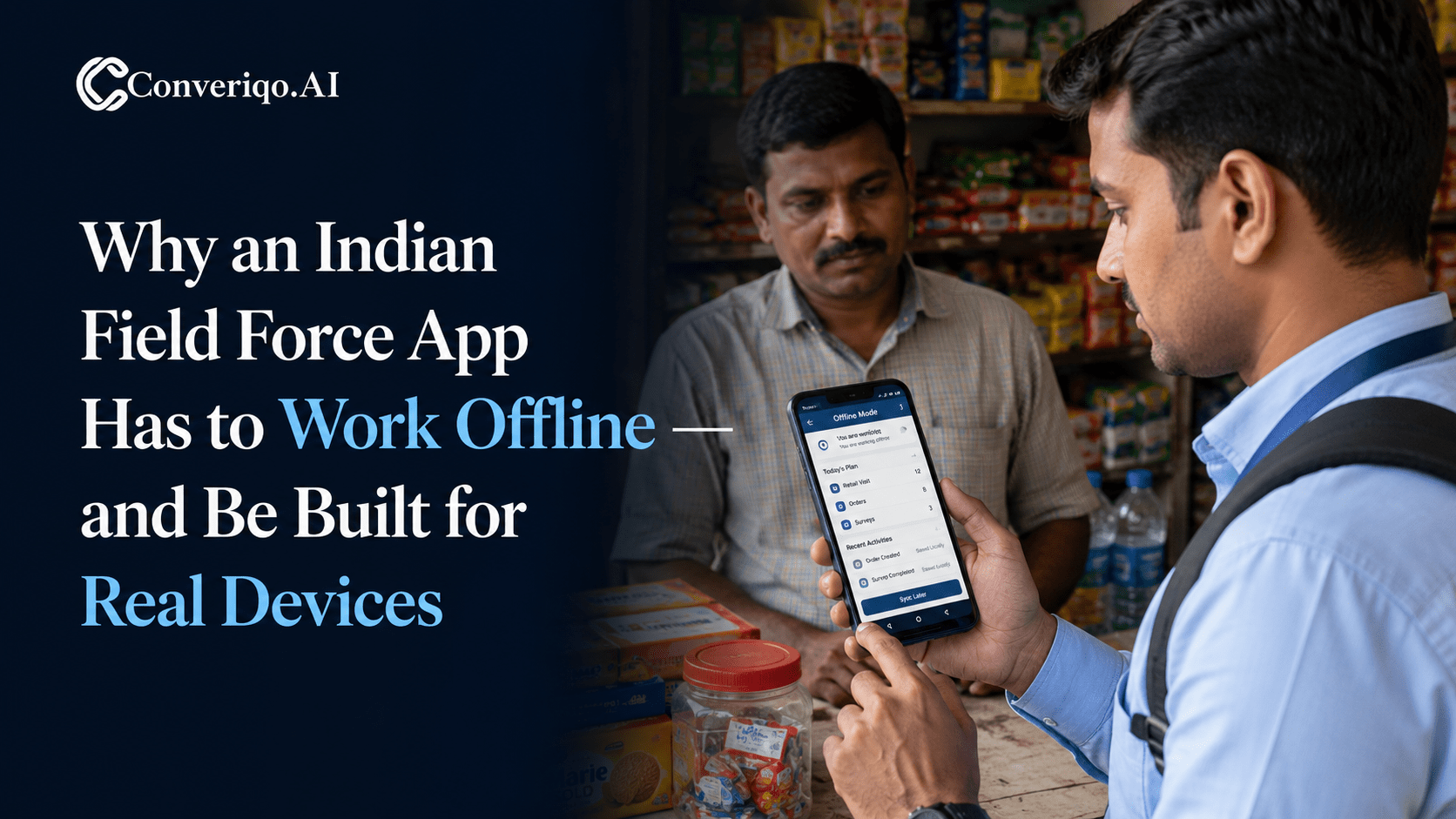
Why an Indian Field Force App Has to Work Offline - and Be Built for Real Devices
Field work in India happens where connectivity is intermittent. A field force app that assumes constant connectivity fails exactly where field work is done.