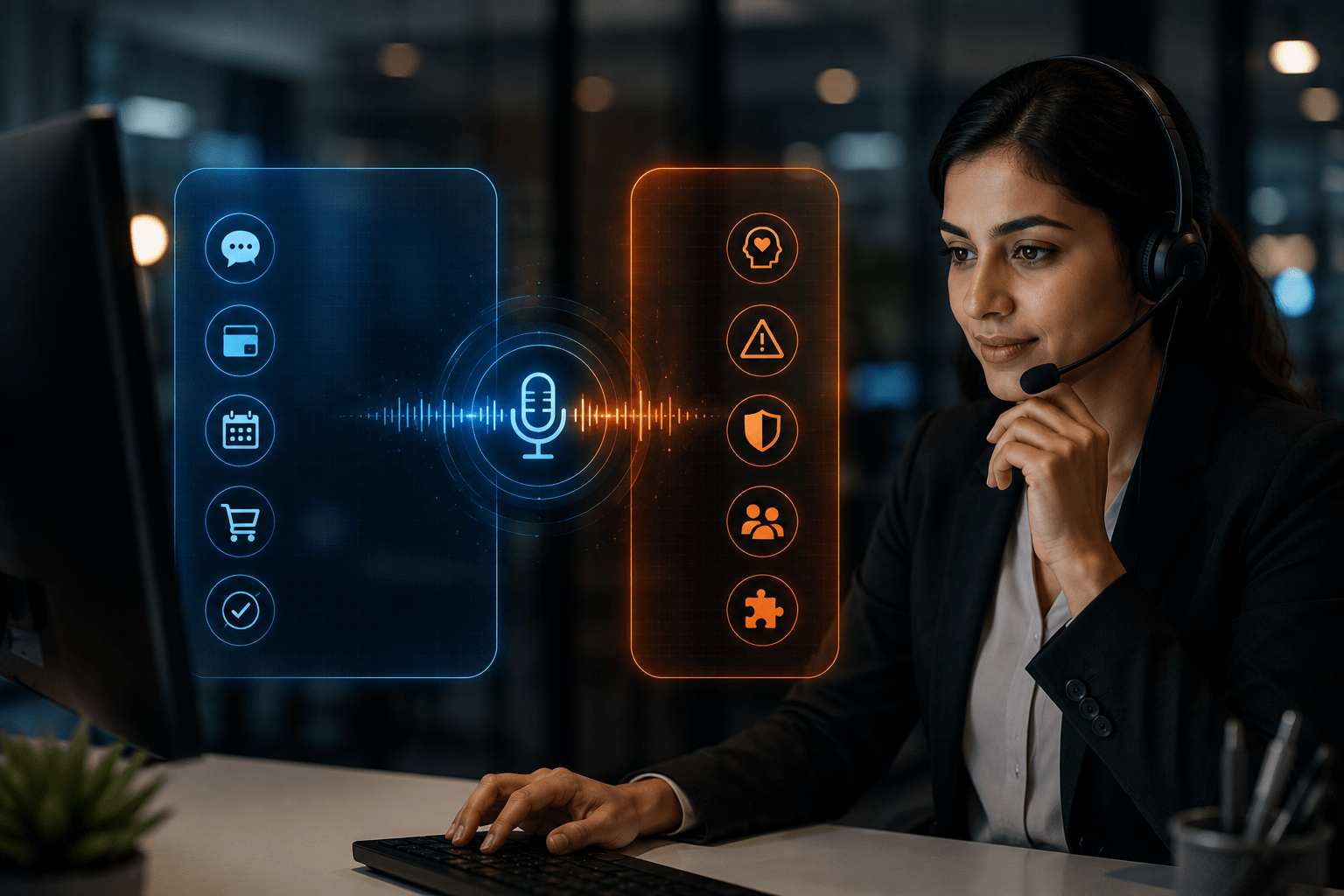
Voice AI pitches to Indian contact centers have been coming since at least 2018. Most operations heads who have been in the role for more than three years have at least one failed pilot in their memory - a 2019 deployment that handled English okay but broke on Hindi, a 2021 deployment that handled Hindi but lost callers on code-switching, a 2022 deployment that worked for two weeks then degraded mysteriously.
The current pitch in 2026 sounds similar to those. The marketing language is similar. The promised capabilities sound similar. The natural reaction is scepticism.
The scepticism is healthy and the situation has actually changed. The shift that happened through 2024-2025 was real and measurable. But it is also not a magic shift - there are still call types AI voice agents do not handle well, and being honest about what falls in and out of scope is the difference between a successful deployment and another failed pilot.
What AI voice agents handle well in 2026
Routine transactional calls with structured intent and clear resolution paths. The categories that consume the most agent hours in most Indian operations are also the categories AI agents handle most reliably.
Banking - balance enquiries, transaction history requests, card blocking, cheque book requests, branch and ATM locator queries, basic account information updates, password and PIN resets where compliant.
Insurance - policy details, premium status, claim status, policy document requests, premium payment reminders, renewal information, branch and TPA contact information.
Telecom - recharge confirmation, plan details, balance enquiry, data usage, bill payment status, complaint registration, basic troubleshooting for common issues.
E-commerce - order tracking, delivery status, return initiation, refund status, basic product information, store credit and wallet balance queries.
Utilities - bill enquiry, payment confirmation, complaint registration, planned outage information, meter reading submission where applicable.
Healthcare - appointment scheduling, lab report status, doctor availability, basic insurance verification, prescription refill requests where compliant.
Across these categories, well-deployed AI voice agents handle 50% to 70% of call volume end-to-end in Hindi, English, and major regional languages without escalation to human agents. The exact percentage depends on the depth of intent coverage, the quality of backend system integration, and how cleanly the operation has defined what 'resolved' means.
What AI voice agents do not handle well in 2026
Honest answer - six categories where deployments either fail or under-perform expectations.
Complex troubleshooting that requires diagnostic judgement. The customer describing a problem that does not fit a known pattern, the issue requiring root-cause investigation, the resolution requiring decisions about exceptions or workarounds. AI agents in 2026 do not improvise effectively on novel problems. Escalation to humans is appropriate.
Emotionally sensitive calls. Grief, distress, complaints with anger, harassment situations, bereavement, financial distress. AI voice agents handle the mechanics but do not match the human capacity for genuine empathy that these calls require. Escalation to specialised human agents - or in some cases, supervisors - is appropriate.
Sales calls where consultative selling is the value. Voice agents work for transactional sales (renewals, upgrades that are essentially automatic) but not for consultative sales where the value is in the conversation itself. A wealth advisor's first call with a potential HNI client cannot be replaced by an AI agent without changing what is being sold.
Calls where the caller is themselves not behaving in a standard pattern. Confused callers, callers under the influence, callers attempting fraud, callers with cognitive limitations. Pattern-trained AI agents struggle here. Human escalation, often to senior agents, is appropriate.
Regulatory edge cases where compliance requires human judgement. Suitability assessments for complex financial products, disclosure conversations for new insurance customers, certain customer verification flows that require human attestation. The compliance layer determines what cannot be automated - and platforms that ignore this carve-out fail audits silently.
Calls in language varieties the voice AI was not trained on. While Hindi and major regional languages are well-covered in 2026, less-common regional dialects and language combinations may break. Verify the specific language coverage of the platform against the operation's actual caller language distribution, not against the platform's claimed list.
The hybrid model that works
The pattern that works in Indian contact centers in 2026 is hybrid - AI agents on routine call types, human agents on complex calls, with intelligent routing that decides which is which and clean handoff between them when needed.
Three principles for designing the hybrid.
Define what AI handles and what humans handle, explicitly. Operations that try to make AI handle 'as much as possible' produce mediocre AI deployments that fail on the edges and frustrate callers. Operations that define the AI-handled categories specifically and route everything else to humans produce better results in both segments.
Design the handoff carefully. When AI escalates to a human, the human should see the full conversation transcript, the AI's understanding of what the caller needs, the steps already attempted, and any flagged sensitivities. The caller should not have to repeat themselves. The handoff is the most common failure point in hybrid deployments - and the most damaging to caller experience when done badly.
Measure the AI tier and the human tier separately. AI deflection rate. AI customer satisfaction on AI-handled calls. Human FCR on calls that reach humans. Human AHT given the AI now removes routine calls from their queue. The metrics for each tier are different and need separate tracking before being rolled up.
What to verify in a vendor demo
Three tests beyond the standard pitch.
Hindi conversational depth, with code-switching. Ask the vendor to demo a call where the caller speaks Hindi, switches to English for a term, then continues in Hindi. Listen to whether the AI follows the switch or breaks. Many platforms claim Hindi support but fail on code-switching.
Edge case handling. Ask what happens when a caller says something the AI does not recognise. Does it default to a generic fallback (poor), does it escalate to human (acceptable), or does it ask a clarifying question and recover (good)? The edge case behaviour is what production looks like, not the happy path.
Compliance configuration. Ask how the platform handles TRAI NCPR for outbound, DPDP consent capture, and the relevant sector regulator overlays for the operation's domain. Ask for specifics - not 'we support DPDP' but 'show me where consent is captured and where the audit log lives.' Vague answers here mean the compliance layer was not designed in; it was added as a marketing claim.
About the Author

Himani Chaudhary
Ready to orchestrate your AI future?
Converiqo AI helps you design, deploy, and scale automation workflows that move your business faster, leveraging specialized solutions like our AI bot platform for lead generation, customer self-service AI bot platform, employee self-service AI bot platform, retail omnichannel automation, and our detailed guides on how agentic AI bot platforms work in enterprises and cost structure of enterprise AI bot platforms. Connect with our team to see the platform in action and co-create the next chapter of intelligent operations.
Read More Blogs
Discover more insights and product updates curated by the Converiqo AI team.
Real ROI of Field Force Automation - Beyond the Activity Dashboard
Four metrics that show real field force automation ROI in India - productivity, data reliability, throughput, and field attrition - not just the activity dashboard.
Beat Planning Is the Highest-Leverage Field Force Capability - Here Is Why
Beat planning decides coverage, call frequency, and whether field time is productive. Why it is the single highest-leverage field force automation capability.
Why an Indian Field Force App Has to Work Offline - and Be Built for Real Devices
Field work in India happens where connectivity is intermittent. A field force app that assumes constant connectivity fails exactly where field work is done.