
Many businesses assume that having multiple communication channels automatically improves customer experience. In some cases, it does. However, when those channels operate independently without coordination, the result is not efficiency but fragmentation.
Instead of creating smoother journeys, disconnected channels often lead to confusion, delays, and missed opportunities. What appears to be a strength on the surface can quietly become an operational weakness.
Common Issues Caused by Fragmentation
- Missed leads due to lack of continuity
- Slow response times across channels
- Repeated conversations with customers
- Broken or inconsistent follow-up
- Unclear ownership of the next step
- Poor visibility in reporting
- Team confusion and inefficiency
These challenges go beyond communication. They directly affect conversion rates and overall operational performance.
How Fragmentation Shows Up in Real Scenarios
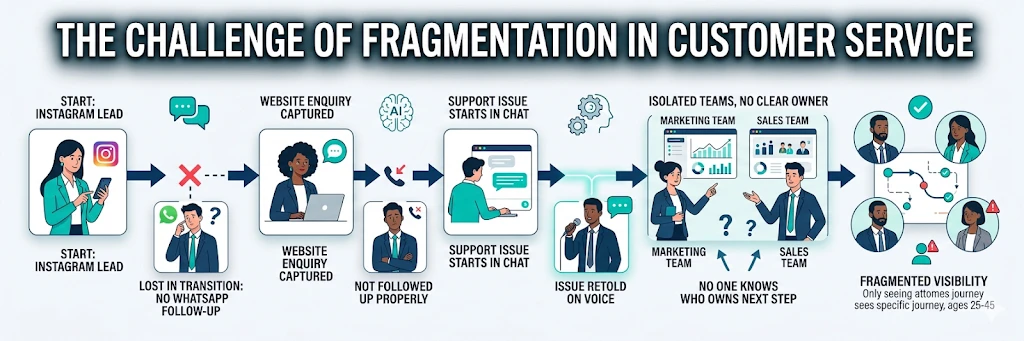
Fragmentation is not always obvious at first. It often appears in everyday interactions where continuity is expected but missing.
Typical examples include:
- A lead starts a conversation on Instagram but is never followed up on WhatsApp
- A website enquiry is captured but not acted on properly
- A support issue begins on chat and has to be repeated on a voice call
- Different teams see only parts of the customer journey
- No clear ownership exists for what should happen next
These are not small inefficiencies. They break the flow of the customer journey and reduce the chances of conversion or resolution.
Conclusion
When channels do not work together, they create operational drag instead of customer value.
Unifying channels into a structured workflow is essential for maintaining continuity, improving response quality, and ensuring that opportunities are not lost between touchpoints. Businesses that focus on coordination rather than just presence are better positioned to deliver consistent and effective experiences.
FAQs
Why do disconnected channels cause missed leads?
Because conversations often start on one channel and require follow-up on another, and without coordination, continuity breaks.
Is this only a problem for larger teams?
No. Even small teams experience fragmentation quickly when multiple channels exist without clear workflow structure.
What is the first thing businesses should fix?
They should define clear channel roles and establish ownership for the next step in every interaction.
Can automation reduce fragmentation?
Yes. Automation helps coordinate communication, maintain context, and ensure consistent follow-up across channels.
How does fragmentation affect conversion?
It disrupts momentum, delays responses, and creates friction, which reduces the likelihood of leads converting.
About the Author

Avni Chadha
Ready to orchestrate your AI future?
Converiqo AI helps you design, deploy, and scale automation workflows that move your business faster, leveraging specialized solutions like our AI bot platform for lead generation, customer self-service AI bot platform, employee self-service AI bot platform, retail omnichannel automation, and our detailed guides on how agentic AI bot platforms work in enterprises and cost structure of enterprise AI bot platforms. Connect with our team to see the platform in action and co-create the next chapter of intelligent operations.
Read More Blogs
Discover more insights and product updates curated by the Converiqo AI team.

Real ROI of Field Force Automation - Beyond the Activity Dashboard
Four metrics that show real field force automation ROI in India - productivity, data reliability, throughput, and field attrition - not just the activity dashboard.

Beat Planning Is the Highest-Leverage Field Force Capability - Here Is Why
Beat planning decides coverage, call frequency, and whether field time is productive. Why it is the single highest-leverage field force automation capability.
Why an Indian Field Force App Has to Work Offline - and Be Built for Real Devices
Field work in India happens where connectivity is intermittent. A field force app that assumes constant connectivity fails exactly where field work is done.