
Many businesses aim to create seamless omnichannel journeys. What they often end up with instead is confusion.
This happens when new channels are added without a clear workflow behind them. Instead of improving the customer experience, the system becomes harder to manage and less effective.
The result is not better engagement. It is operational chaos.
What Omnichannel Chaos Typically Looks Like
- No clarity on who is responsible for handling each interaction
- Customers being asked the same questions across channels
- Poor coordination between support and sales teams
- Follow-up happening in the wrong channel
- No ownership of cross-channel continuation
- Broken or inconsistent handoffs
These are not technology limitations. They are symptoms of weak workflow design.
What Strong Omnichannel Journey Design Requires
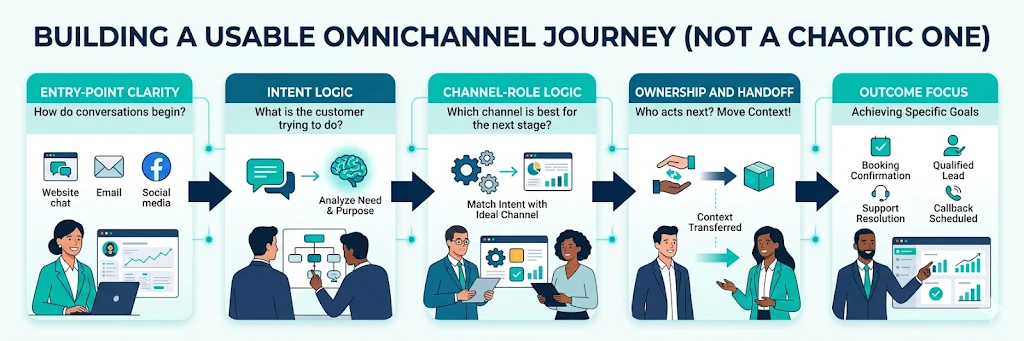
A structured omnichannel system is built on clear logic, not just multiple touchpoints. When workflows are defined properly, channels start working together instead of competing.
Entry-Point Clarity
Every journey begins somewhere. Businesses need to clearly define how conversations start, whether through website chat, social platforms, calls, or forms.
Intent Logic
Understanding what the customer is trying to achieve is critical. Whether it is enquiry, booking, support, or escalation, intent should guide the next step in the workflow.
Channel-Role Logic
Each channel should have a purpose. Some are better for discovery, others for follow-up, and others for resolution. Assigning roles prevents confusion and improves efficiency.
Ownership and Handoff
Clear ownership ensures that every step in the journey is handled properly. When a conversation moves between channels or teams, context should move with it to avoid repetition and delays.
Outcome Focus
Every journey should lead toward a defined outcome. This could be booking completion, lead qualification, support resolution, escalation, or a scheduled callback.
Without this clarity, conversations remain open-ended and ineffective.
Conclusion
Omnichannel success does not come from simply being available on more platforms. It comes from designing clean, structured workflows that connect those platforms into a unified journey.
When businesses focus on workflow clarity, they reduce confusion, improve coordination, and create smoother experiences for both customers and teams.
Unify My Customer Workflow
FAQs
Why does omnichannel create chaos for some teams?
Because channels are added without clear workflow logic, ownership, or structured handoff processes.
What should be defined first in an omnichannel setup?
Businesses should define entry points, channel roles, ownership of next steps, and escalation logic.
Is this relevant for support as well as leads?
Yes. Both lead journeys and support workflows often break when channels are not coordinated properly.
Can automation help reduce omnichannel chaos?
Yes. Automation helps structure workflows, maintain context, and ensure consistent handling across channels.
What is the biggest mistake in omnichannel design?
The biggest mistake is adding more channels without defining how they should work together within a unified workflow.
About the Author
Akanksha
Ready to orchestrate your AI future?
Converiqo AI helps you design, deploy, and scale automation workflows that move your business faster, leveraging specialized solutions like our AI bot platform for lead generation, customer self-service AI bot platform, employee self-service AI bot platform, retail omnichannel automation, and our detailed guides on how agentic AI bot platforms work in enterprises and cost structure of enterprise AI bot platforms. Connect with our team to see the platform in action and co-create the next chapter of intelligent operations.
Read More Blogs
Discover more insights and product updates curated by the Converiqo AI team.

Real ROI of Field Force Automation - Beyond the Activity Dashboard
Four metrics that show real field force automation ROI in India - productivity, data reliability, throughput, and field attrition - not just the activity dashboard.

Beat Planning Is the Highest-Leverage Field Force Capability - Here Is Why
Beat planning decides coverage, call frequency, and whether field time is productive. Why it is the single highest-leverage field force automation capability.
Why an Indian Field Force App Has to Work Offline - and Be Built for Real Devices
Field work in India happens where connectivity is intermittent. A field force app that assumes constant connectivity fails exactly where field work is done.