Most cloud kitchen owners believe they lose orders because of competition, pricing, or delivery delays. In reality, many orders are lost before the food even reaches the kitchen.
The real problem is manual order management and slow customer responses.
Cloud kitchens operate in a high-speed environment where customers expect immediate clarity. When responses are delayed or orders are handled manually across platforms, even a small gap can cause customers to cancel or choose another kitchen.
This article explains why cloud kitchens lose orders daily, where manual processes break down, and how these losses happen silently without showing up in reports. You can also explore how AI automation for cloud kitchens helps solve these problems with faster response, structured order capture, and consistent customer communication.
The Reality of Order Flow in Cloud Kitchens
Unlike traditional restaurants, cloud kitchens don’t rely on walk-ins. Every order comes through a digital channel, and every channel creates its own operational demand.
Most cloud kitchens manage orders from:
- Food delivery platforms
- WhatsApp and phone calls
- Instagram or social media messages
- Sometimes a basic website or Google listing
Each channel requires monitoring, responding, confirming, and coordinating with the kitchen. When this is done manually, delays and mistakes are unavoidable.
How Manual Order Management Creates Invisible Revenue Loss
Manual order management does not fail loudly. It fails quietly.
A customer sends a WhatsApp message asking for today’s menu. The kitchen is busy with food preparation. The reply goes out four minutes later. By then, the customer has already placed an order elsewhere.
That order never appears as “lost” in any system. But it was real revenue.
This happens multiple times a day in most cloud kitchens, especially during peak hours.
Why Delayed Customer Responses Hurt Conversion
Food ordering is a time-sensitive decision. Customers usually message one or two kitchens at the same time and order from the one that responds first.
When responses are delayed:
- Customers assume the kitchen is busy or unreliable
- Confidence drops instantly
- The order is placed elsewhere without further communication
Manual replies depend entirely on staff availability. If the staff is cooking, packing, or handling another order, responses slow down.
This delay directly impacts order conversion, even if food quality is excellent.
The Problem of Managing Too Many Order Channels Manually
Cloud kitchens often believe that being available on more platforms automatically means more orders. But without automation, more platforms often mean more chaos.
Manual handling across Swiggy, Zomato, WhatsApp, and Instagram leads to:
- Missed notifications
- Confused order details
- Duplicate or forgotten orders
- Delayed confirmations
Each platform operates differently, but customers expect the same speed and clarity everywhere. Manual systems struggle to meet this expectation consistently.
How Order Confusion Leads to Cancellations and Refunds
Many cancellations happen not because of delivery delays, but because customers feel uncertain.
When an order is not confirmed quickly or details are unclear, customers assume something is wrong. They cancel to avoid risk.
Manual systems increase this uncertainty because:
- Confirmations are delayed
- Custom instructions are missed
- Updates are inconsistent
These issues lead to refunds, negative reviews, and lower ratings on food delivery platforms.
Staff Dependency Makes Order Handling Unreliable
In most cloud kitchens, one or two staff members handle all customer communication. When they are unavailable, overwhelmed, or replaced, the entire process suffers.
Order handling becomes dependent on:
- Who is on shift
- Who remembers what
- Who responds faster
This creates inconsistency and makes scaling extremely difficult.
Manual systems work only when people are perfect. Operations should not depend on perfection.
Why Peak Hours Expose the Weakness of Manual Systems
Peak hours are when cloud kitchens earn the most. Unfortunately, they are also when manual systems fail the hardest.
During rush hours:
- Staff focuses on food preparation
- Messages pile up
- Notifications are missed
- Customers wait longer than expected
Even a delay of two to three minutes during peak time can result in lost orders.
Manual systems cannot handle parallel tasks efficiently. This is a structural limitation, not a staffing issue.
The Impact on Customer Experience and Brand Trust
Customers judge cloud kitchens not just by taste, but by how smoothly the experience feels. Slow replies, unclear confirmations, and inconsistent communication create friction. Over time, this reduces trust and repeat orders. Customers may never complain. They simply stop ordering. This silent churn is one of the biggest growth blockers for cloud kitchens.
Why These Problems Grow as the Kitchen Scales
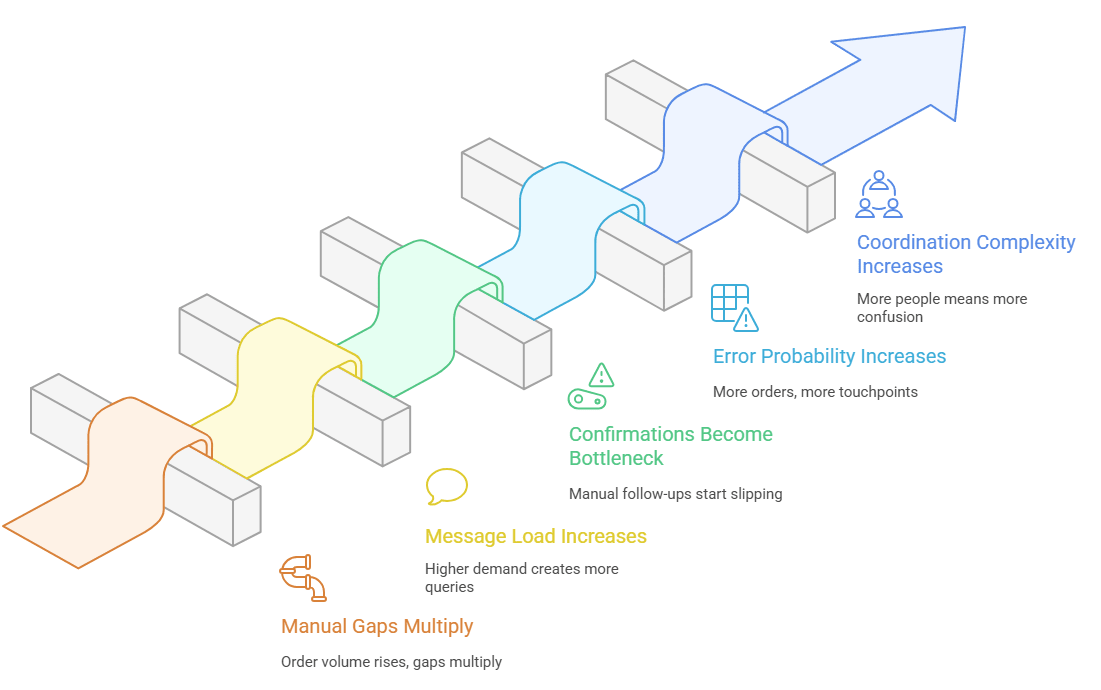
As order volume increases, manual problems multiply.
More customers mean:
- More messages
- More confirmations
- More chances for error
Without automation, adding more staff only increases coordination complexity. The system becomes harder to manage, not easier.
This is why many cloud kitchens plateau despite strong demand.
The Need for Structured, Automated Order Handling
The core issue is not lack of demand. It is lack of structure.
Cloud kitchens need systems that:
- Respond instantly
- Capture orders accurately
- Confirm details clearly
- Reduce staff dependency
This is where AI-powered systems built for cloud kitchen operations become relevant.
At a broader level, agentic AI works as an autonomous layer that manages repetitive workflows across industries:
How This Connects to AI Automation for Cloud Kitchens
Manual order management and delayed responses are not isolated issues. They are symptoms of an outdated operational model.
AI automation introduces:
- Instant customer engagement
- Structured order capture
- Consistent communication
- Reduced operational friction
A deeper explanation of how AI automation improves order management and customer experience in cloud kitchens is covered in our AI automation for cloud kitchens customer experience guide.
What Cloud Kitchen Owners Should Reflect On
If your kitchen:
- Misses messages during peak hours
- Relies on staff memory for follow-ups
- Faces frequent cancellations without clear reasons
- Struggles to respond instantly across channels
Then manual order management is already costing you orders.
The problem is not visible in reports, but it is visible in daily stress and inconsistent growth.
Conclusion
Cloud kitchens don’t lose orders because of food quality or lack of demand. They lose orders because manual systems are not built for the speed and volume at which modern food ordering happens.
Delayed replies, missed messages, and unstructured order handling create small gaps in the customer journey. These gaps may seem minor, but they add up every day, quietly reducing conversions, increasing cancellations, and limiting repeat business.
As order volume grows, these problems don’t stay the same. They multiply. Adding more staff rarely fixes the issue because the core challenge is structural, not human.
Understanding where manual order management breaks down is the first step toward building more reliable operations. Once cloud kitchens recognize these hidden losses, they can start evaluating smarter, automated ways to handle customer communication and orders without increasing operational stress.
The kitchens that address these issues early don’t just stop losing orders. They build systems that support consistent growth, better customer experience, and long-term scalability.
Next Step:- Understanding How Automation Fixes This
This blog explains why orders are lost. The next step is understanding how AI automation fixes these problems at an operational level.
The complete AI automation for cloud kitchens guide covers how automation fixes these operational problems in detail.
FAQs
1: Why do cloud kitchens lose orders even when food quality is good?
Orders are often lost before reaching the kitchen due to slow responses, missed messages, and unstructured manual order handling. Even small delays can push customers to competitors.
2: How does managing multiple order channels manually cause problems?
Handling WhatsApp, social media, phone calls, and delivery apps manually increases missed notifications, confused orders, and delayed confirmations, which frustrates customers and reduces conversions.
3: What role does staff dependency play in lost orders?
When order handling depends on specific staff members, delays or mistakes increase. If a staff member is busy, absent, or forgets details, customer experience suffers and orders can be lost.
4: Why are peak hours particularly challenging for manual systems?
During rush hours, staff focus on cooking while messages pile up. Manual systems cannot handle multiple tasks at once, leading to delayed responses, missed orders, and higher cancellations.
5: How do delayed responses affect customer trust?
Slow or inconsistent replies make customers doubt reliability. Even if food quality is excellent, this friction reduces repeat orders and damages brand trust over time.
6: Why doesn’t adding more staff solve these problems?
More staff increases coordination complexity without fixing structural issues. Manual systems still rely on memory, multitasking, and human consistency, which are prone to errors at scale.
7: What is the main structural problem with manual order management?
Manual systems lack speed, structure, and consistency. They fail quietly, causing lost revenue, cancellations, and missed repeat orders, even if no errors appear in reports.
About the Author
Ankur Kumar Singh
Ready to orchestrate your AI future?
Converiqo AI helps you design, deploy, and scale automation workflows that move your business faster, leveraging specialized solutions like our AI bot platform for lead generation, customer self-service AI bot platform, employee self-service AI bot platform, retail omnichannel automation, and our detailed guides on how agentic AI bot platforms work in enterprises and cost structure of enterprise AI bot platforms. Connect with our team to see the platform in action and co-create the next chapter of intelligent operations.
Read More Blogs
Discover more insights and product updates curated by the Converiqo AI team.
Real ROI of Field Force Automation - Beyond the Activity Dashboard
Four metrics that show real field force automation ROI in India - productivity, data reliability, throughput, and field attrition - not just the activity dashboard.

Beat Planning Is the Highest-Leverage Field Force Capability - Here Is Why
Beat planning decides coverage, call frequency, and whether field time is productive. Why it is the single highest-leverage field force automation capability.
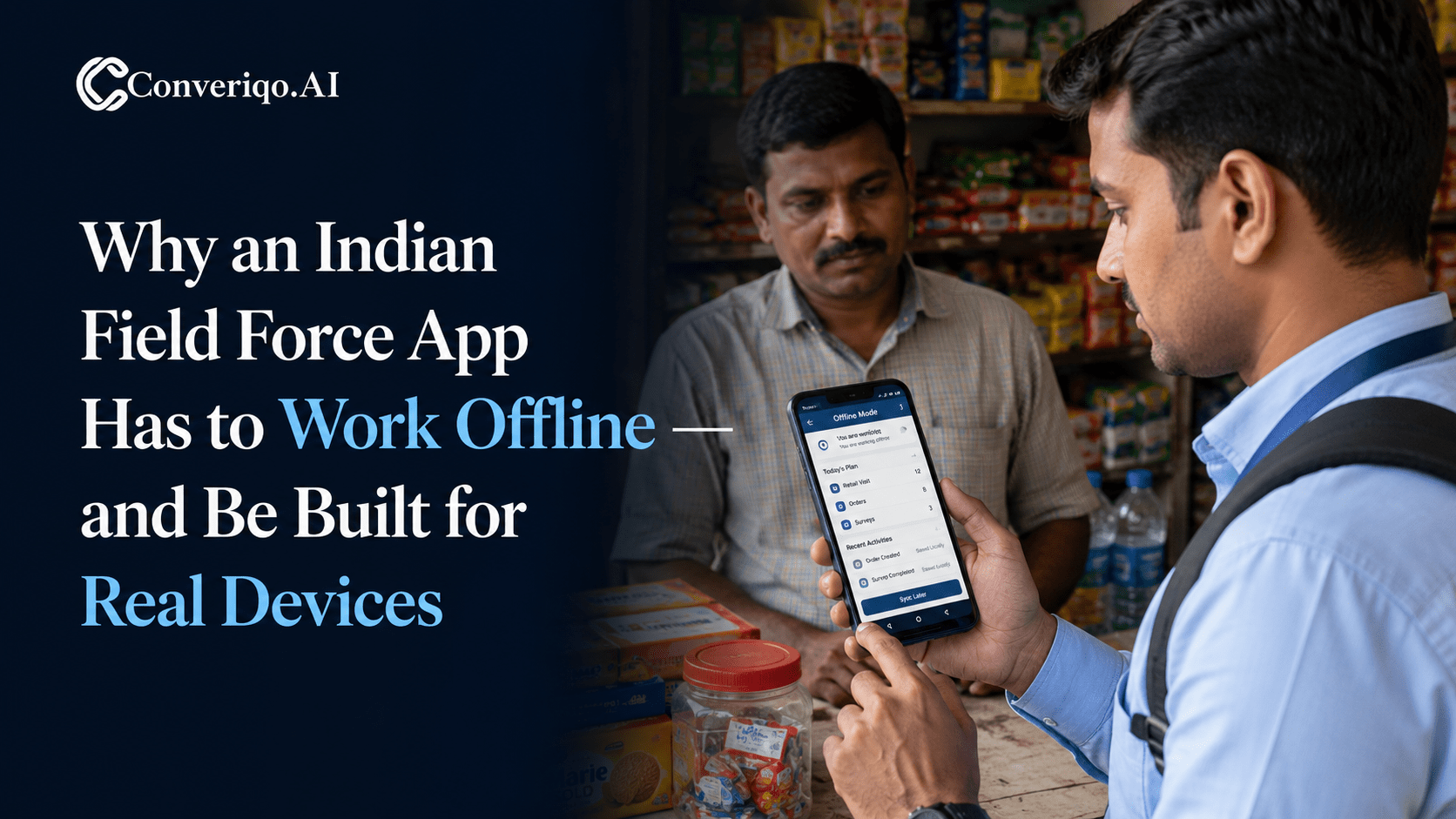
Why an Indian Field Force App Has to Work Offline - and Be Built for Real Devices
Field work in India happens where connectivity is intermittent. A field force app that assumes constant connectivity fails exactly where field work is done.