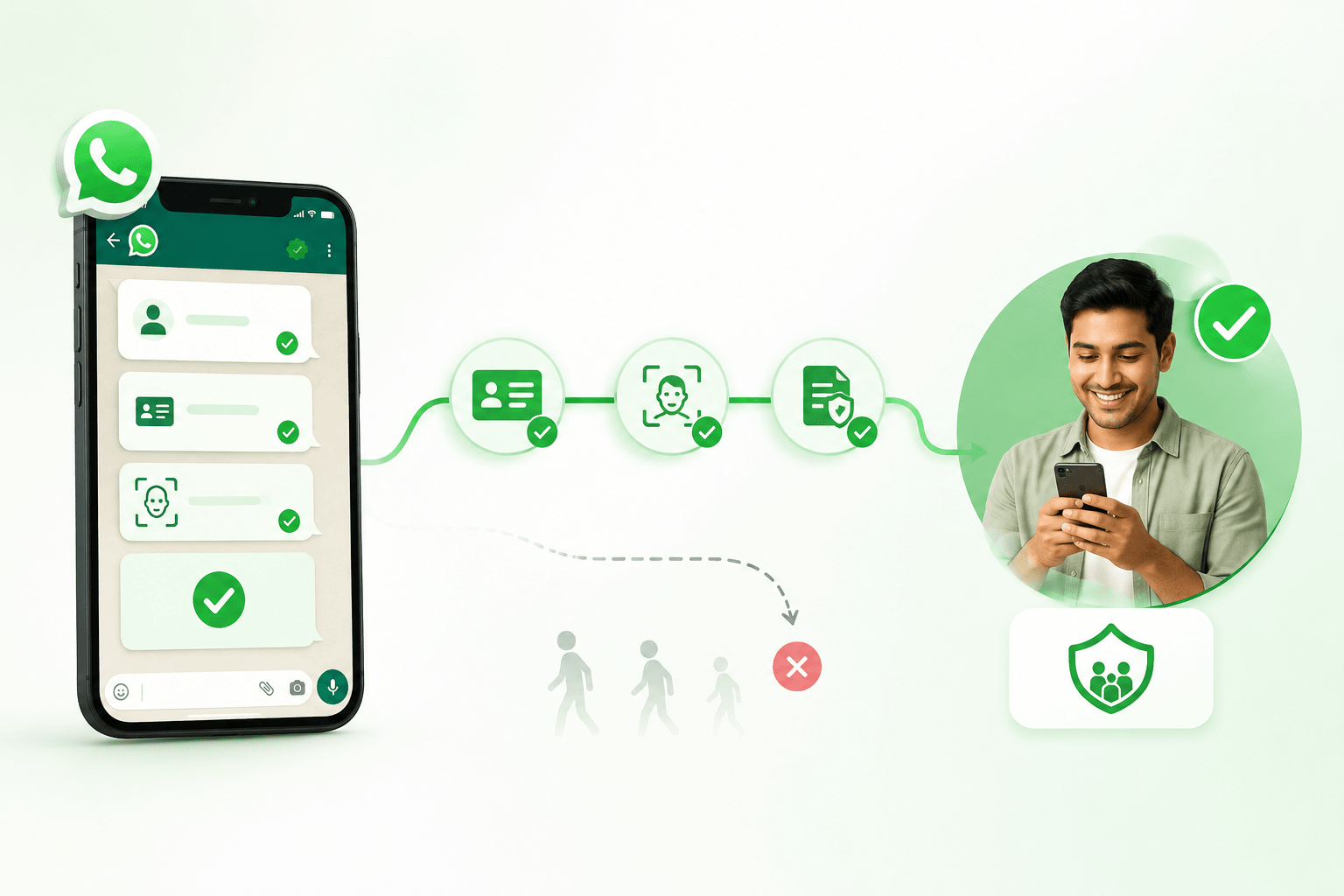
There is a painful pattern in BFSI: the institution does the hard work of winning a customer - the marketing, the offer, the decision to say yes - and then loses them during onboarding. The account application is abandoned half-finished. The loan journey stalls at document upload. The policy is never issued because a step was unclear. Onboarding is where BFSI most often loses customers it had already paid to acquire, and conversational AI on WhatsApp is one of the most direct ways to close that leak.
Why onboarding leaks customers
Onboarding and KYC journeys are inherently demanding. They are multi-step. They are document-heavy. They involve unfamiliar terms and requirements. They often move between channels and devices. And every one of those characteristics is an opportunity to drop out. A customer hits a step they do not understand, a document they cannot find right now, a form that feels long, an interface that is awkward on a phone - and they postpone. Postponed onboarding very often becomes abandoned onboarding. The intent was there; the journey lost it.
Onboarding as a conversation
Conversational AI reframes onboarding from a form the customer must complete alone into a journey the customer is guided through. The shift sounds small and is not.
-
One step at a time - the agent asks for what it needs in a natural sequence, so the customer is never staring at the whole intimidating form at once.
-
Explanation in context - when a step or a document is unclear, the customer simply asks, and the agent explains why it is needed and what is acceptable, then and there.
-
Documents inside the chat - the customer photographs and sends documents in the same thread they are already in, with no app-switch, upload portal, or separate channel.
-
Active recovery of the missing - when something is incomplete, the agent follows up and helps finish it, instead of letting a half-done application go silent.
-
Resume where you left off - because the journey lives in a persistent thread, the customer can pause and continue later without starting over.
The drop-off arithmetic
The value here is unusually easy for a BFSI institution to see, because it already measures onboarding completion. Every percentage point of drop-off recovered is customers who become active, funded, revenue-generating relationships rather than wasted acquisition spend. Because the institution paid to acquire each of those customers, the return on reducing abandonment is large and direct - and it shows up in numbers the business already tracks, which makes onboarding an unusually clean place to prove conversational AI's worth.
KYC, handled with care
KYC and verification are regulated, and the agent's role is to make the customer's side of a compliant process smoother - clearly explaining what is required, helping submit it correctly, checking completeness, and guiding the customer through verification - while the verification itself runs through the institution's approved, compliant systems. The conversational layer improves the experience of KYC; it does not bypass the controls of it. As with every BFSI deployment, the journey is designed against current KYC and onboarding regulation, with the institution's compliance team validating the flow.
A strong place to start
Onboarding is one of the best first use cases in all of BFSI conversational AI: the pain is concrete, the value is measurable in a number the institution already owns, and the journey is well-bounded. An institution that gets one onboarding flow genuinely right - guided, document-friendly, recovering drop-off, integrated and compliant - has both a clear result and a template for the rest. The pillar article this supports shows how onboarding fits the wider BFSI lifecycle alongside servicing, collections and claims.
About the Author

Ankur Singh
Ready to orchestrate your AI future?
Converiqo AI helps you design, deploy, and scale automation workflows that move your business faster, leveraging specialized solutions like our AI bot platform for lead generation, customer self-service AI bot platform, employee self-service AI bot platform, retail omnichannel automation, and our detailed guides on how agentic AI bot platforms work in enterprises and cost structure of enterprise AI bot platforms. Connect with our team to see the platform in action and co-create the next chapter of intelligent operations.
Read More Blogs
Discover more insights and product updates curated by the Converiqo AI team.

Real ROI of Field Force Automation - Beyond the Activity Dashboard
Four metrics that show real field force automation ROI in India - productivity, data reliability, throughput, and field attrition - not just the activity dashboard.

Beat Planning Is the Highest-Leverage Field Force Capability - Here Is Why
Beat planning decides coverage, call frequency, and whether field time is productive. Why it is the single highest-leverage field force automation capability.
Why an Indian Field Force App Has to Work Offline - and Be Built for Real Devices
Field work in India happens where connectivity is intermittent. A field force app that assumes constant connectivity fails exactly where field work is done.