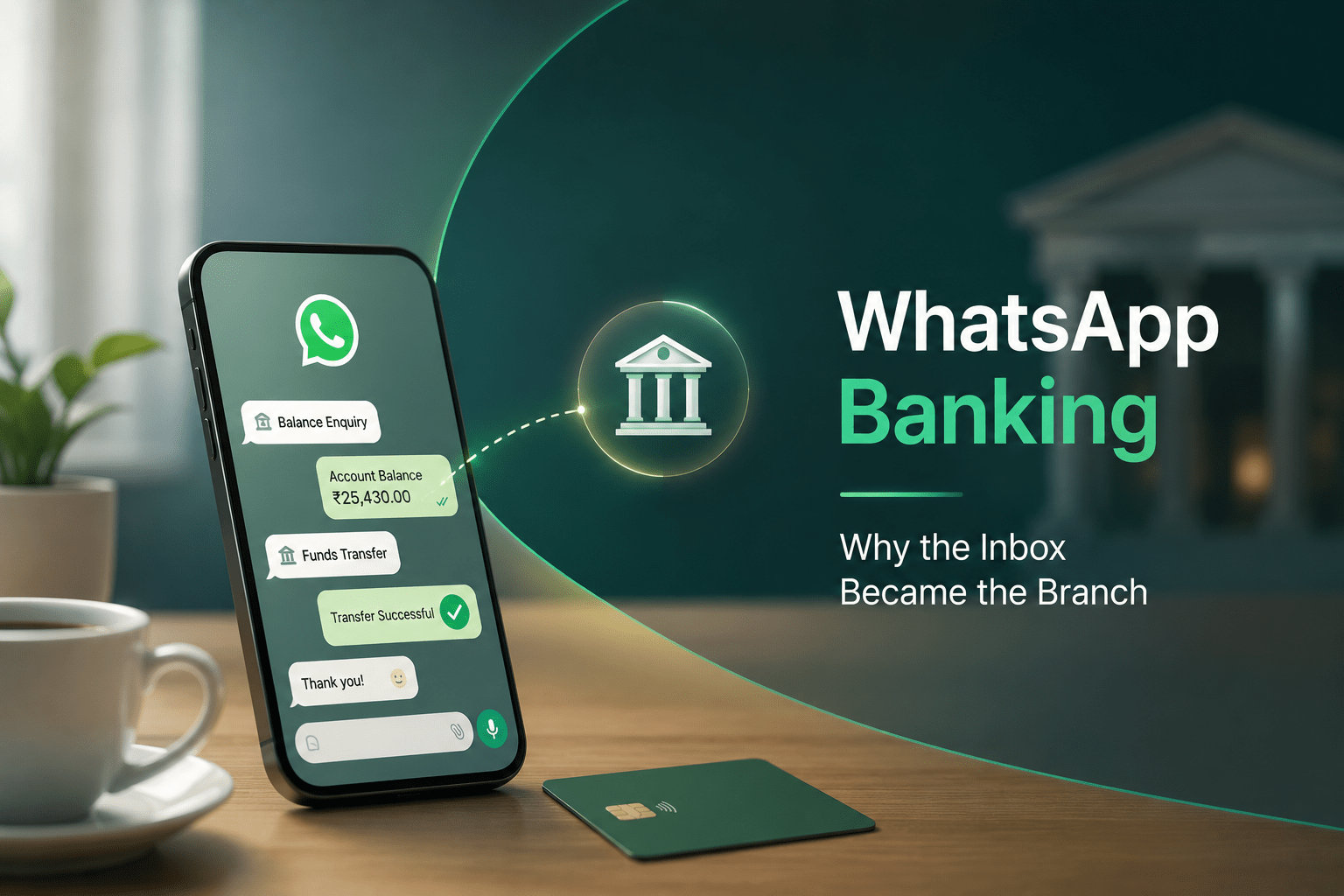
For most of a customer's banking life, the branch was the bank. It was where you went to ask a question, complete a request, or sort out a problem. Then the call centre took some of that load, and the app and portal took more. Each shift moved volume and each left a gap. In India in 2026, the channel closing that gap is not another app - it is the messaging inbox the customer already lives in. WhatsApp banking is the branch experience, reassembled inside a thread.
What WhatsApp banking actually means
WhatsApp banking is not a marketing broadcast list, and it is not a menu-driven bot bolted onto a phone number. Done properly, it is a conversational agent - running on the verified WhatsApp Business platform - that lets a customer do real banking by simply asking. Check a balance. Understand a transaction. Request a statement. Update a detail. Raise and track a service request. Get help with a card. The customer types or speaks naturally, in their own language, and the agent understands, retrieves the real answer from the bank's systems, and where permitted completes the request.
The distinction that matters is between telling and doing. A weak WhatsApp banking implementation tells the customer how to do something - open the app, visit a branch, call this number. A strong one does it, inside the conversation. That is the difference between a channel that adds a step and a channel that removes one.
Why the inbox beats the app for routine banking
Banking apps are genuinely useful, and nothing here argues against them. But for the long tail of quick, routine interactions, the inbox has structural advantages the app cannot match.
-
Zero friction to start - there is nothing to download, no password to recall, no interface to relearn. The customer opens a chat the way they open any other.
-
Universal reach - WhatsApp spans the customer base, including the segments least comfortable with a banking app, which widens digital servicing rather than narrowing it to the digitally confident.
-
Natural language over navigation - the customer asks for what they want instead of hunting for the right screen. There is no menu tree to learn.
-
Asynchronous by nature - the customer can deal with the bank between other things, on their own time, without holding a line or sitting in a queue.
-
A persistent, reviewable record - the whole interaction stays in the thread, so confirmations, statements and references are simply there to scroll back to.
The trust dimension
Banking is built on trust, and a message about money invites a reasonable question: is this really my bank? The verified WhatsApp Business identity - the official business profile and green tick - gives a clear, visible answer. That verified identity is also a quiet line of defence against the impersonation and phishing scams the sector constantly fights: a customer who knows what their bank's genuine WhatsApp presence looks like is better equipped to recognise what is not it.
What good looks like
A WhatsApp banking deployment worth having is integrated with the core systems so answers are real and current, not generic. It resolves rather than deflects. It handles the customer's language naturally. It knows its limits and hands over cleanly to a human for anything sensitive or complex. And it operates within the consent and template discipline the channel requires, so the bank's presence in the inbox stays welcome.
Assembled that way, the inbox genuinely does become the branch - open at every hour, with no queue, reachable by every customer. It does not replace the bank's other channels; it absorbs the routine volume they were never the best place to handle, and lets branches and call centres concentrate on the interactions that genuinely need a person. The pillar article this supports sets WhatsApp banking in the wider BFSI picture, alongside lending, insurance and the compliance layer.
About the Author

Himani Chaudhary
Ready to orchestrate your AI future?
Converiqo AI helps you design, deploy, and scale automation workflows that move your business faster, leveraging specialized solutions like our AI bot platform for lead generation, customer self-service AI bot platform, employee self-service AI bot platform, retail omnichannel automation, and our detailed guides on how agentic AI bot platforms work in enterprises and cost structure of enterprise AI bot platforms. Connect with our team to see the platform in action and co-create the next chapter of intelligent operations.
Read More Blogs
Discover more insights and product updates curated by the Converiqo AI team.

Real ROI of Field Force Automation - Beyond the Activity Dashboard
Four metrics that show real field force automation ROI in India - productivity, data reliability, throughput, and field attrition - not just the activity dashboard.

Beat Planning Is the Highest-Leverage Field Force Capability - Here Is Why
Beat planning decides coverage, call frequency, and whether field time is productive. Why it is the single highest-leverage field force automation capability.
Why an Indian Field Force App Has to Work Offline - and Be Built for Real Devices
Field work in India happens where connectivity is intermittent. A field force app that assumes constant connectivity fails exactly where field work is done.