A lot of companies create industry pages but still run generic demos and generic offers.
That weakens the motion.
Because the vertical story should not stop at the landing page.
It should continue into:
-
demo flow
-
CTA
-
offer
-
meeting structure
-
buyer conversation
That is what creates a real vertical GTM motion.
What strong vertical demo flows usually include
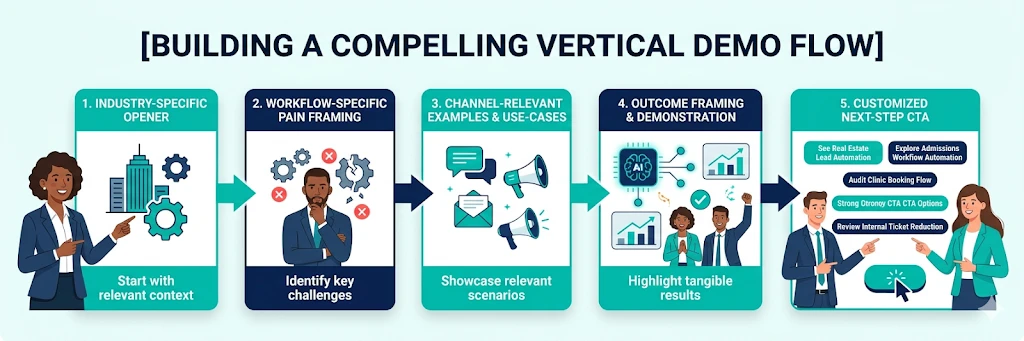
Usually:
-
industry-specific opener
-
workflow-specific pain framing
-
channel-relevant examples
-
use-case-first demonstration
-
familiar business scenarios
-
outcome framing
-
next-step CTA matched to the buyer stage
Examples of stronger CTAs:
-
See Real Estate Lead and Site Visit Automation
-
Explore Admissions Workflow Automation
-
Audit Our Clinic Booking and Reminder Flow
-
Review Our Internal Ticket Reduction Opportunity
Conclusion
A vertical GTM motion is not complete until the page, demo, CTA, and follow-up all tell the same workflow story.
That is how better pipeline gets built.
Unlock the Power of a Vertical Demo Funnel
FAQ
Why do generic demos underperform after vertical pages?
Because the buyer enters with specific expectations and loses momentum when the demo becomes generic.
What should a vertical CTA do?
It should reflect the specific workflow or outcome the buyer cares about.
Should every industry have a different offer?
Not always, but the framing and next step should usually be tailored.
Can this improve qualified pipeline?
Yes. Vertical consistency often improves both meeting quality and conversion.
About the Author
Akanksha
Ready to orchestrate your AI future?
Converiqo AI helps you design, deploy, and scale automation workflows that move your business faster, leveraging specialized solutions like our AI bot platform for lead generation, customer self-service AI bot platform, employee self-service AI bot platform, retail omnichannel automation, and our detailed guides on how agentic AI bot platforms work in enterprises and cost structure of enterprise AI bot platforms. Connect with our team to see the platform in action and co-create the next chapter of intelligent operations.
Read More Blogs
Discover more insights and product updates curated by the Converiqo AI team.

Real ROI of Field Force Automation - Beyond the Activity Dashboard
Four metrics that show real field force automation ROI in India - productivity, data reliability, throughput, and field attrition - not just the activity dashboard.

Beat Planning Is the Highest-Leverage Field Force Capability - Here Is Why
Beat planning decides coverage, call frequency, and whether field time is productive. Why it is the single highest-leverage field force automation capability.
Why an Indian Field Force App Has to Work Offline - and Be Built for Real Devices
Field work in India happens where connectivity is intermittent. A field force app that assumes constant connectivity fails exactly where field work is done.