One of the most common mistakes businesses make with voice automation is trying to automate the most complex calls first.
While this may seem ambitious, it often leads to poor outcomes. Complex conversations require nuance, trust, and flexibility. When automation is forced into these scenarios too early, it creates low caller confidence, weak experiences, and resistance from internal teams.
A more effective approach is to start where automation can deliver clear and measurable value with minimal risk.
Where Voice Automation Should Start
The best starting point is not sophistication. It is identifying call workflows that are repetitive, structured, and operationally expensive to handle manually.
Ideal characteristics of early automation use cases:
- Repetitive in nature
- Clearly structured with predictable flow
- High in volume or frequency
- Low variation in outcomes
- Time-consuming for teams
- Easy to measure and optimize
These types of workflows allow businesses to see quick improvements without disrupting customer experience.
The Best Call Workflows to Automate First
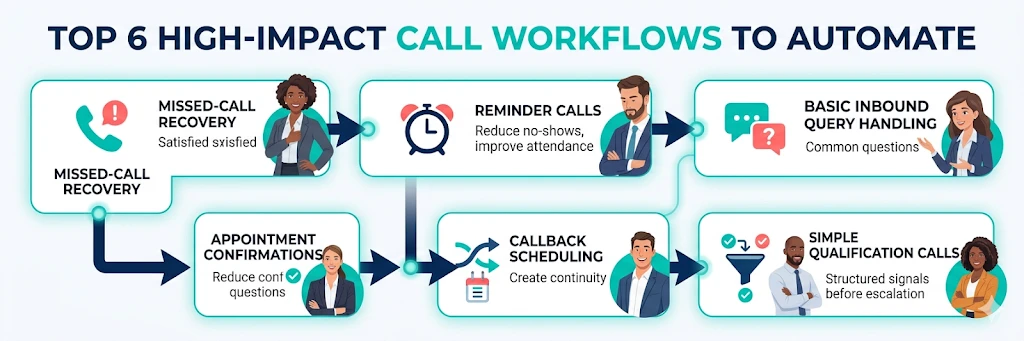
Missed-Call Recovery
When a call is missed, the intent is already high. A fast and structured follow-up can recover opportunities that would otherwise be lost.
Appointment Confirmations
These are highly repetitive and critical for ensuring that bookings actually convert into completed interactions.
Reminder Calls
Reminders help reduce no-shows and improve attendance rates, especially in appointment-driven businesses.
Callback Scheduling
Instead of relying on manual follow-up, automated scheduling creates continuity and reduces delays in reconnecting with leads.
Basic Inbound Query Handling
Common questions with predictable answers can be handled efficiently through automation, freeing up human resources.
Simple Qualification Calls
Initial qualification based on a few structured inputs can help filter and route leads more effectively before human involvement.
These workflows are strong starting points because they are directly tied to measurable outcomes and do not require handling emotionally complex situations.
What Not to Automate First
Some call types should not be automated at the beginning. These require human judgment, empathy, and flexibility.
Avoid starting with:
- Sensitive complaints
- Emotionally charged disputes
- Complex, account-specific issues
- Negotiation-heavy conversations
- Trust-repair interactions
- Highly ambiguous support cases
Automation can support these areas later, but it should not take primary ownership in the early stages.
Conclusion
The goal of early voice automation is not to build the most advanced system. It is to create operational relief while improving call continuity.
By focusing on structured, repetitive workflows first, businesses can achieve quick wins, build confidence, and create a strong foundation for more advanced automation later.
Section
Not sure which call workflows your business should automate first?
FAQs
What are the easiest call workflows to automate first?
Missed-call recovery, reminders, confirmations, callback scheduling, and repetitive inbound queries are usually the best starting points.
Why not automate complex calls first?
Because complex interactions require human judgment and can lead to poor experiences if automated too early.
Can voice automation handle complex workflows later?
Yes. Once the system is stable, automation can gradually support more advanced use cases alongside human teams.
How do businesses identify repetitive call workflows?
By analyzing call patterns, frequency, and whether the interaction follows a predictable structure.
What is the main benefit of starting with simple workflows?
It allows businesses to reduce manual workload quickly while improving efficiency and measurable outcomes.