Many businesses approach voice automation with a flawed mindset. They believe they must choose between AI voicebots and human callers.
This binary thinking leads to poor decisions. In reality, the goal is not replacement. It is identifying which parts of the call workflow are best handled by automation and where human interaction creates more value.
Where Automation Works Best
Automation is most effective in handling structured, repetitive, and predictable call tasks. These interactions do not require deep judgment or emotional nuance, making them ideal for workflow-driven execution.
Strong use cases for automation:
- Reminders for appointments or actions
- Confirmation calls
- Repetitive information sharing
- Structured lead qualification
- Missed-call recovery
- Status updates and routine follow-up
- Call routing and initial intake
These tasks are high in frequency and consistency, making them well-suited for automation.
Where Human Interaction Matters Most
Human callers bring value in situations that require empathy, flexibility, and contextual understanding. These interactions often involve complexity or emotional sensitivity that automation cannot handle effectively.
Strong use cases for human handling:
- Empathy-driven conversations
- Negotiation or persuasion
- Complex issue resolution
- Escalation handling
- Trust repair situations
- Sensitive or high-stakes interactions
- Exception-heavy cases
These are areas where human judgment and communication skills are essential.
Why Smart Division of Labor Is the Right Model
The most effective voice strategy is not about choosing one over the other. It is about dividing responsibilities intelligently.
Automation handles repetitive workflows efficiently, while human teams focus on high-value conversations. This balance improves both operational efficiency and customer experience.
Why Poor Escalation Ruins Voice Automation
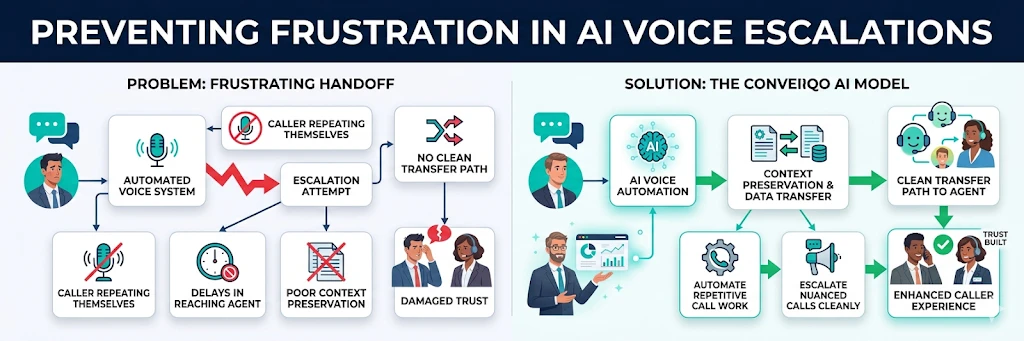
Even well-designed voice automation can fail if escalation is not handled properly.
Common escalation failures include:
- Callers being forced to repeat information
- No clear or fast path to reach a human
- Delays during transfer
- Loss of context between automation and human handling
- Callers feeling stuck or unsupported
These issues quickly reduce trust and damage the overall experience.
A strong system ensures smooth transitions, preserves context, and routes calls intelligently when human involvement is needed.
Conclusion
Voice automation works best when it supports human teams rather than competing with them.
By combining automation for repetitive tasks with human expertise for complex interactions, businesses can create a more efficient system while maintaining a high-quality caller experience. This balanced approach delivers both operational gains and stronger customer trust.
Section
Want to define what calls should stay human and what should be automated?
FAQs
Should AI voicebots replace human callers?
No. The best approach is to use automation for repetitive tasks and human callers for complex or sensitive conversations.
What is the biggest mistake in voice automation?
Trying to automate complex or emotionally sensitive calls without proper escalation leads to poor experiences.
When should voice workflows hand off to humans?
They should escalate when the issue is sensitive, unresolved, urgent, or requires human judgment.
Can voice automation work for small teams?
Yes. It helps reduce repetitive workload and allows small teams to focus on higher-value interactions.
How do you ensure smooth escalation in voice workflows?
By creating clear transfer paths, preserving context, and minimizing delays when moving from automation to human support.