A missed call is not always a lost customer. But in many businesses, it eventually becomes one.
This happens because missed calls fall into a critical gap. There is no immediate response, callbacks are delayed, after-hours enquiries are ignored, and by the time someone reconnects, the intent has already faded.
This is where call leakage begins. And since voice is often a high-intent channel, the cost of that leakage is higher than most businesses realize.
Why Missed Calls Matter More Than They Seem
A person who takes the effort to call is usually closer to taking action than someone browsing passively. Their intent is often clearer and more immediate.
They may be looking to book a service, confirm details, clarify something urgent, resolve an issue, or connect with a real person quickly.
Because of this, missed calls are not just missed interactions. They are missed opportunities with strong conversion potential.
What Businesses Should Do First
Recovering missed-call value does not require complex systems at the start. It requires a structured approach to ensure that intent is not lost.
A strong missed-call workflow should include:
- Capturing every missed-call event
- Enabling a fast and reliable callback path
- Providing after-hours fallback handling
- Collecting basic context from the caller
- Triggering follow-up if the callback is not answered
These steps ensure that even if the first interaction is missed, the opportunity can still be recovered.
Conclusion
If calls play an important role in your business, missed-call leakage is not a small operational issue. It directly affects both conversion and customer experience.
By building a structured recovery process, businesses can protect high-intent demand, improve response quality, and reduce lost opportunities.
FAQ
Why are missed calls so important?
Missed calls matter because callers often have higher intent and are closer to taking action than passive leads.
What causes missed-call leakage?
It is usually caused by delayed callbacks, lack of after-hours handling, weak recovery workflows, and unclear ownership.
Can automation reduce missed-call loss?
Yes. Automation helps capture missed calls, trigger quick follow-ups, and ensure consistent recovery.
Is this only relevant for call-heavy industries?
No. Any business where calls indicate strong intent can benefit from reducing missed-call leakage.
How quickly should businesses respond to missed calls?
Ideally, as quickly as possible, since delays significantly reduce the chances of recovering the opportunity.
About the Author
Priya Maurya
Ready to orchestrate your AI future?
Converiqo AI helps you design, deploy, and scale automation workflows that move your business faster, leveraging specialized solutions like our AI bot platform for lead generation, customer self-service AI bot platform, employee self-service AI bot platform, retail omnichannel automation, and our detailed guides on how agentic AI bot platforms work in enterprises and cost structure of enterprise AI bot platforms. Connect with our team to see the platform in action and co-create the next chapter of intelligent operations.
Read More Blogs
Discover more insights and product updates curated by the Converiqo AI team.

Real ROI of Field Force Automation - Beyond the Activity Dashboard
Four metrics that show real field force automation ROI in India - productivity, data reliability, throughput, and field attrition - not just the activity dashboard.

Beat Planning Is the Highest-Leverage Field Force Capability - Here Is Why
Beat planning decides coverage, call frequency, and whether field time is productive. Why it is the single highest-leverage field force automation capability.
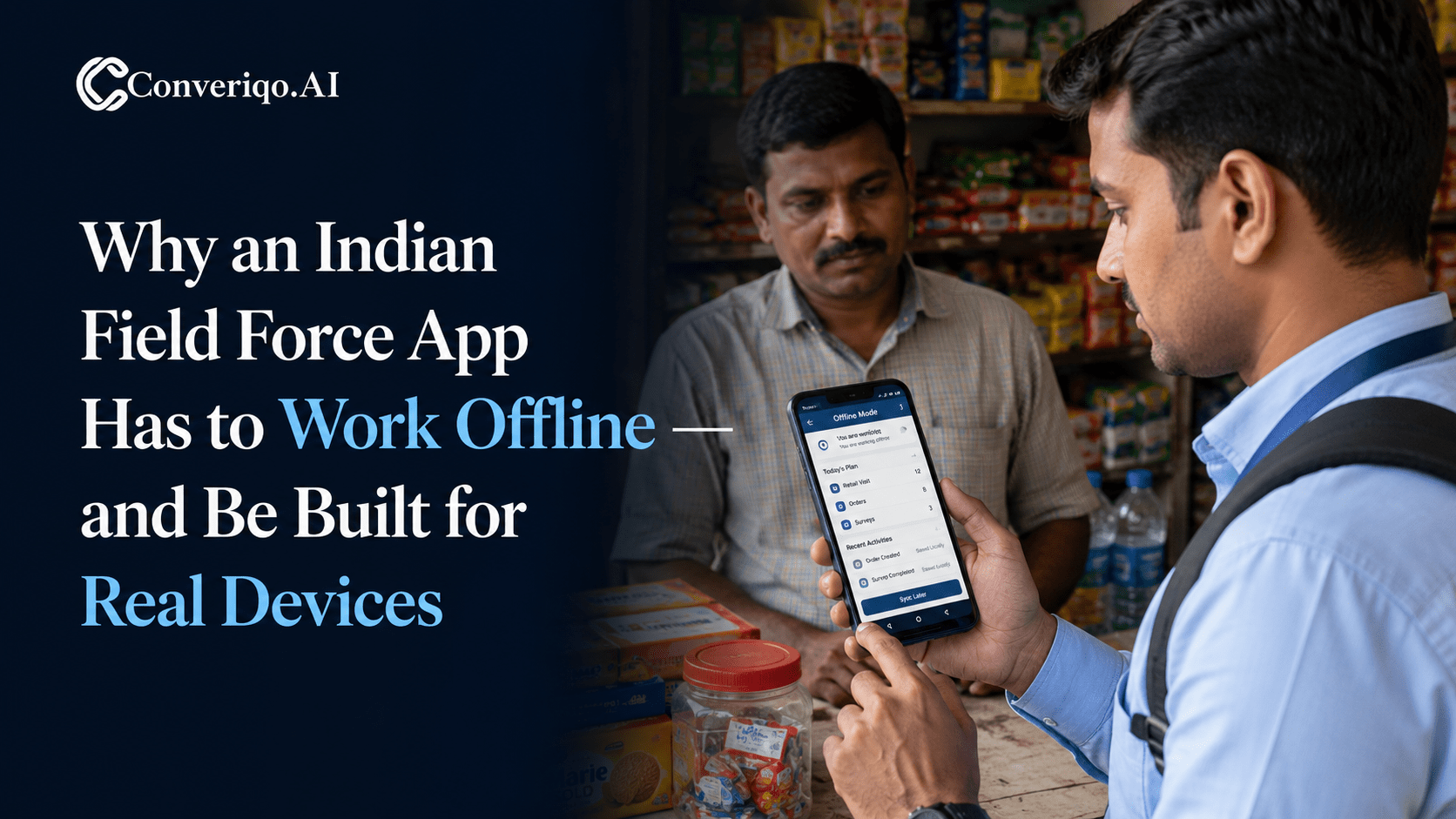
Why an Indian Field Force App Has to Work Offline - and Be Built for Real Devices
Field work in India happens where connectivity is intermittent. A field force app that assumes constant connectivity fails exactly where field work is done.