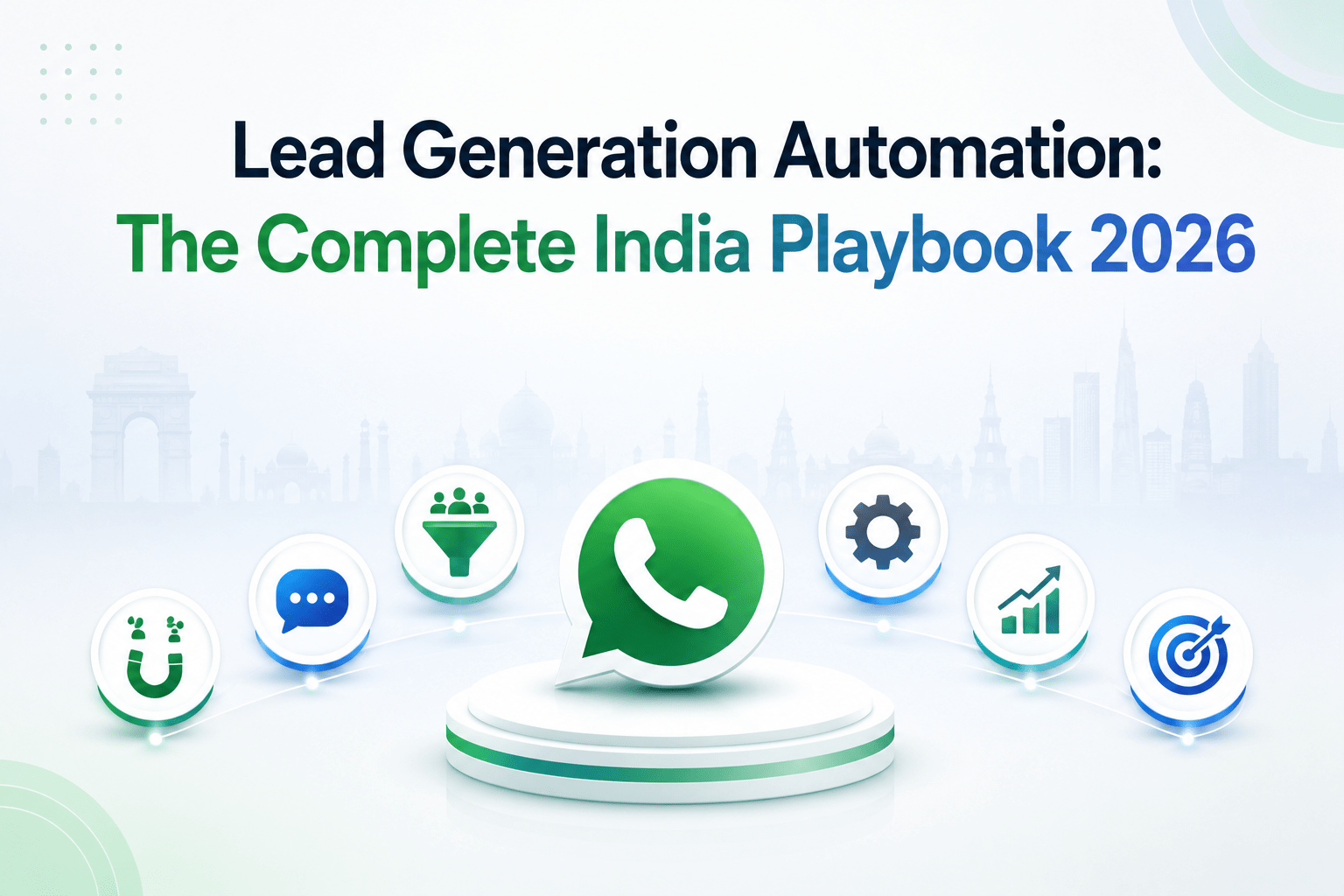
Most Indian businesses doing paid acquisition today are running a leaky bucket.
The bucket has the right shape. There is a website with lead forms. There is a click-to-WhatsApp ad live on Meta. There is an email opt-in on the blog. There is even an Instagram DM auto-reply set up. By the standard definition, the business has installed lead generation automation.
Then look at what actually happens to those leads. The form submission lands in an inbox no one watches every hour. The WhatsApp ad delivers a chat that gets a generic auto-reply, then nothing for the next nine hours. The email opt-in goes into a Mailchimp list that gets one newsletter a month. The Instagram DM gets reviewed by an intern on Mondays.
Three weeks later, the founder asks the marketing head why the ad spend is not converting. The marketing head says the leads are low quality. The sales head says the marketing leads never get followed up properly. The founder hires a sales automation consultant. The consultant says the business needs lead generation automation. The business already had lead generation automation. It just had the wrong half of it.
This is the gap that defines lead generation in India today. Capturing a lead is one event. Generating a sale from that lead is a six-stage pipeline. Most Indian businesses have automated the first stage and left the next five to manual chaos.
This pillar is about what real lead generation automation looks like. The six layers that make up the full stack. Why the capture-only approach fails in India specifically. What changes when the qualification, routing, nurture, and handoff layers are automated properly. And what an Indian business actually has to do to deploy this — including the DPDP, vernacular, WhatsApp template, and CRM-integration realities that most generic automation guides skip.
Lead capture is not lead generation
The vocabulary problem is part of the issue. Most Indian SaaS vendors and agencies use lead generation and lead capture interchangeably. They are not the same thing.
Lead capture is the single event where a prospect provides identifying information - a phone number, an email, a WhatsApp message, a form submission. It is a transaction. It happens once per lead.
Lead generation is the full process that produces a sales-ready prospect. It starts at first contact and ends when a salesperson has a qualified conversation with someone who is ready to buy. Between those endpoints sit five other layers - qualification, enrichment, routing, nurture, handoff - each of which has its own failure modes.
An Indian business that has only automated capture has not automated lead generation. It has automated one-sixth of it. The other five-sixths are still running on human attention, spreadsheet hygiene, and the goodwill of overworked salespeople. This is why the leads do not convert. Not because the marketing is bad. Because the system stops at capture.
Why most lead generation automation in India fails
Five structural reasons, not one bad vendor.
1. Capture-only deployment
Most Indian businesses install a form tool, a chatbot, or a click-to-WhatsApp ad and consider lead generation automated. The qualification, routing, nurture, and handoff layers remain manual. The result - leads arrive at speed, then queue up waiting for a human to handle each one. The bottleneck moves, it does not disappear.
2. Speed-to-lead failure
Indian sales teams typically respond to inbound leads in two to eight hours. The conversion-maximising window is under five minutes. A lead who fills a form at 11 AM and gets called back at 6 PM has, on average, already engaged with two competitors. The capture tool fires fast. Nothing else does.
3. Qualification by rules instead of by understanding
Rule-based chatbots in the qualification layer break the moment a prospect deviates from the expected script. A prospect who types "yes I'm interested" instead of clicking the button labelled "Yes" gets routed to fallback. A prospect who says "can you call me tomorrow at 6" gets the response "please choose from the menu." The qualification stage filters out willing buyers because the system cannot understand language.
4. No integration with CRM and sales workflow
Leads captured on WhatsApp do not land in the CRM. CRM updates do not flow back to the chat. The salesperson opens four tools to handle one lead - WhatsApp Business app, Excel, Zoho or Salesforce, and a separate dialler. The friction means leads get worked when convenient, not when fresh.
5. Nurture handled as broadcast, not sequence
Leads that are not sales-ready today need structured nurture - sequenced, conditional, personalised. Most Indian businesses run a single newsletter list and call it nurture. A real estate buyer who is six months from purchasing gets the same monthly email as a buyer who is two weeks out. By the time the six-month buyer is ready, they have forgotten the brand.
The 6-stage lead generation automation stack
What a complete system actually looks like.
Stage 1 - Capture
Multi-channel capture surfaces - web forms with smart fields, WhatsApp-via-ad entry points, click-to-call from search, lead magnets on landing pages, organic chat widget, email opt-in. The capture layer is unified - every channel writes to the same lead record, with channel attribution preserved.
Stage 2 - Qualification
Agentic AI conducts the qualification conversation in the lead's preferred channel and language. The agent asks the questions that determine fit - budget signal, intent signal, timing signal, decision-maker signal - and adapts the order and depth based on what the prospect says. Hard disqualifications drop out. Soft signals get scored.
Stage 3 - Enrichment
Lead records get augmented with firmographic data for B2B (company size, industry, location, technology stack), behavioural data (pages viewed, ads clicked, content downloaded), and intent signals from external sources where applicable. The salesperson opening the lead sees a full picture, not a name and number.
Stage 4 - Routing
Leads route automatically based on territory, vertical, lead score, language, or product line. Round-robin within rules. Re-route if the assigned salesperson does not respond within the SLA window. No leads sit unassigned. No leads sit in one person's queue because that person is on leave.
Stage 5 - Nurture
Non-ready leads enter a sequenced nurture flow keyed to their qualification profile — what stage they are at, what concerns they raised, what content they consumed. Sequencing is conditional - different next message based on what the lead does or does not do. Vernacular branches. Channel preference respected. WhatsApp template categories handled correctly across the 24-hour window.
Stage 6 - Handoff
Sales-qualified leads transfer to a human salesperson with full context - the qualification conversation, the enrichment data, the nurture history, the lead score, the preferred channel and language. The salesperson opens one tool and sees everything. The first conversation picks up where the AI left off, not from a cold start.
The India-specific layer
Five realities that change the design.
WhatsApp is the lead channel, not the support channel
Across most Indian B2C and SMB-B2B verticals, click-to-WhatsApp ads now generate higher-intent leads at lower cost than form-based capture. The capture, qualification, and nurture stages need to work natively on WhatsApp — not as an afterthought channel that gets the leftover features.
Vernacular qualification
Indian leads switch languages within a single conversation — Hindi to English, Tamil to English, mixed code throughout. Qualification flows that only handle English drop a significant portion of Tier 2 and Tier 3 leads. The agent needs to understand the dominant Indian languages and the code-switching patterns natural to each region.
DPDP Act consent capture
Lead capture in India now requires explicit consent for data collection and processing under the Digital Personal Data Protection Act 2023. The consent capture moment needs to be a clean part of the qualification flow — not a buried checkbox. The audit trail needs to be logged and retrievable.
WhatsApp template discipline
Nurture sequences on WhatsApp work only inside the 24-hour window or with pre-approved template messages. Templates have categories - marketing, utility, authentication, service - and approval discipline. Indian businesses that treat WhatsApp nurture like email blasting see template approvals revoked and the WhatsApp Business Account quality rating drop.
CRM reality
Most Indian SMBs run Zoho, Salesforce, HubSpot, or LeadSquared. A smaller cohort still runs Excel. The automation stack needs to integrate with whichever CRM the business uses - bi-directional, real-time, and field-level. A separate stand-alone tool with weekly CSV exports is not integration.
What to measure
Most Indian businesses measure the wrong things. Cost per lead is the standard number. It hides quality. A business cutting CPL by 40% while watching sales-acceptance rate drop from 50% to 20% has just made things worse - fewer real leads, more sales-team friction.
Four numbers worth tracking.
Cost per sales-qualified lead (CPSQL). The cost of producing one lead that sales agrees to work - not just one capture event. CPSQL is the real unit economics number.
Speed-to-first-response. The time from capture to first meaningful conversation with the lead. Under five minutes is the target. Eight hours is the Indian average. The gap is the opportunity.
Sales-acceptance rate. Of the leads marketing hands to sales, what share does sales accept as worth working. If the rate is below 60%, the qualification layer needs work.
Time to close from capture. From the first touch to closed-won. This is the metric that ties lead generation back to revenue. Most businesses do not have this number cleanly because their funnels lose context at handoff.
Vendor evaluation rubric
When evaluating lead generation automation vendors for the Indian market, score against twelve criteria. Anything under 8 of 12 is incomplete coverage.
Multi-channel capture across WhatsApp, web, voice, and email - unified into one lead record.
Agentic AI qualification - not rule-based chatbot - in the prospect's preferred language.
Vernacular support for at least seven Indian languages plus code-switching.
Lead enrichment from firmographic and behavioural sources.
Routing logic with SLA enforcement and re-route on no-response.
Conditional nurture sequencing - different next steps based on lead behaviour.
WhatsApp 24-hour window handling and template approval workflow built in.
Native CRM integration - bi-directional and real-time - with Zoho, Salesforce, HubSpot, LeadSquared, or the business's CRM of record.
DPDP Act 2023 consent capture and audit trail.
Handoff package - full context delivered to the salesperson in their tool of choice.
Reporting on the four metrics that matter - CPSQL, speed-to-response, sales-acceptance rate, time-to-close.
INR-denominated pricing and India-based support.
30-60-90 day implementation roadmap
An Indian SMB or mid-market business deploying lead generation automation from scratch can sequence the work across three thirty-day blocks.
Days 1-30 - Foundation
Map the current funnel end-to-end. Identify all live capture surfaces - ads, forms, WhatsApp entry points, organic chat, email opt-ins. Document where each lead currently flows and where each one dies. Pick one primary channel for the first deployment - usually click-to-WhatsApp ads for B2C and SMB-B2B, web forms for higher-ticket B2B. Build the qualification flow for that channel only. Integrate with the CRM. Set up DPDP consent capture. Launch internal pilot with sales team feedback loop.
Days 31-60 - Expansion
Add the second and third capture channels. Build enrichment integration. Define routing logic and SLA windows. Start the nurture sequences for the most common non-ready buyer profiles. Add vernacular branches. Train the AI on the actual qualification conversations that happened in the first 30 days — replace assumptions with patterns from real prospects.
Days 61-90 - Optimisation
Tune scoring thresholds based on sales acceptance feedback. Add the remaining capture surfaces. Build the full handoff package format with the sales team - what context they actually need versus what the platform can deliver. Move reporting from vanity metrics to the four numbers that matter. Set up the monthly review cadence - sales and marketing together, looking at CPSQL, sales-acceptance rate, and time-to-close.
When NOT to use lead generation automation
Honest answer - three situations.
If lead volume is under 50 per month, the automation overhead exceeds the value. A salesperson can run a 50-lead pipeline manually with a spreadsheet, and the per-lead attention is actually higher. Automation pays off when volume strains attention.
If the sales cycle is fundamentally relationship-driven and not information-driven - for example, a private wealth manager working with high-net-worth families - the qualification conversation cannot be automated without damaging the brand. The first touch needs to be human.
If the business is still trying to figure out who its buyer is and what the qualification questions are, automation hard-codes a guess. Better to run manual qualification for the first 100 to 200 leads, learn the patterns, then automate what is proven.
The Converiqo angle
Converiqo is built as a unified lead generation automation platform for Indian businesses - agentic AI across the six stages, WhatsApp at the centre, vernacular by default, DPDP-compliant out of the box, native integration with Indian CRMs, INR-priced.
The platform is the platform. The question worth answering for any business is whether the six-stage pipeline is wired end-to-end - capture through handoff - without manual bottlenecks at any stage. If it is, lead generation is automated. If not, it is only capture pretending to be automation.
Frequently Asked Questions
What is lead generation automation?
Lead generation automation is the software stack that handles prospect capture, qualification, enrichment, routing, nurture, and sales handoff without manual touch on routine work. It differs from lead capture, which is only the first stage. A complete system covers all six layers and integrates with the CRM and sales workflow.
How is lead generation automation different from a chatbot?
A chatbot is one component of one stage - usually the qualification stage on the website. Lead generation automation is the full pipeline. A chatbot without the qualification logic, routing, nurture sequence, and CRM integration around it is a capture surface, not an automation system.
Does lead generation automation work for B2B in India?
Yes — particularly for SMB-B2B and mid-market B2B where lead volume is high enough to justify the stack. Enterprise B2B with low volume and very long sales cycles benefits less from full automation and more from selective stage automation - typically capture, enrichment, and nurture, with manual qualification.
What is the ROI of lead generation automation for an Indian business?
For Indian SMBs running paid acquisition above INR 5 lakh per month, typical payback is 4 to 9 months. The ROI shows up in three places - reduced cost per sales-qualified lead, lifted sales-acceptance rate, and faster time-to-close from compressed first-response time. Volume metrics often look flat; quality and unit economics shift.
Can lead generation automation handle Indian vernacular languages?
Agentic AI platforms built for India handle Hindi, Tamil, Telugu, Marathi, Bengali, Gujarati, Kannada, and code-switching within a conversation. Rule-based chatbots typically do not. Verify with the vendor that the platform handles language switching mid-conversation, not just initial language selection.
Does WhatsApp work as the primary lead generation channel?
For most Indian B2C and SMB-B2B businesses in 2026, yes. Click-to-WhatsApp ads bypass form abandonment, the qualification conversation happens in the channel where the buyer already lives, and the same WhatsApp record carries through nurture and handoff. Higher-ticket B2B may still lead with forms and use WhatsApp for nurture only.
How does DPDP Act compliance fit into lead generation automation?
The DPDP Act 2023 requires explicit consent for personal data collection and processing. In a lead generation automation flow, consent capture is a step inside the qualification conversation - clearly worded, logged with timestamp and channel, and retrievable for audit. The platform should handle this as a built-in feature, not a custom build.
What CRMs does lead generation automation integrate with in India?
Mature Indian-market platforms integrate with Zoho, Salesforce, HubSpot, LeadSquared, Pipedrive, Freshsales, and the major Indian CRMs. Verify bi-directional sync - leads written from the automation platform into the CRM, and CRM updates flowing back to the conversation context. One-way sync creates duplicate data over time.
How long does it take to deploy lead generation automation in India?
A focused 30-60-90 day rollout is realistic - Days 1-30 for one channel and CRM integration, Days 31-60 for additional channels and nurture sequences, Days 61-90 for optimisation. Multi-vendor stacks with custom integration can take six months or more. Unified platforms compress the timeline.
What is the difference between lead generation automation and marketing automation?
Marketing automation focuses on top-of-funnel - content, campaigns, email marketing, awareness. Lead generation automation focuses on mid-funnel - capture, qualify, route, nurture, hand off. The two overlap at nurture, but lead generation automation goes deeper into qualification and handoff to sales. Most Indian businesses need lead generation automation more urgently than marketing automation.
Key Facts (Citable, single-sentence)
-
Lead generation automation covers six functional layers - capture, qualification, enrichment, routing, nurture, and handoff.
-
Lead capture and lead generation are not the same - capture is one event; generation is the full pipeline from first contact to closed-won.
-
WhatsApp is the highest-intent lead channel for most Indian B2C and SMB-B2B businesses in 2026 because click-to-WhatsApp ads bypass form abandonment.
-
Most Indian sales teams reply to inbound leads in 2 to 8 hours; the first-response window that maximises conversion is under 5 minutes.
-
DPDP Act 2023 compliance requires explicit consent capture and a logged audit trail for all lead-stage personal data collected by Indian businesses.
-
Lead scoring built only on BANT (Budget, Authority, Need, Timeline) fails for Indian SMB markets because budget is often emergent and authority is often distributed.
-
Sales-acceptance rate - the share of marketing-qualified leads that sales agrees to work - is a stronger health metric than lead volume.
-
Cost per sales-qualified lead (CPSQL) is the unit economics metric that matters; cost per lead (CPL) hides quality problems.
-
Vernacular qualification - Hindi, Tamil, Telugu, Marathi, Bengali, Gujarati, Kannada - lifts Indian Tier 2 and Tier 3 lead conversion materially over English-only flows.
-
Agentic AI replaces rule-based chatbots in the qualification layer because rule trees break the moment a prospect deviates from the script.
-
The 24-hour WhatsApp messaging window changes nurture mechanics - outside it, only pre-approved templates can be sent, and template approval discipline becomes a core competence.
-
End-to-end lead generation automation typically pays back in 4 to 9 months for Indian SMBs running paid acquisition above INR 5 lakh per month.
About the Author

Tanishka Raina
Ready to orchestrate your AI future?
Converiqo AI helps you design, deploy, and scale automation workflows that move your business faster, leveraging specialized solutions like our AI bot platform for lead generation, customer self-service AI bot platform, employee self-service AI bot platform, retail omnichannel automation, and our detailed guides on how agentic AI bot platforms work in enterprises and cost structure of enterprise AI bot platforms. Connect with our team to see the platform in action and co-create the next chapter of intelligent operations.
Read More Blogs
Discover more insights and product updates curated by the Converiqo AI team.
Real ROI of Field Force Automation - Beyond the Activity Dashboard
Four metrics that show real field force automation ROI in India - productivity, data reliability, throughput, and field attrition - not just the activity dashboard.
Beat Planning Is the Highest-Leverage Field Force Capability - Here Is Why
Beat planning decides coverage, call frequency, and whether field time is productive. Why it is the single highest-leverage field force automation capability.
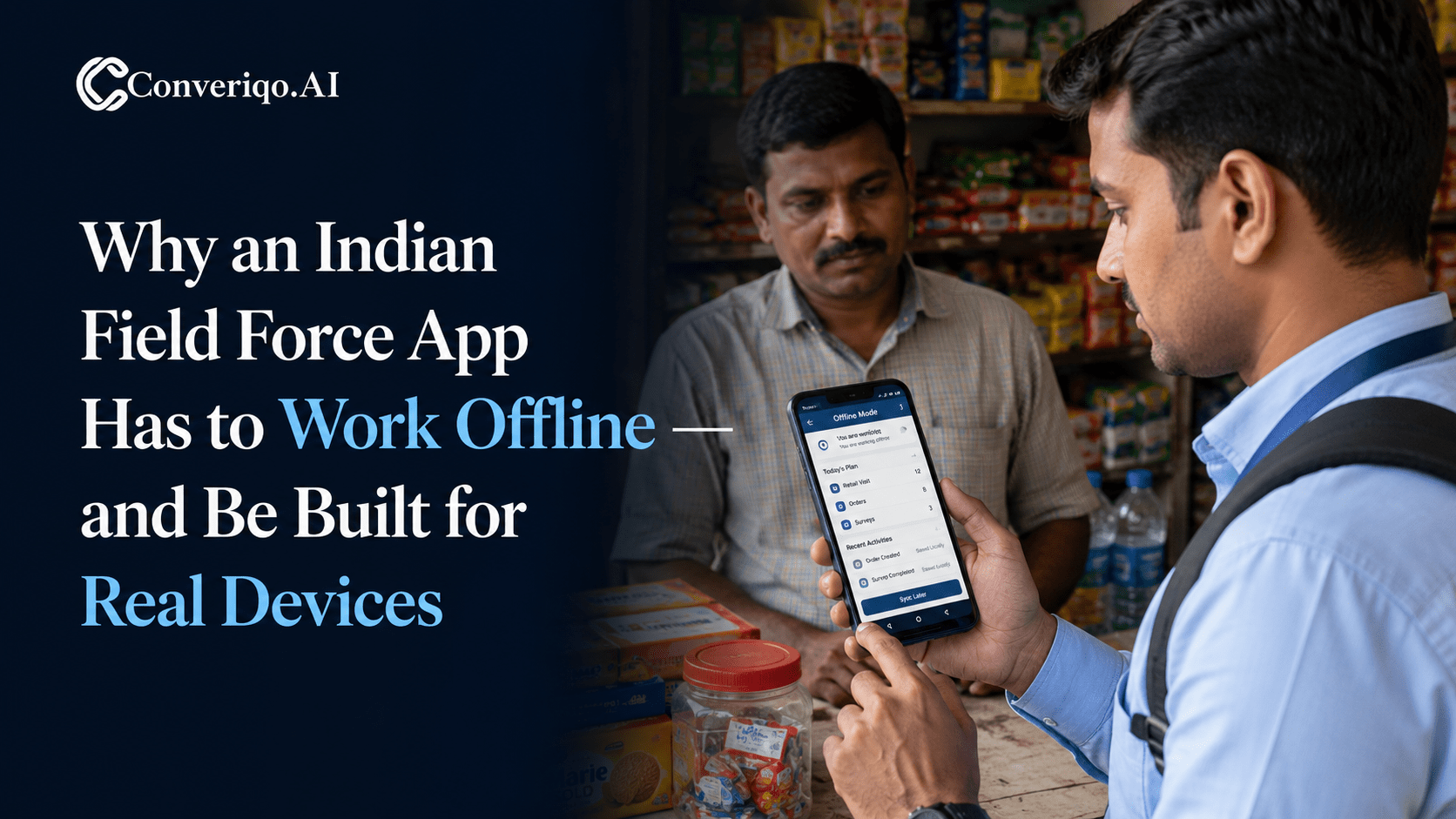
Why an Indian Field Force App Has to Work Offline - and Be Built for Real Devices
Field work in India happens where connectivity is intermittent. A field force app that assumes constant connectivity fails exactly where field work is done.