
Section
Many businesses try to decide whether voice automation should focus on inbound or outbound calls. A more practical approach is to identify which call workflows will deliver the highest value first.
Both inbound and outbound automation are useful, but they address different types of problems within the business. Understanding this distinction helps in prioritizing the right starting point.
Where Inbound Call Automation Creates Value
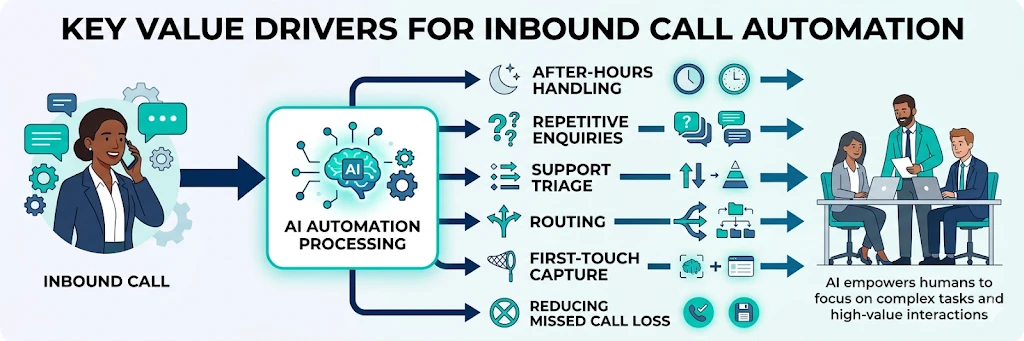
Inbound automation focuses on handling incoming interactions more efficiently. It is particularly useful when businesses struggle with missed calls, high call volume, or inconsistent handling of first-touch enquiries.
Key areas where inbound automation helps:
- After-hours call handling
- Managing repetitive enquiries
- Support triage and initial screening
- Call routing to the right team
- First-touch lead capture
- Reducing missed-call loss
These workflows ensure that incoming intent is captured and managed consistently, even when teams are unavailable.
Where Outbound Call Automation Creates Value
Outbound automation focuses on maintaining continuity after the initial interaction. It helps businesses follow up, reconnect, and ensure that opportunities are not lost due to inaction or delay.
Key areas where outbound automation helps:
- Sending reminders for appointments or actions
- Confirming bookings or schedules
- Recovering missed-call opportunities
- Re-engaging inactive leads
- Following up on incomplete bookings
- Supporting callback continuity
These workflows are critical for maintaining momentum and improving conversion outcomes over time.
Conclusion
Inbound and outbound voice automation are not competing approaches. They serve different roles within the overall workflow.
The most effective strategy is to identify where the business is currently losing value, whether that is at the point of incoming calls or during follow-up. From there, automation can be applied in a targeted way to improve outcomes.
Over time, combining both inbound and outbound workflows creates a more complete and efficient voice strategy.
CTA Section
Want to identify whether inbound or outbound voice workflows should come first for your business?
CTA button: Improve Call Conversion
FAQs
What is the difference between inbound and outbound call automation?
Inbound automation handles incoming calls and enquiries, while outbound automation focuses on follow-up, reminders, confirmations, and re-engagement.
Which is more valuable?
It depends on where the business is currently losing opportunities, either during incoming calls or in follow-up processes.
Should businesses automate both inbound and outbound calls?
Yes. In many cases, combining both creates a stronger and more complete workflow over time.
Is outbound automation only useful for reminders?
No. It can also support missed-call recovery, lead re-engagement, qualification, and ongoing conversation continuity.
How should businesses decide where to start?
They should analyze where the most friction or loss occurs and prioritize automation for that specific workflow first.
About the Author
Tanishka Raina
Ready to orchestrate your AI future?
Converiqo AI helps you design, deploy, and scale automation workflows that move your business faster, leveraging specialized solutions like our AI bot platform for lead generation, customer self-service AI bot platform, employee self-service AI bot platform, retail omnichannel automation, and our detailed guides on how agentic AI bot platforms work in enterprises and cost structure of enterprise AI bot platforms. Connect with our team to see the platform in action and co-create the next chapter of intelligent operations.
Read More Blogs
Discover more insights and product updates curated by the Converiqo AI team.
Real ROI of Field Force Automation - Beyond the Activity Dashboard
Four metrics that show real field force automation ROI in India - productivity, data reliability, throughput, and field attrition - not just the activity dashboard.

Beat Planning Is the Highest-Leverage Field Force Capability - Here Is Why
Beat planning decides coverage, call frequency, and whether field time is productive. Why it is the single highest-leverage field force automation capability.
Why an Indian Field Force App Has to Work Offline - and Be Built for Real Devices
Field work in India happens where connectivity is intermittent. A field force app that assumes constant connectivity fails exactly where field work is done.