Why Voice Automation Should Not Be Limited to One Role
One of the most common mistakes businesses make is treating voice automation as a single-purpose tool. Many assume it is only useful for answering inbound calls.
In reality, voice can support multiple stages of a workflow. When used correctly, it becomes a versatile layer that helps move conversations forward rather than just responding to them.
Voice automation can assist with reminding customers, confirming actions, qualifying leads, reconnecting with inactive users, recovering missed intent, and guiding the caller toward the next step. This makes it far more valuable than a basic call-handling feature.
Where Voice Works Especially Well
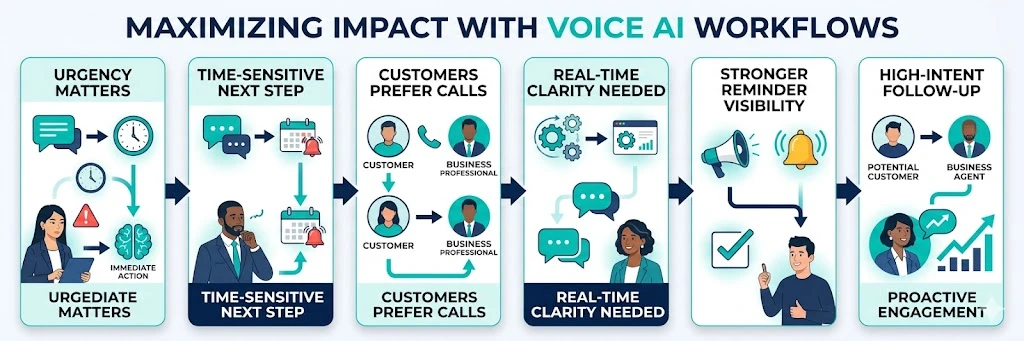
Voice becomes particularly effective in situations where timing, clarity, and responsiveness matter. Unlike passive channels, it allows immediate interaction and reduces delays in decision-making.
Scenarios where voice delivers strong impact:
- When urgency is high and immediate response is needed
- When the next step is time-sensitive
- When customers are more likely to respond to calls than messages
- When real-time clarity improves understanding
- When reminders need stronger visibility
- When high-intent follow-up should not rely only on passive communication
These use cases highlight why voice plays an important role in reminder systems, confirmation workflows, and re-engagement strategies.
Conclusion
Voice automation is most effective when it is integrated into clear business workflows rather than used as an isolated feature.
When aligned with specific stages such as reminders, confirmations, and follow-up, it helps improve response rates, reduce delays, and create smoother customer journeys. This is where voice moves from being a novelty to a meaningful operational and commercial asset.
Section
FAQs
What can voice automation be used for besides answering calls?
It can support reminders, confirmations, lead qualification, callbacks, re-engagement, and structured follow-up workflows.
Why use voice for reminders?
Voice reminders are often more effective when urgency or clarity is important, as they prompt immediate attention.
Can voice help with qualification?
Yes. It can collect structured information and signals before routing or escalation.
Is re-engagement through voice too intrusive?
It depends on timing, audience, and context. When used thoughtfully, it can be highly effective.
When should businesses use voice over text channels?
They should use voice when speed, clarity, or higher response likelihood is needed compared to passive messaging channels.
About the Author
Akanksha
Ready to orchestrate your AI future?
Converiqo AI helps you design, deploy, and scale automation workflows that move your business faster, leveraging specialized solutions like our AI bot platform for lead generation, customer self-service AI bot platform, employee self-service AI bot platform, retail omnichannel automation, and our detailed guides on how agentic AI bot platforms work in enterprises and cost structure of enterprise AI bot platforms. Connect with our team to see the platform in action and co-create the next chapter of intelligent operations.
Read More Blogs
Discover more insights and product updates curated by the Converiqo AI team.

Real ROI of Field Force Automation - Beyond the Activity Dashboard
Four metrics that show real field force automation ROI in India - productivity, data reliability, throughput, and field attrition - not just the activity dashboard.

Beat Planning Is the Highest-Leverage Field Force Capability - Here Is Why
Beat planning decides coverage, call frequency, and whether field time is productive. Why it is the single highest-leverage field force automation capability.
Why an Indian Field Force App Has to Work Offline - and Be Built for Real Devices
Field work in India happens where connectivity is intermittent. A field force app that assumes constant connectivity fails exactly where field work is done.