An Indian mid-market company at INR 200 crore in annual revenue runs SAP. The procurement team has eight people. The accounts payable team has four. The CFO presents at the board meeting that procurement is automated - SAP handles PO approvals through configured workflows, multi-level routing happens automatically, the digital trail exists in the ERP. By the standard definition that most CFOs and CPOs use in 2026, this is procurement automation.
Then look at the actual procure-to-pay cycle for a typical purchase request. The requester raises the request through an email to the procurement team. The procurement coordinator opens it on day one, asks clarifying questions, gets answers on day three. Goes to find vendor quotes - three quotes per the policy. Sends RFQs by email on day four. Receives quotes between days seven and fourteen. Builds a comparison sheet in Excel on day fifteen. Internal evaluation meeting on day eighteen. Selection decision documented on day twenty. PO created in SAP on day twenty-two and routed through the approval workflow that the CFO points to as evidence of automation - approvals complete by day twenty-six. PO sent to the vendor. Goods delivered between days thirty-five and forty-five. GRN raised. Invoice received between days fifty and sixty. Three-way matching by accounts payable team - PO, GRN, invoice - done manually with verification of line items, GST amounts, TDS applicability between days sixty and sixty-six. Payment release between days sixty-eight and seventy-two.
Total cycle from purchase request raised to vendor paid: 8 to 12 weeks. The PO approval workflow that the CFO described as procurement automation occupies four days of the cycle. The other 56 to 80 days are manual coordination - email, Excel, paper, phone, in-person follow-up.
Across the same year, the company also accumulates 22% maverick spend (purchases made outside negotiated contracts), loses 5% of GST input credit through invoice reconciliation gaps, breaches the MSME 45-day payment requirement on 18% of MSME vendor invoices, and operates contracts whose renewal dates and term clauses live in PDFs in shared drives that nobody systematically tracks. None of these show up in the board presentation. All of them show up in the audit, in the working capital cycle, in the vendor relationships, and in the silent erosion of the company's actual procurement effectiveness.
This is the gap that defines most Indian procurement operations in 2026. ERP-based PO approval is in place. The board hears that procurement is automated. The rest of the procure-to-pay cycle - intake, vendor management, contract handling, invoice processing, spend visibility - remains manual or partially automated through email and Excel. The cycle times stay long, the leakages accumulate, the compliance risks persist, and the CFO does not have the visibility to see them clearly.
This pillar is about what procurement automation actually means in 2026 for Indian companies. The six capabilities that make up end-to-end procure-to-pay orchestration, not just PO approval. Why most Indian companies confuse the two and what the buying decision should actually look like. What the India-specific layer requires - GST input credit reconciliation, TDS handling, MSME payment compliance, e-invoicing integration, sector-specific procurement regulations, vendor due diligence, vernacular vendor communication for the SMB and Tier 2/3 vendor base. And what the ROI looks like across cycle time, maverick spend, contract savings, processing cost, and the compliance exposure that does not appear on most procurement dashboards.
PO approval is not procurement automation
The vocabulary problem repeats with a sharper finance-operations edge. ERP vendors, procurement consultants, and finance system integrators describe configured PO approval workflows as 'procurement automation.' The pitch decks show automated approval routing. The reality after deployment is that the approval workflow does its narrow job well - multi-level routing, escalation, audit trail, delegation handling - while everything else in the procure-to-pay cycle remains as manual as it was before the ERP went live.
ERP-based PO approval is a workflow tool for one stage of procurement. The purchase request comes in (often informally), the PO gets generated, approval routing fires, the PO goes to the vendor. This is automation of the approval step. It is not automation of procurement.
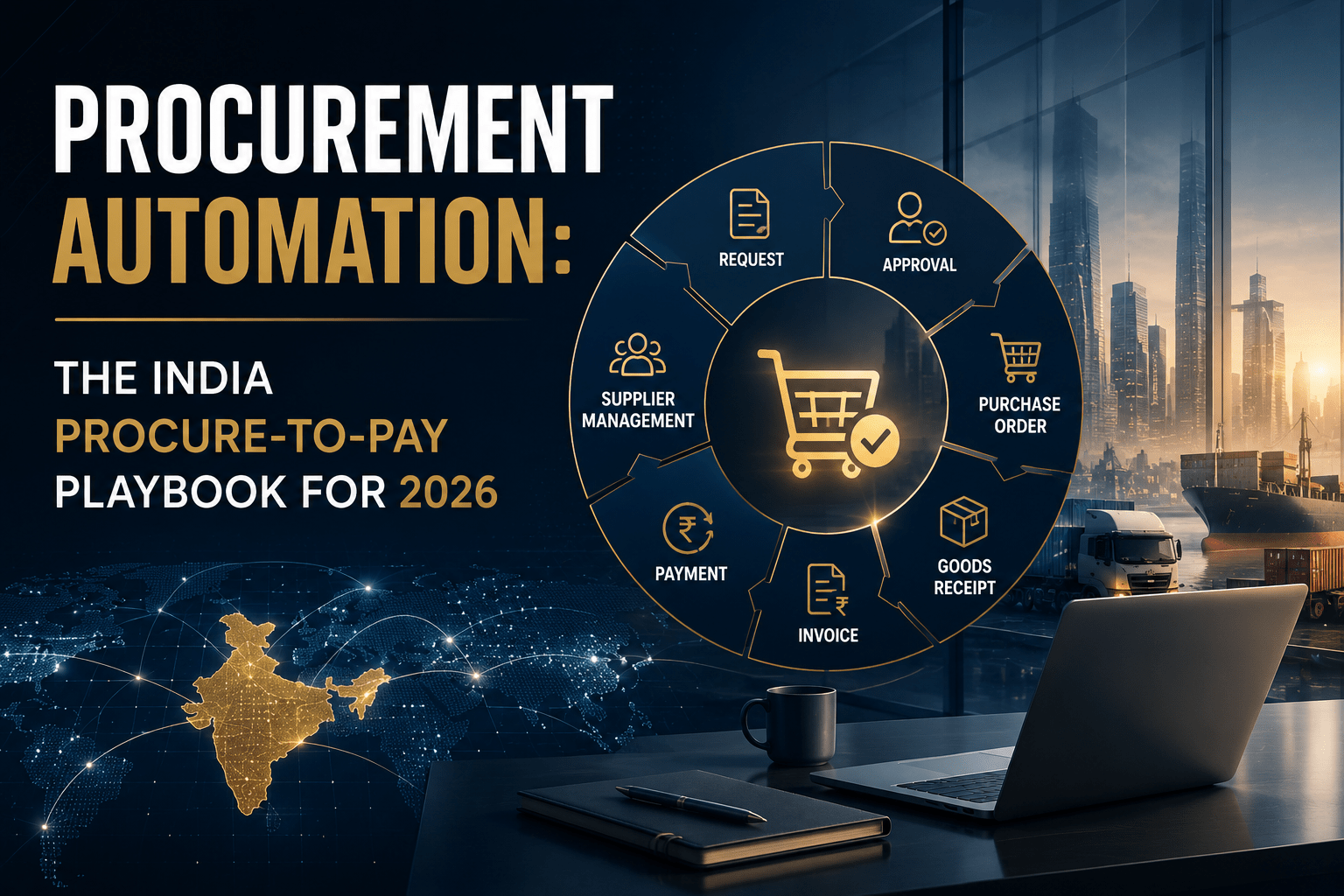
Procurement automation is the end-to-end orchestration of the full procure-to-pay cycle. Six capabilities working together - intelligent intake, vendor discovery and evaluation, contract intelligence, PO and approval orchestration, invoice and three-way matching, spend analytics with maverick detection. The ERP stays as the system of record for transactional data. The contract repository stays as the system of record for legal documents. The procurement automation layer sits above these systems, orchestrating across them and adding the intelligence layer that the systems of record do not provide.
Most Indian companies have the system of record (the ERP) and the workflow tool (PO approval). They do not have the orchestration layer. The orchestration is the work; the ERP is the framework. The cycle time, maverick spend, and compliance exposure all live in the orchestration layer that has not been deployed.
The six capabilities of real procurement automation
1. Intelligent intake
Purchase requests arrive through any channel - email, web form, Slack, MS Teams, WhatsApp for distributed teams, in-app from operational systems - and get classified at intake. The AI identifies the spend category, validates against policy (is this an approved expense type for this requester's role and budget), checks budget availability against the cost centre, determines whether existing contracts cover the requirement (a preferred vendor with negotiated rates may already exist), and identifies the appropriate approval flow. The request that previously took three days of email back-and-forth to land in the right queue lands there in minutes with the metadata attached.
2. Vendor discovery and evaluation
For purchases where existing contracts do not cover the requirement, the system recommends vendors based on historical performance, capability match, geographic coverage, MSME status (relevant for MSME procurement preferences), and risk scoring from due diligence data. RFx (RFP, RFQ, RFI) processes execute through automation - templates generated, vendors invited, responses collected in structured form, comparison scoring run automatically. The Excel comparison sheet that takes two weeks to build manually becomes a structured evaluation that takes hours.
3. Contract intelligence
Contracts get ingested into a queryable repository with clause extraction - payment terms, delivery SLAs, pricing schedules, termination clauses, liability caps, renewal terms, exclusivity provisions, MSME status declarations. Risk scoring flags contracts with unusual terms relative to the company's standard playbook. Renewal management surfaces contracts approaching expiry with sufficient lead time for renegotiation. Deviation flagging catches when a PO is being raised against a contract on terms that differ from what the contract specifies. The contract repository transitions from a shared-drive of PDFs to a structured information system.
4. PO and approval orchestration
POs get generated from approved purchase requests with contract terms automatically populated where contracts exist. Multi-level approval routing respects delegation of authority and any sector-specific approval thresholds. Escalation handles approvers on leave or unresponsive within SLA. The capability the ERP delivers natively - PO approval workflow - operates within the broader orchestration context where intake intelligence, contract terms, and vendor selection have already done their work upstream. The PO is not a starting point; it is a downstream artifact of the upstream orchestration.
5. Invoice and three-way matching automation
Invoices arrive through email, e-invoicing portal, vendor self-service portal (the parallel module covered in the next pillar), or paper. OCR converts paper or PDF invoices to structured data. AI matches the invoice line items against the PO line items and the GRN, identifying matches that pass straight-through (typically 70% to 85% of invoices) and exceptions that require human review. GST input credit gets reconciled against GSTR-2A/2B with discrepancies flagged. TDS applicability is calculated and deducted. MSME status drives payment timeline enforcement. The accounts payable team transitions from processing every invoice to handling the exception queue.
6. Spend analytics with maverick detection
AI analyses the full spend population to surface patterns single-transaction review cannot reveal. Maverick spend - purchases outside negotiated contracts or approved processes - gets flagged with category, vendor, and requester attribution. Contract savings realisation gets measured (negotiated rates versus actual rates paid). Category trend analysis surfaces emerging spend categories that may warrant contract negotiation. Vendor consolidation opportunities surface where the company is paying multiple vendors for the same category at different rates. The CFO and CPO get the visibility the email-and-Excel operating model structurally prevents.
The India-specific layer
GST input credit reconciliation
GST input credit is one of the largest cash-flow line items in Indian procurement. Companies claim input credit on purchases against the GST they collect on sales. The reconciliation requires matching each purchase invoice against the vendor's filings as reflected in GSTR-2A and GSTR-2B. Mismatches produce input credit denials and ITC reversals during GST audits. Manual reconciliation across hundreds or thousands of invoices monthly produces 3% to 8% input credit leakage - invoices where the credit is technically claimable but the reconciliation paperwork is not clean enough to defend in an audit. Automated reconciliation catches mismatches at processing time and pushes back to vendors before the period closes.
TDS deduction and reporting
Indian payments to vendors are subject to TDS (Tax Deducted at Source) under various Income Tax Act sections - 194C for contractor payments, 194I for rent, 194J for professional services, 194Q for goods purchase above thresholds, and so on. The procurement automation needs to determine TDS applicability per invoice, deduct at the correct rate, generate the TDS certificate, and feed into the TDS return filing. Manual TDS handling produces errors that surface in tax audits months later; automated handling catches the determination at invoice processing.
MSME 45-day payment compliance
The MSME Development Act 2006 mandates that buyers pay MSME vendors within 45 days of acceptance of goods or services. Non-compliance attracts compound interest at three times the bank rate and reputational consequences. Recent enforcement under sector regulators (particularly RBI for banking customers and the Companies Act amendments for MSME payment disclosure) has made compliance more visible than ever. Procurement automation needs to identify MSME-status vendors at onboarding, track invoice ageing against the 45-day clock, alert before breach, and enforce payment release timing. Companies that miss this requirement compound interest costs and audit exposures.
E-invoicing integration
GST e-invoicing is mandatory for businesses above the prescribed turnover threshold. The vendor generates the invoice through the GST e-invoicing portal, the IRP (Invoice Registration Portal) assigns an IRN (Invoice Reference Number) and QR code, and the invoice data flows into the buyer's system through API or download. Procurement automation needs to ingest e-invoices as the first-class input format, validate the IRN, and process the structured data without re-keying. Companies that treat e-invoicing as a parallel paper process produce double-data-entry errors and miss the productivity benefit of the e-invoicing framework.
Sector-specific procurement regulations
Indian sectors carry specific procurement compliance requirements. Banking (RBI guidelines on outsourcing, vendor risk management, payment processing). Insurance (IRDAI rules on third-party outsourcing). Listed companies (SEBI and Companies Act disclosure requirements on related-party transactions). Government and PSU contracting (GeM platform requirements, transparency obligations). Healthcare (drug procurement licensing, medical device regulations). The procurement automation needs to handle the sector-specific overlay applicable to the company's domain - not as a generic compliance checkbox but as enforced controls in the workflow.
Vendor due diligence and risk monitoring
Vendor onboarding in India requires PAN verification, GST registration verification, MCA filings check for company existence and director information, MSME status verification where applicable, and sector-specific checks (banking vendor risk assessment, ABDM-aligned healthcare vendor checks). Ongoing monitoring surfaces vendor risk changes - GST cancellation, MCA strike-off, court orders, ratings changes, blacklist additions. Manual annual due diligence misses risk changes that happen mid-cycle. Automated continuous monitoring catches them and triggers procurement review.
Indian ERP and procurement platform landscape
Indian procurement automation integrates across a varied stack. ERPs: SAP, Oracle, Microsoft Dynamics for enterprise; Tally Prime, Zoho Books, Marg, Busy for SMB and mid-market. Dedicated procurement platforms: Coupa, GEP, Procurify for enterprise; Pace, ProcureDesk for Indian mid-market. Treasury and payment systems for the payment leg. Bank statements for reconciliation. The automation needs to work across whichever combination the company runs, not force standardisation as a precondition.
Vernacular vendor communication
Indian companies procure from Tier 2 and Tier 3 vendors whose primary working language is Hindi or the regional language. RFQ documents, PO communications, payment notifications, and dispute handling in English create friction with vendors who would respond faster and more accurately in their own language. Procurement automation that handles vernacular vendor communication - particularly through WhatsApp for SMB vendor base - reduces the friction that delays the procure-to-pay cycle at the vendor-interface stage.
What to measure
Five metrics, used together.
Procure-to-pay cycle time. Time from purchase request raised to vendor payment released. The primary efficiency metric. Indian baselines: 6 to 10 weeks with only PO approval automated; 2 to 4 weeks with full procurement automation deployed and tuned. The cycle time directly affects working capital position and vendor relationships.
Maverick spend rate. Share of total spend that occurs outside negotiated contracts and approved procurement processes. Indian baselines run 15% to 35% in companies without spend analytics. Mature automation reduces this to 5% to 15% as visibility surfaces the leakage and contract coverage expands to address it. Maverick spend is typically paid at rates 8% to 25% higher than contracted rates - the visible cost is the rate differential; the hidden cost is the lost negotiation leverage and the compliance exposure.
Contract savings realisation. The share of negotiated contract savings that actually shows up in paid prices. Sounds tautological but it is not - many companies negotiate contract rates and then pay invoices at different rates because the procurement and accounts payable teams do not have visibility into contract terms at invoice processing time. Realisation typically runs 60% to 80% in companies without contract intelligence; mature automation lifts this to 90%+ by catching deviations at invoice matching.
Cost per invoice processed. Total accounts payable cost (salaries, infrastructure, processing platform fees) divided by invoices processed. Indian baselines: INR 250 to INR 1,200 per invoice depending on volume and current automation depth. Mature automation reduces this to INR 50 to INR 150 per invoice as straight-through processing handles 70% to 85% of invoices and the AP team handles only the exception queue.
Compliance violation rate. Share of transactions that breach GST, TDS, MSME 45-day, or sector-specific procurement requirements. Most companies do not track this systematically until an audit surfaces violations. Mature automation drives this rate to near-zero by enforcing compliance at workflow points rather than relying on post-transaction review.
Vendor evaluation rubric
When evaluating procurement automation platforms for the Indian market, score against twelve criteria.
End-to-end procure-to-pay coverage - intake, vendor management, contract, PO, invoice, analytics - not just one stage.
Native integration with the Indian ERP stack - SAP, Oracle, Microsoft Dynamics, Tally Prime, Zoho Books, Marg, Busy - and global procurement platforms.
GST input credit reconciliation against GSTR-2A/2B at invoice processing.
TDS determination, deduction, certificate generation, and return-filing integration.
MSME identification, 45-day payment tracking, breach alerts, and statutory interest calculation.
E-invoicing portal integration - direct ingestion of e-invoices, IRN validation, structured data flow.
Contract intelligence - clause extraction, risk scoring, renewal management, deviation flagging at invoice processing.
Three-way matching automation (PO + GRN + Invoice) with OCR for non-electronic invoices and straight-through processing for matches.
Vendor due diligence - PAN/GST verification, MCA filings check, ongoing monitoring with risk-change alerts.
Sector-specific compliance support for the company's domain - BFSI, insurance, healthcare, listed companies, government.
Spend analytics with maverick detection, contract savings realisation tracking, and category trend surfacing.
Vernacular vendor communication via WhatsApp and email for SMB and Tier 2/3 vendor base.
30-60-90 day implementation roadmap
An Indian company deploying procurement automation can sequence the work across three thirty-day blocks.
Days 1-30 - Foundation
Audit current procure-to-pay cycle time end-to-end. Map the ERP integration requirements (SAP, Oracle, Tally, Zoho Books, whichever applies). Catalogue active contracts and ingest them into the contract intelligence layer with clause extraction. Identify the highest-volume spend categories - these become the candidates for full automation first. Set up GST reconciliation against GSTR-2A/2B for the current month. Set up MSME identification across the vendor master. Deploy intelligent intake for purchase requests with classification and budget checking.
Days 31-60 - Expansion
Build vendor discovery and RFx automation for the top spend categories from Day 1-30. Deploy three-way matching automation for the same categories. Add TDS automation across applicable invoice types. Build the MSME 45-day payment tracking and breach alerts. Add the e-invoicing portal integration. Set up the reporting dashboard for the five primary metrics - cycle time, maverick spend, contract savings realisation, cost per invoice, compliance violation rate. Run the first formal monthly review with the CFO and CPO.
Days 61-90 - Optimisation
Expand three-way matching to the full invoice population. Build the spend analytics layer with maverick detection, contract savings realisation tracking, and category trend surfacing. Add sector-specific compliance configurations applicable to the company's domain. Add vernacular vendor communication for SMB and Tier 2/3 vendors. Move reporting from activity metrics to outcome metrics - cycle time trajectory, maverick spend trend, contract savings curve, AP cost per invoice. Set quarterly business review cadence with the CFO, CPO, and finance leadership.
When NOT to use procurement automation
Three situations.
If annual addressable procurement spend is under INR 10 to 15 crore or monthly invoice volume is under 200, the orchestration overhead typically exceeds the value. Small operations can run effectively on ERP-based PO approval with strong process discipline. Automation pays off when spend and invoice volume strain finance and procurement attention.
If the ERP is in mid-migration or partially deployed, procurement automation built on top inherits the underlying issues. Stabilise the ERP first. Automation is the orchestration layer; it needs a working system of record underneath for the transactional data.
If the procurement function itself is undefined or in flux - category strategy unset, approval delegation undocumented, vendor master not deduplicated - procurement automation will hard-code the existing chaos. Address the operating model first. Define category strategy, document approval delegation, clean the vendor master, then automate the discovery and execution of a defined model.
The Converiqo angle
Converiqo is built as a unified procurement automation platform for Indian operations - agentic AI across the six capabilities, native integration with Indian and global ERP and procurement stacks, GST input credit reconciliation against GSTR-2A/2B, TDS determination and reporting automation, MSME 45-day payment compliance enforcement, e-invoicing portal integration, contract intelligence with clause extraction and deviation flagging, vendor due diligence with continuous monitoring, sector-specific compliance support for BFSI, insurance, listed companies, government, and healthcare, vernacular vendor communication for SMB and Tier 2/3 vendor base, INR-priced.
The platform is the platform. The question worth answering for any company is whether procure-to-pay is actually orchestrated end-to-end - purchase requests classified at intake, vendor discovery and RFx automated, contracts intelligent and queryable, PO and approval routing respecting context from upstream, invoices three-way matched with GST and TDS handled, spend analytics surfacing maverick and contract realisation. If those are happening, procurement automation is delivering. If not, the ERP is running its PO approval workflow and the rest of the cycle is email and Excel.
Frequently Asked Questions
What is procurement automation?
Procurement automation is the end-to-end orchestration of intelligent purchase request intake, vendor discovery and evaluation, contract intelligence, PO and approval routing, invoice and three-way matching, and spend analytics with maverick detection across the procure-to-pay lifecycle. It differs from ERP-based PO approval workflows, which automate only one stage of procurement.
How is procurement automation different from ERP PO approval workflows?
ERP PO approval workflows (in SAP, Oracle, Tally, Zoho Books, Microsoft Dynamics, etc.) automate one stage — PO routing and approval. Procurement automation is the orchestration of the full procure-to-pay cycle, of which PO approval is one stage. The ERP stays as the system of record; procurement automation adds the orchestration layer above it.
What is three-way matching and why does it matter?
Three-way matching is the verification that a Purchase Order (PO), Goods Receipt Note (GRN), and Invoice all align on quantity, price, and other terms before payment is released. It is the core control against invoice fraud, overpayment, and duplicate payments. AI-driven three-way matching with OCR handles 70% to 85% of invoices straight-through in mature deployments, leaving only exceptions for human accounts payable review.
How does procurement automation handle GST compliance in India?
Production platforms reconcile each purchase invoice against the vendor's GST filings as reflected in GSTR-2A and GSTR-2B at invoice processing time, flagging mismatches for vendor pushback before the period closes. Manual reconciliation produces 3% to 8% input credit leakage; automated reconciliation captures most of this.
What is the MSME 45-day payment requirement?
The MSME Development Act 2006 mandates that buyers pay MSME-registered vendors within 45 days of acceptance of goods or services. Non-compliance attracts compound interest at three times the bank rate and reputational consequences under recent enforcement frameworks. Procurement automation tracks MSME-status vendor invoices against the 45-day clock and enforces payment timing.
What ROI does procurement automation deliver for Indian companies?
For Indian companies with 500+ monthly invoices or INR 50 crore+ annual addressable spend, typical payback is 5 to 11 months. ROI shows up in procure-to-pay cycle time compression (6-10 weeks reduced to 2-4 weeks), maverick spend reduction (40-70% reduction from baseline), contract savings realisation (60-80% lift to 90%+), cost per invoice reduction (INR 250-1,200 baseline reduced to INR 50-150), and compliance violation rate near-zero.
Which Indian ERPs and procurement platforms does procurement automation integrate with?
Indian ERPs: SAP, Oracle, Microsoft Dynamics, Tally Prime, Zoho Books, Marg, Busy. Global procurement platforms: Coupa, GEP, Procurify, Ariba. Indian procurement platforms: Pace, ProcureDesk. Verify bi-directional sync at the field level, not just one-way data export. Manual data entry between procurement automation outputs and the ERP is the breakdown point where automation value evaporates.
How does procurement automation handle e-invoicing under GST?
Production platforms ingest e-invoices directly from the GST e-invoicing portal as structured data, validate the IRN (Invoice Reference Number), reconcile against PO and GRN, and process the structured data without re-keying. Treating e-invoicing as a parallel paper process produces double-data-entry errors and misses the productivity benefit.
What is maverick spend and how do we measure it?
Maverick spend is procurement that occurs outside negotiated contracts and approved processes. It is typically paid at rates 8-25% higher than contracted rates and bypasses the controls (compliance, due diligence, audit trail) of the formal process. Indian baselines run 15-35% in companies without spend analytics. Spend analytics with maverick detection surfaces the leakage by category, vendor, and requester.
How does procurement automation handle vendor due diligence in India?
Production platforms verify PAN, GST registration, MCA filings, MSME status, and run sector-specific checks (banking risk assessment, healthcare licensing) at vendor onboarding. Ongoing monitoring surfaces vendor risk changes - GST cancellation, MCA strike-off, court orders, ratings changes, blacklist additions - between annual reviews. Manual annual diligence misses mid-cycle risk changes that automated continuous monitoring catches.
Should we deploy procurement automation across all spend categories at once?
Generally no. Start with the highest-volume spend categories - typically indirect procurement (office supplies, IT, services) for most companies, or direct procurement for manufacturing-heavy operations. Land the deployment there and prove the orchestration works. Then expand to adjacent categories. Multi-category simultaneous deployment fails predictably; sequenced deployment converges in 6 to 12 months across the full spend footprint.
Key Facts (Citable, single-sentence)
-
Procurement automation covers six functional capabilities - intelligent intake, vendor discovery and evaluation, contract intelligence, PO and approval orchestration, invoice and three-way matching, and spend analytics with maverick detection.
-
ERP-based PO approval workflows (in SAP, Oracle, Tally, Zoho Books, Microsoft Dynamics) automate one stage of procurement; most Indian companies confuse this with end-to-end procurement automation.
-
The Indian procure-to-pay cycle commonly takes 6 to 10 weeks from purchase request to vendor payment when only PO approval is automated; full automation compresses this to 2 to 4 weeks.
-
Maverick spend - purchases made outside negotiated contracts and approved processes - typically runs 15% to 35% of total spend in Indian mid-market companies without spend analytics visibility.
-
GST input credit reconciliation against GSTR-2A/2B is a primary procurement automation requirement; manual reconciliation produces 3% to 8% input credit leakage that automated matching captures.
-
The MSME Development Act 2006 mandates payment to MSME vendors within 45 days of acceptance; non-compliance attracts compound interest at three times the bank rate and reputational consequences.
-
E-invoicing under GST is mandatory for businesses with aggregate turnover above the prescribed threshold; procurement automation needs e-invoicing data ingestion as a first-class capability, not a bolt-on.
-
Three-way matching - PO + Goods Receipt Note (GRN) + Invoice - is the core invoice processing control; AI-driven matching with OCR handles 70% to 85% of invoices straight-through, leaving only exceptions for human review.
-
Contract intelligence - clause extraction, risk scoring, renewal management, deviation flagging - is the most under-deployed capability in Indian procurement; most companies store contracts in shared drives without queryable structure.
-
Vendor due diligence under DPDP, sector regulators (RBI for BFSI, IRDAI for insurance, SEBI for securities), and audit frameworks requires PAN/GST verification, MCA filings check, and ongoing risk monitoring that automation makes continuous rather than annual.
-
Cost per invoice processed varies from INR 250 to INR 1,200 in Indian companies depending on volume and automation depth; mature automation reduces this to INR 50 to INR 150 per invoice.
-
For Indian companies with 500 or more invoices processed per month or INR 50 crore or higher annual addressable spend, full procurement automation typically pays back in 5 to 11 months on combined cycle time compression, maverick spend reduction, contract savings realization, and processing cost reduction.
About the Author

Md Ashik Alam
Ready to orchestrate your AI future?
Converiqo AI helps you design, deploy, and scale automation workflows that move your business faster, leveraging specialized solutions like our AI bot platform for lead generation, customer self-service AI bot platform, employee self-service AI bot platform, retail omnichannel automation, and our detailed guides on how agentic AI bot platforms work in enterprises and cost structure of enterprise AI bot platforms. Connect with our team to see the platform in action and co-create the next chapter of intelligent operations.
Read More Blogs
Discover more insights and product updates curated by the Converiqo AI team.

Real ROI of Field Force Automation - Beyond the Activity Dashboard
Four metrics that show real field force automation ROI in India - productivity, data reliability, throughput, and field attrition - not just the activity dashboard.

Beat Planning Is the Highest-Leverage Field Force Capability - Here Is Why
Beat planning decides coverage, call frequency, and whether field time is productive. Why it is the single highest-leverage field force automation capability.
Why an Indian Field Force App Has to Work Offline - and Be Built for Real Devices
Field work in India happens where connectivity is intermittent. A field force app that assumes constant connectivity fails exactly where field work is done.