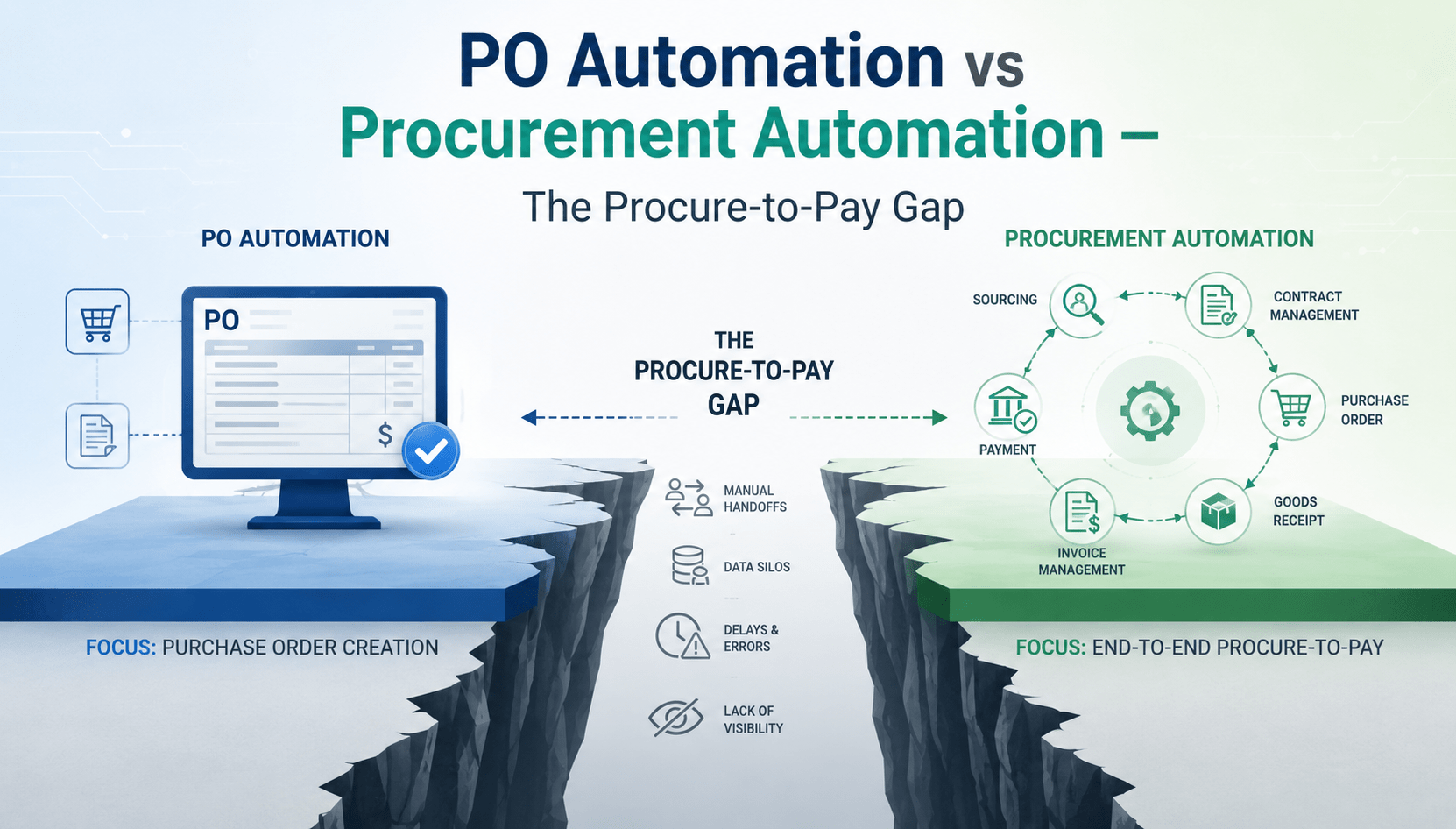
Ask the CFO or CPO at any Indian company between INR 100 crore and INR 2,000 crore in revenue whether procurement is automated. Most will say yes and point to the ERP - SAP, Oracle, Microsoft Dynamics, Tally Prime, Zoho Books, depending on what runs the company. They will describe the PO approval workflow - multi-level routing, delegation handling, escalation rules, audit trail, the digital record in the ERP. By the standard vocabulary of finance and procurement vendors, all of this counts as procurement automation.
It does not. Or rather - it is automation of one stage of procurement, applied to a cycle that has multiple stages. The vocabulary lag is producing buying decisions that miss the actual category of capability the modern procure-to-pay function needs.
What ERP PO approval workflow actually does
PO approval workflow is a workflow tool for one stage of procurement. The purchase request gets formalised into a PO, the PO routes through configured approval levels based on amount and category, approvers click approve or reject in the ERP or via email, the PO becomes valid once all approvals complete, and the audit trail captures the decisions.
This is real automation of a real stage. Multi-level approval routing replaces email chains. Delegation respects who is on leave. Escalation handles unresponsive approvers. The audit trail satisfies internal and external auditors. The PO approval workflow does its narrow job well in most Indian ERP deployments.
The narrow job is one stage of an eight to ten stage procure-to-pay cycle. Intake, vendor discovery, RFx, contract negotiation, PO generation, PO approval (the stage the ERP automates), PO transmission, goods or services receipt, invoice receipt, three-way matching, GST and TDS handling, payment release, and downstream spend analytics. The ERP automates one of these stages. The other stages remain manual or partially automated through email and Excel.
What procurement automation actually does
Procurement automation is the end-to-end orchestration of the full procure-to-pay cycle. Six capabilities working together - intelligent intake, vendor discovery and evaluation, contract intelligence, PO and approval orchestration, invoice and three-way matching, spend analytics with maverick detection. The ERP-based PO approval is one of the six capabilities, not the whole.
Critically, the ERP stays. Procurement automation is not an ERP replacement. The SAP, Oracle, or Tally instance continues to be the system of record for transactional data. The automation sits above the ERP as the orchestration layer, integrating bi-directionally, and adds the intelligence layer the ERP does not provide. The PO approval workflow inside the ERP continues to operate; procurement automation feeds context into it from upstream and acts on output from it downstream.
Why the vocabulary confusion persists
Three reasons specific to the Indian finance and procurement market.
ERP vendor positioning. The major ERP vendors describe their PO approval workflow as 'procurement automation' in marketing materials and in implementation kick-off documents. The CFO buying into an ERP implementation is told the procurement function will be automated. Post-deployment, the CFO has PO approval automation. The vocabulary set the expectation; the delivery met the narrow vocabulary; the broader expectation went unmet.
Procurement consulting frames PO approval as the deliverable. Procurement transformation consultants often scope ERP-based PO approval as the primary procurement deliverable. The other capabilities - intake intelligence, contract management, spend analytics - get scoped as 'phase 2' or 'future state' and rarely get delivered. The phase 1 PO approval gets delivered and ticked off as procurement automation.
Finance leadership inherits the 2010 definition. Many Indian CFOs and finance heads came up through the ERP implementation era when PO approval workflow was a meaningful productivity step from email chains and paper. The mental model anchors there. The 2026 procurement automation capability sits outside that mental model unless someone forces an update.
What the gap costs
Four costs a CFO can quantify if they look.
Cycle time as working capital impact. The 6 to 10 week procure-to-pay cycle in companies with only PO approval automated means significant working capital tied up in procurement inefficiency. Goods needed in week one don't arrive until week four. Vendor invoices for goods received in week four don't pay until week ten. The working capital impact compounds across hundreds of transactions monthly. Cycle time compression to 2 to 4 weeks releases the working capital.
Maverick spend as direct cost. Maverick spend running 15% to 35% of total spend, paid at rates 8% to 25% above contract rates, produces direct cost leakage on the order of 2% to 8% of total procurement spend. For an INR 100 crore procurement budget, this is INR 2 to 8 crore annually paid above what negotiated rates would have delivered. Most of this leakage is invisible without spend analytics.
Compliance exposure as audit and statutory risk. GST input credit leakage, TDS errors, MSME 45-day breaches, sector regulator violations - most of these stay invisible until an audit or a regulatory inspection surfaces them. The cost is unpredictable and often substantially larger than the apparent savings of staying on email and Excel for these compliance functions. The risk-adjusted cost of compliance gaps is one of the strongest cases for procurement automation that most CFO presentations skip.
AP team capacity as opportunity cost. Accounts payable teams handling three-way matching, GST reconciliation, TDS calculation, and MSME tracking manually are doing work that automation would handle. The team time is the visible cost; the work the team is not doing - vendor relationship management, payment optimisation, treasury alignment, supplier rationalisation — is the opportunity cost that often exceeds the visible cost.
Naming the vocabulary gap correctly - ERP PO approval as one stage versus procurement automation as end-to-end orchestration - is the precondition for the buying decision that addresses these costs. As long as the CFO treats them as the same category, the buying decision will be smaller in scope than the procure-to-pay function actually needs.
About the Author

Himani Chaudhary
Ready to orchestrate your AI future?
Converiqo AI helps you design, deploy, and scale automation workflows that move your business faster, leveraging specialized solutions like our AI bot platform for lead generation, customer self-service AI bot platform, employee self-service AI bot platform, retail omnichannel automation, and our detailed guides on how agentic AI bot platforms work in enterprises and cost structure of enterprise AI bot platforms. Connect with our team to see the platform in action and co-create the next chapter of intelligent operations.
Read More Blogs
Discover more insights and product updates curated by the Converiqo AI team.
Real ROI of Field Force Automation - Beyond the Activity Dashboard
Four metrics that show real field force automation ROI in India - productivity, data reliability, throughput, and field attrition - not just the activity dashboard.
Beat Planning Is the Highest-Leverage Field Force Capability - Here Is Why
Beat planning decides coverage, call frequency, and whether field time is productive. Why it is the single highest-leverage field force automation capability.
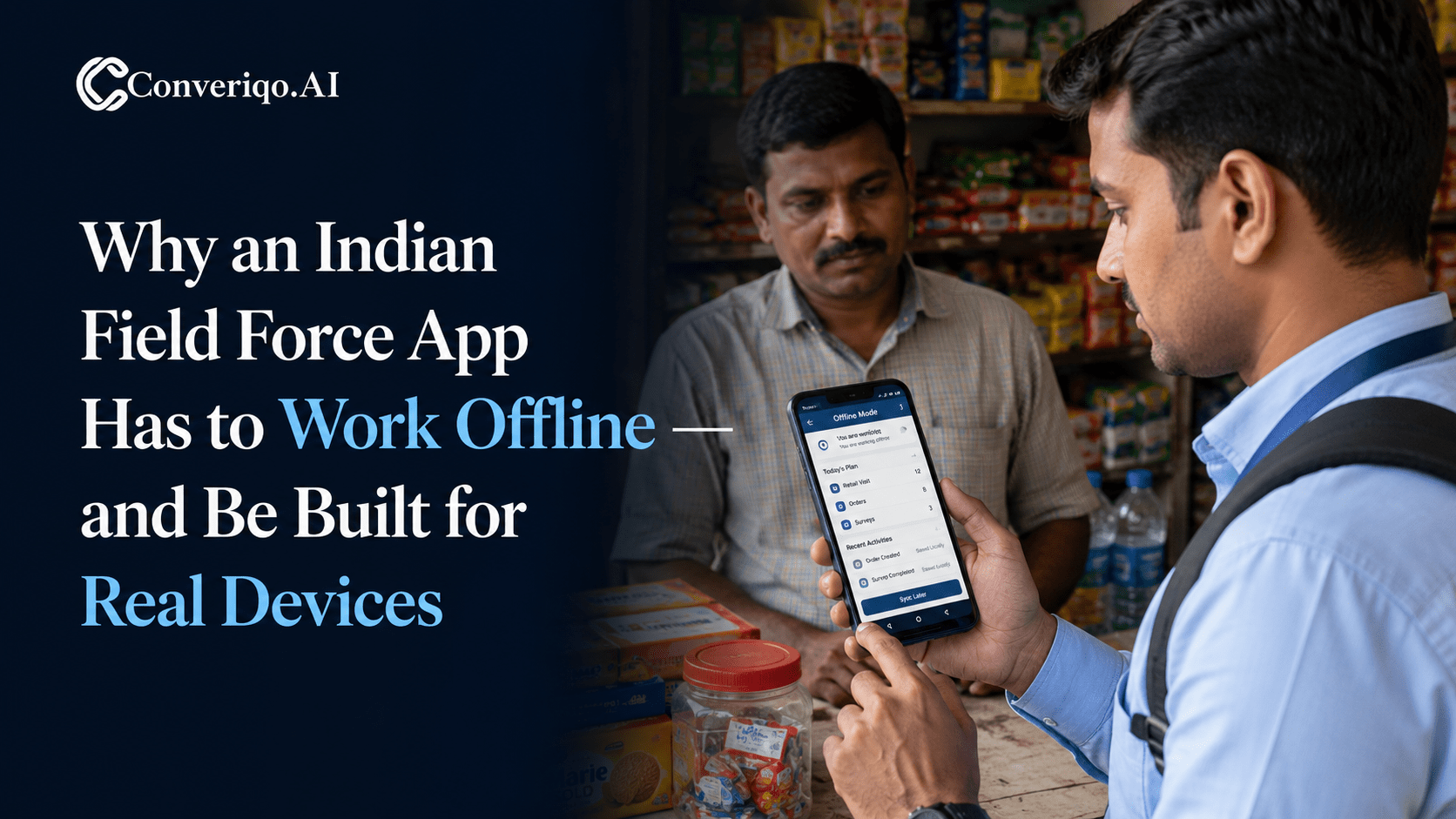
Why an Indian Field Force App Has to Work Offline - and Be Built for Real Devices
Field work in India happens where connectivity is intermittent. A field force app that assumes constant connectivity fails exactly where field work is done.