Most Indian businesses run lead nurture on email because that is what every marketing automation tutorial teaches.
Email works in markets where email is the primary professional channel. In India, for most consumer-facing businesses and many B2B ones, it is not.
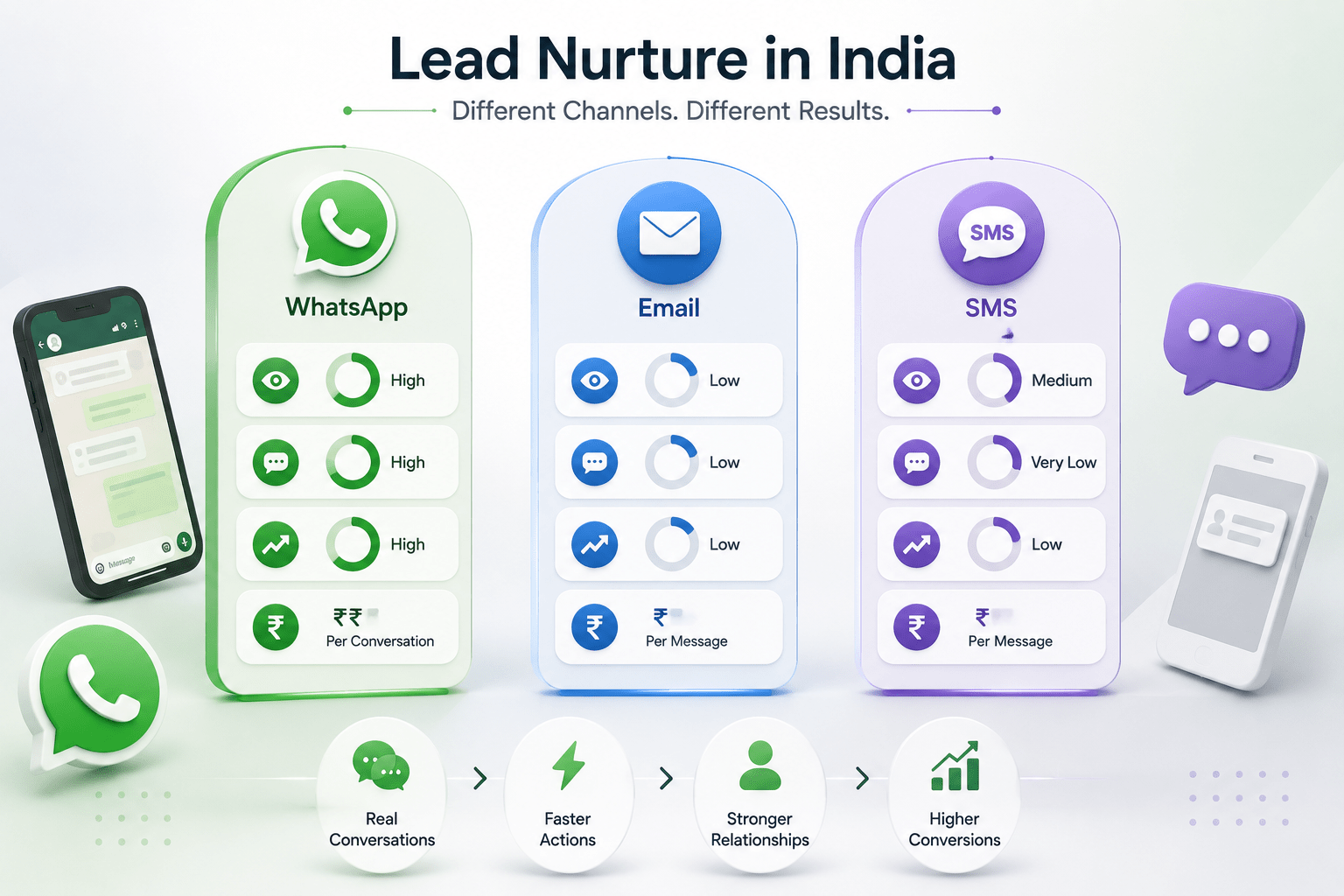
Here is the honest comparison of WhatsApp, email, and SMS for lead nurture in India - open rates, conversion, cost, what each is actually good for.
Open rates
Email open rates in India - typically 15 to 25 percent for transactional email, lower for marketing email. Drop further if the email lands in promotions or spam.
SMS open rates in India - high in absolute terms because of the notification, but most marketing SMS is now ignored. The signal-to-noise ratio on SMS marketing has collapsed.
WhatsApp message open rates in India - typically much higher than email, because WhatsApp notifications interrupt the user in a more attention-getting way and because the inbox is less cluttered.
The absolute numbers vary by industry and audience, but the directional reality is consistent - WhatsApp messages get seen, email often does not, SMS marketing is mostly dead.
Response rates
Reply rates on lead nurture -
Email - reply rates in the low single digits even for personalised nurture.
SMS - virtually no replies. SMS is one-way in practice.
WhatsApp - reply rates can be dramatically higher because the format invites conversation and customers are already comfortable replying on WhatsApp to friends and family.
The reply rate gap is what makes WhatsApp a fundamentally different nurture channel. Email nurture is broadcast. WhatsApp nurture is conversation.
Conversion to meaningful action
Booking a call. Visiting a store. Completing a purchase. Scheduling a demo.
Email - drop-off at every step. Click email, land on page, find action, complete action. Four steps, each losing customers.
SMS - similar drop-off, plus the cumbersome nature of clicking through SMS.
WhatsApp - the action can happen in the same conversation. Book a slot from a Flow. Complete a purchase via UPI. Schedule a callback. One step instead of four.
Costs
Email - close to zero per message at scale. Cost is in the platform (Mailchimp, Sendinblue, MoEngage) and the design and copy work.
SMS in India - paise per message, but volumes need to be high for it to compete on engagement. Marketing SMS rules under TRAI's DLT framework have made it more cumbersome and less effective for many use cases.
WhatsApp - per-conversation pricing, more expensive per message than email but the conversion economics often justify the cost. A WhatsApp conversation that produces a booking is far more valuable than 50 emails that produce nothing.
Where each channel still wins
B2B sales to senior decision-makers who actually read email. Long-form content that needs to be referenced later (proposals, whitepapers, case studies). Distribution lists where opt-in via WhatsApp is unrealistic. Markets outside India where email penetration is higher.
SMS
Transactional notifications (OTP, payment confirmation, delivery status) - though WhatsApp templates are increasingly preferred even here. Reach to customers without smartphones.
Consumer-facing lead nurture in India across nearly all categories. SMB and mid-market B2B with non-technical buyers. Re-engagement and relationship building. Anything where conversation is part of the conversion.
The multi-channel reality
Most well-run Indian businesses do not pick one channel - they use each one for what it is best at.
WhatsApp for active lead nurture, re-engagement, and conversational close.
Email for long-form content, B2B sales to senior buyers, and archival of detailed proposals.
SMS for compliance-required notifications and for customers who specifically opt out of WhatsApp.
The mistake - running everything on email because that is what the marketing team is used to. The other mistake - running everything on WhatsApp because someone read that WhatsApp open rates are 90 percent. Different stages of the funnel benefit from different channels.
Why most Indian businesses are still over-invested in email
Three reasons that have nothing to do with what actually works.
Habit. The marketing playbook from 5 years ago put email at the centre. Updating the playbook is slow.
Tool comfort. Mailchimp, MoEngage, and similar tools are familiar. WhatsApp automation platforms are newer and require learning.
Cost myth. The misconception that WhatsApp is much more expensive per message than email, without accounting for the dramatically different conversion economics.
The shift to make
Stop running lead nurture by channel out of habit.
Start picking the channel that matches the stage of the funnel, the audience, and the action you are trying to drive.
For most Indian businesses, that means more WhatsApp than they currently use, less email than they currently use, and SMS reserved for what only SMS can do.
About the Author

Md Ashik Alam
Ready to orchestrate your AI future?
Converiqo AI helps you design, deploy, and scale automation workflows that move your business faster, leveraging specialized solutions like our AI bot platform for lead generation, customer self-service AI bot platform, employee self-service AI bot platform, retail omnichannel automation, and our detailed guides on how agentic AI bot platforms work in enterprises and cost structure of enterprise AI bot platforms. Connect with our team to see the platform in action and co-create the next chapter of intelligent operations.
Read More Blogs
Discover more insights and product updates curated by the Converiqo AI team.
Real ROI of Field Force Automation - Beyond the Activity Dashboard
Four metrics that show real field force automation ROI in India - productivity, data reliability, throughput, and field attrition - not just the activity dashboard.
Beat Planning Is the Highest-Leverage Field Force Capability - Here Is Why
Beat planning decides coverage, call frequency, and whether field time is productive. Why it is the single highest-leverage field force automation capability.
Why an Indian Field Force App Has to Work Offline - and Be Built for Real Devices
Field work in India happens where connectivity is intermittent. A field force app that assumes constant connectivity fails exactly where field work is done.