A New Era of Business Orchestration
In 2025, over 73% of enterprises globally are actively investing in AI-driven workflow automation, according to Gartner’s State of Automation Survey. Yet fewer than 25% have achieved full orchestration across departments. The gap lies not in ambition but in integration.Traditional businesses still juggle dozens of siloed tools: CRM, HR, helpdesk, procurement, and analytics systems that rarely “talk” to each other.AI automation workflows represent the next leap forward: where every process, conversation, and decision flows seamlessly through one intelligent fabric.
What Are AI Automation Workflows?
Simply put, they are connected digital pathways powered by AI models that understand context, predict intent, and trigger the next logical action automatically .Imagine a sales inquiry entering your website chat an AI assistant identifies the buyer type, fetches relevant inventory, assigns the lead, schedules a callback, and notifies the sales manager.No human intervention, yet full human control.Modern platforms now fuse communication APIs, predictive analytics, and workflow logic into cohesive orchestration layers that deliver measurable results.
 Why This Matters Now
The business landscape is transforming faster than ever:
- Employees spend 58% of their time on “work about work”(Asana, 2024).
- 75% of buyers expect near-instant responses, even for complex services (Salesforce State of the Connected Customer, 2024).
- AI-assisted teams deliver 30–50% faster cycle times across core processes (McKinsey Automation Benchmark, 2025).
In this environment, manual workflows aren’t just inefficient they’re invisible losses in time, morale, and opportunity.
Key Pillars of Intelligent Automation
1. Context-Aware Data Flow
AI workflows don’t merely route information they interpret it. A customer query isn’t a ticket; it’s an intent signal that cascades through CRM, campaign, and support pipelines instantly.
2. Real-Time Decision Engines
Predictive analytics no longer live in dashboards they operate within every transaction, guiding next actions automatically.
3. Unified Communication Layer
From chat to voice to email, communication channels converge. The system “knows” where each stakeholder is best reached, reducing latency and error.
4. Cognitive Feedback Loops
Workflows learn continuouslyrecognizing what succeeded, where delays occur, and which automations need recalibration.
How Industries Are Harnessing It
1. Real Estate
Builders are unifying lead capture, campaign response, and site follow-up through AI.
- Response time reduction: from 14 hours to under 15 minutes.
- Sales velocity gain: 27% higher conversions after automated follow-ups. AI-driven orchestration brings marketing, CRM, and site teams under one command layer bridging physical and digital sales journeys.
2. Hospitals & Healthcare Networks
Healthcare automation saves administrative staff up to 2.5 hours per patient episode. Intelligent schedulers now coordinate appointments, insurance verification, and follow-up communication automatically.
AI workflows connect teleconsults, pharmacy orders, and diagnostic updates into a single patient timeline minimizing manual data errors by 80%.
3. Diagnostic Labs
Automation enables faster sample tracking, digital test reports, and dynamic inventory forecasting. AI reminders ensure patients receive results instantly while procurement systems reorder reagents before shortages occur.
4. Schools & Colleges
Institutions are adopting smart workflows for admissions, attendance, and communication.AI engines personalize student engagement, while staff automate everything from fee reminders to parent-teacher scheduling.The result? A measurable 40% reduction in administrative overhead and better student retention through proactive communication.
5. Co-Working Spaces
Flexible work environments thrive on real-time orchestration: visitor management, billing, and community engagement in one system.AI workflow logic predicts usage spikes, auto-allocates rooms, and integrates billing instantly with finance tools.
6. Manufacturing & Industry 4.0
Production lines are increasingly data-synced. AI monitors machine data, triggers predictive maintenance, and connects procurement to production readiness.Factories adopting workflow automation report 20–25% reduction in downtime and tighter supplier coordination.
7. Retail & E-Commerce
Customer expectations demand omnichannel responsiveness. AI automation now links product catalogs, customer chats, shipping updates, and marketing triggers.
- Abandoned cart recovery rates: ↑35%.
- Customer support cost reduction: ↓45%.
Retailers using unified AI workflows turn real-time browsing data into tailored engagement.
8. NBFCs & Fintech
Fintech players integrate credit scoring, KYC verification, and loan disbursement into end-to-end AI logic.By automating document verification and customer onboarding, loan processing times shrink from days to minutes, ensuring compliance and customer delight.
9 Government & PSU
Public bodies increasingly adopt automation for citizen services license renewals, application tracking, grievance redressal all powered by conversational AI interfaces.Workflow automation ensures transparency, audit trails, and measurable service timelines.
10. Utilities & Energy
Smart grids and water utilities depend on real-time orchestration between sensors, billing, and support systems.
Predictive workflows detect faults before customers call, reroute crews, and issue alerts autonomously enhancing uptime and trust.
11. Logistics & Field Services
Fleet tracking, delivery confirmation, and client communication are now unified.
AI-driven dispatchers cut idle time by 18–22%, while auto-escalation workflows handle exceptions without human intervention.
12. IT & Software Services
Technology firms use automation to handle internal tickets, project sprints, and hiring pipelines.A single AI workflow connects project updates, HR onboarding, and finance reports reducing cross-departmental friction and improving delivery timelines.
Functional Dimensions of AI Workflows
Customer Engagement
Conversational interfaces powered by large language models handle FAQs, feedback, and escalations instantly cutting dependency on call centers by up to 60%.
Sales Acceleration
Predictive scoring and automated nurture sequences help teams focus on high-probability prospects. Businesses adopting AI sales orchestration see 15–25% higher closure rates.
Employee Enablement
Automation reduces HR load onboarding, attendance, and payroll sync run autonomously while managers focus on culture and retention.
Procurement & Vendor Collaboration
Smart vendor scoring, AI-led negotiations, and automated purchase orders prevent supply bottlenecks and cost overruns.
Support & Service Experience
AI ticket routing and resolution systems respond in real time, ensuring every issue finds the right owner.
Data & Decision Intelligence
Integrated analytics transform every workflow into a feedback system executives can query “why delays rose this week” and receive natural-language insights instantly.
The Human + AI Balance
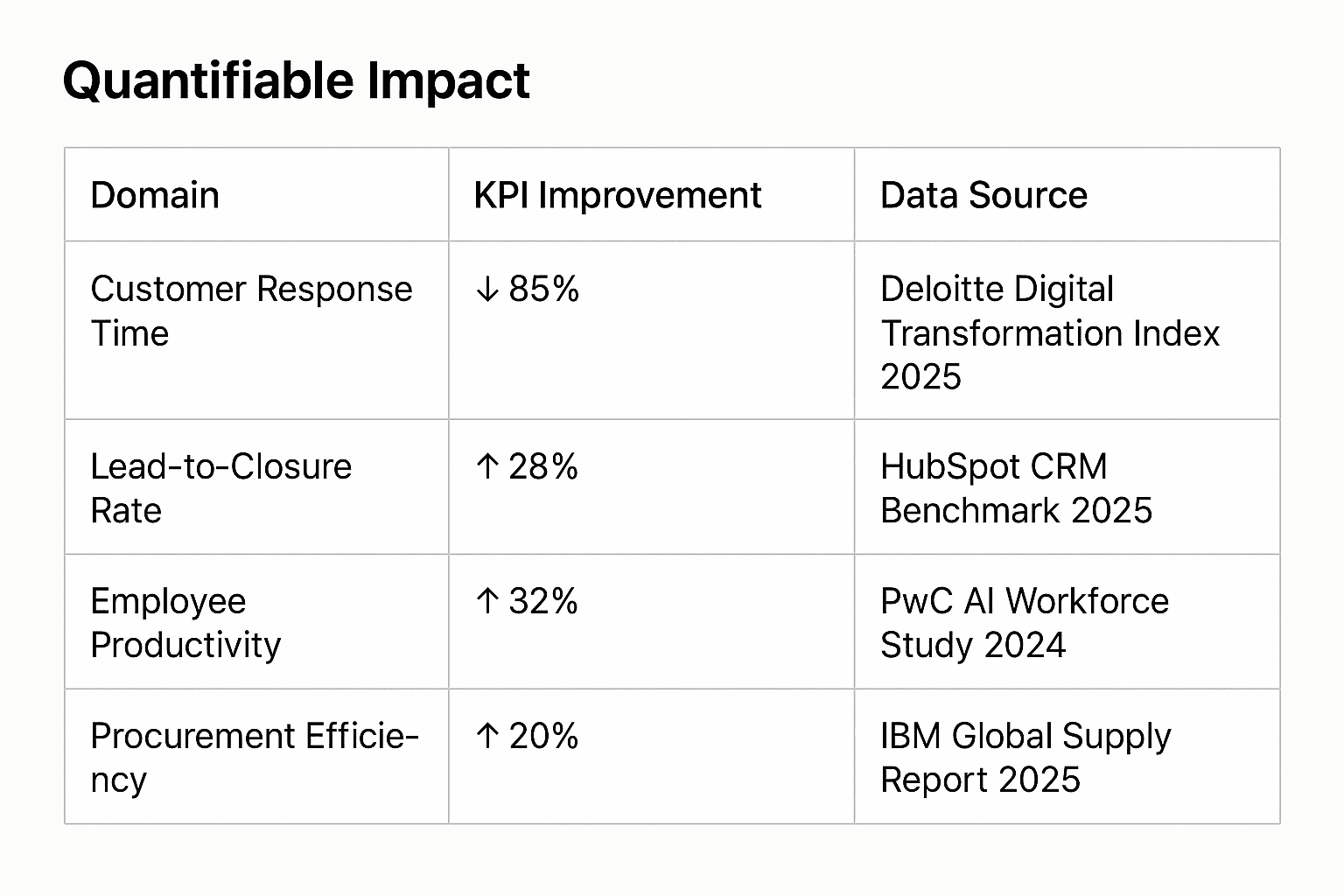
The misconception is that automation replaces people. In reality, it liberates them.AI workflows remove repetitive clutter so teams can do higher-value work strategy, creativity, and customer relationships.When data flows seamlessly, decisions become faster and employees feel empowered.A Harvard Business Review study (2025) notes that organizations implementing “AI with empathy” where automation augments rather than replaces show 2.4× higher employee satisfaction and 1.8× stronger innovation velocity.
The Silent Architect: Unified Workflow Platforms
The shift toward orchestration requires robust infrastructure APIs, AI reasoning, data lakes, and communication logic.This is where modern orchestration platforms quietly transform business operations behind the scenes.Solutions modeled on Converiqo.ai philosophy integrate diverse enterprise functions sales, HR, support, procurement, and analytics into a single intelligent continuum.
They don’t replace tools; they connect them.They don’t sell automation; they build coherence.By unifying workflows under one cognitive layer, such platforms let every department operate faster, cleaner, and smarter without the noise of fragmented software stacks.
Looking Ahead: The Agentic Future
As enterprises move toward agentic architectures, workflows will no longer be linear but adaptive.AI agents will autonomously initiate, execute, and optimize processes across departments based on live data and organizational goals.By 2027, IDC predicts that over 45% of business operations in digitally mature enterprises will be executed by autonomous agents under human supervision.This future isn’t distant it’s unfolding now.Organizations embracing automation as a core mindset not as an add-on are already rewriting their playbooks for growth.
Final Thought
AI automation workflows are not about replacing human effort; they’re about redirecting it to where it matters most.Whether you’re building homes, healing patients, teaching students, or delivering parcels the backbone of modern efficiency is orchestration.And as the invisible network connecting people, processes, and possibilities, platforms designed in the spirit of Converiqo.ai are quietly shaping how businesses scale in the intelligent decade ahead.
FAQs
1. How do AI automation workflows improve business speed?
AI removes manual steps, automates repetitive tasks and routes work instantly to the right team. This eliminates delays, reduces dependency on people and ensures every process moves in real time, making operations significantly faster across all departments.
2. Which industries benefit the most from AI automation?
AI workflows support every sector real estate, healthcare, schools, e-commerce, BFSI, logistics, manufacturing and SaaS. Any business with repetitive processes, customer support needs or operational complexity can accelerate efficiency with intelligent automation.
3. Can AI reduce operational costs for growing businesses?
Yes. AI automation cuts manpower needs for routine tasks, reduces errors, speeds up workflows and lowers support load. This leads to major savings, allowing businesses to operate leaner while delivering faster, more consistent customer and employee experiences.
4. How do AI-powered workflows enhance customer experience?
AI provides instant responses, personalized updates, faster resolution and real-time self-service across WhatsApp and website channels. Customers get clarity without waiting, which improves satisfaction, reduces complaints and builds long-term trust with the brand.
5. Are AI automation workflows difficult to implement?
No. Modern AI platforms integrate quickly with CRMs, ERPs, ticketing systems and communication channels. Most businesses can deploy core automation in 7–21 days, depending on complexity, without disrupting existing workflows or teams.
6. Can AI handle cross-department workflows?
Absolutely. AI coordinates tasks across sales, support, HR, IT, logistics and finance. It assigns responsibilities, tracks SLAs, escalates delays and ensures every department works in sync-creating a unified, fast-moving operational ecosystem.
7. Does AI replace employees or support their work?
AI supports employees by taking over repetitive tasks, follow-ups, routing and data lookups. This frees teams to focus on higher-value work like strategy, creativity and customer relationships. AI enhances human productivity instead of replacing it.
To Know More Contact Us : https://converiqo.ai/contact
About the Author
Nikita Srivastava
Ready to orchestrate your AI future?
Converiqo AI helps you design, deploy, and scale automation workflows that move your business faster, leveraging specialized solutions like our AI bot platform for lead generation, customer self-service AI bot platform, employee self-service AI bot platform, retail omnichannel automation, and our detailed guides on how agentic AI bot platforms work in enterprises and cost structure of enterprise AI bot platforms. Connect with our team to see the platform in action and co-create the next chapter of intelligent operations.
Read More Blogs
Discover more insights and product updates curated by the Converiqo AI team.
Real ROI of Field Force Automation - Beyond the Activity Dashboard
Four metrics that show real field force automation ROI in India - productivity, data reliability, throughput, and field attrition - not just the activity dashboard.
Beat Planning Is the Highest-Leverage Field Force Capability - Here Is Why
Beat planning decides coverage, call frequency, and whether field time is productive. Why it is the single highest-leverage field force automation capability.
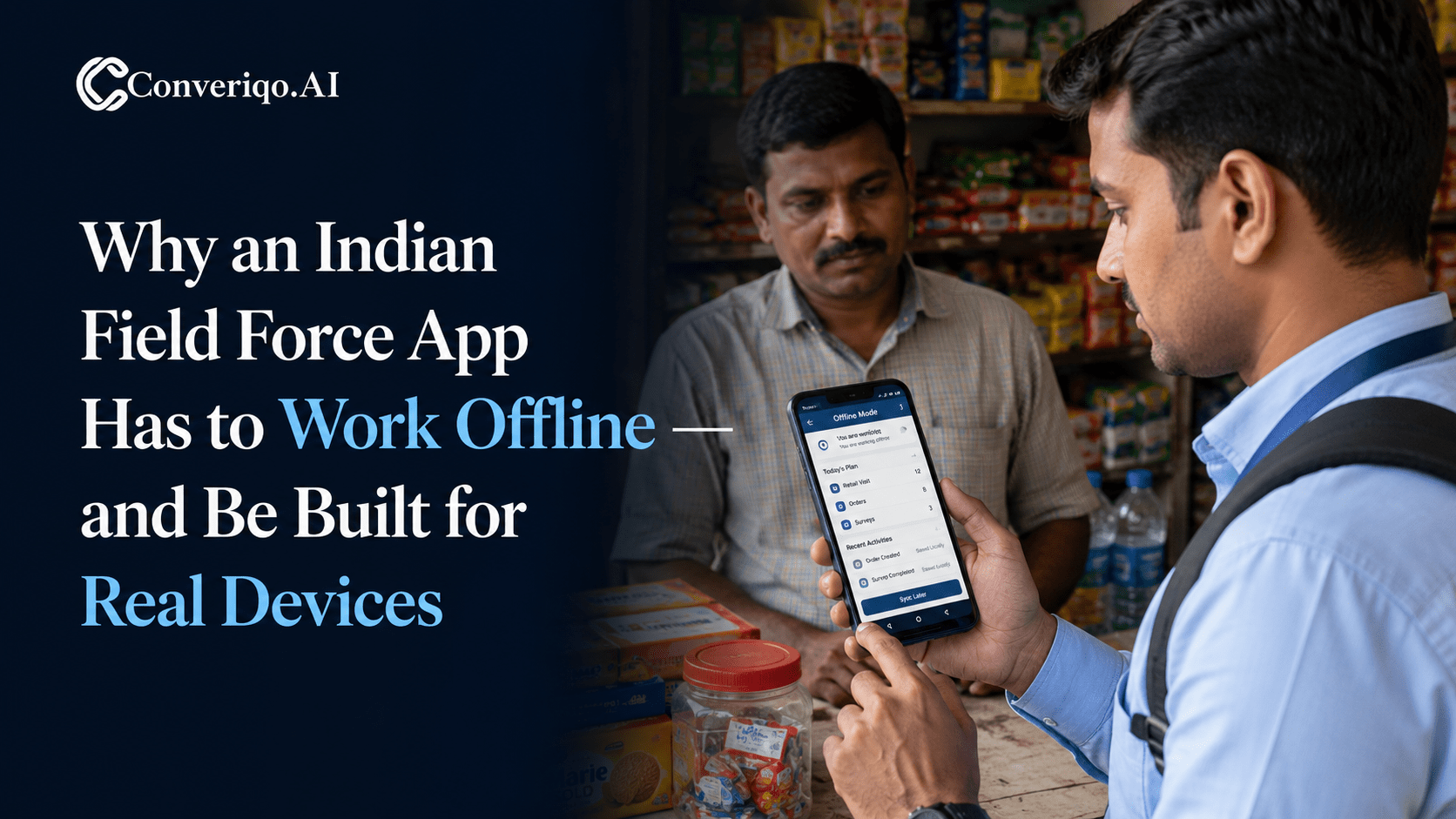
Why an Indian Field Force App Has to Work Offline - and Be Built for Real Devices
Field work in India happens where connectivity is intermittent. A field force app that assumes constant connectivity fails exactly where field work is done.