
A lot of HR teams are spending too much time on work that repeats every day. Payslip requests. Leave clarifications. Reimbursement updates. Policy questions. Letter requests. Onboarding follow-ups. Basic process guidance. None of these requests are unimportant. But when they depend too heavily on manual response, HR teams lose time that should be available for more strategic work. That is why HR request automation matters.
What repetitive HR request work looks like
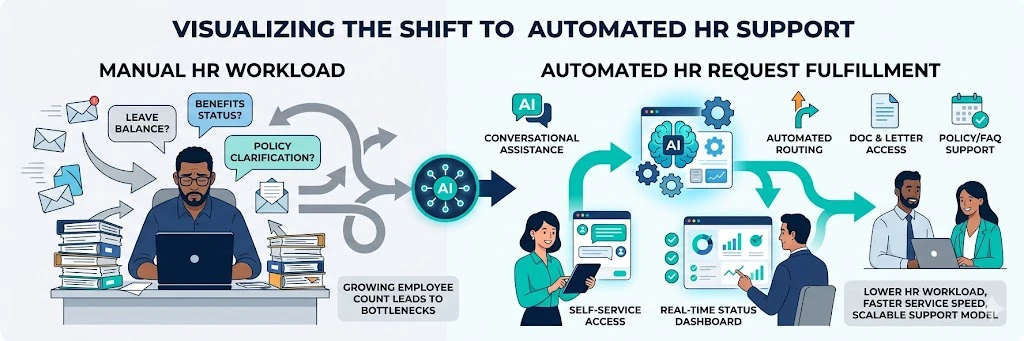
Common repetitive internal requests include:
- document and letter access
- leave and attendance questions
- benefits and reimbursement status queries
- policy clarifications
- onboarding and joining support
- workflow status checks
Why this becomes a scaling problem
As employee count grows, repetitive request volume grows faster than teams expect. If the support model stays manual, HR becomes a bottleneck.
What automation improves
HR request automation helps through:
- self-service access to common tasks
- request routing
- status visibility
- policy and FAQ support
- conversational assistance
- reminders and nudges
Why this matters commercially
The business outcome is not just fewer emails. It is lower HR workload, better service speed, and a more scalable internal support model.
Conclusion
If HR teams are overwhelmed by repetitive internal service work, the answer is usually not more manual effort. It is better workflow design.
FAQ
What is HR request automation?
HR request automation is the use of systems and workflows to handle routine employee requests such as payslips leave and reimbursements without manual intervention.
Why do HR teams struggle with repetitive requests?
HR teams struggle because many requests are handled manually through email or chat leading to repeated effort delays and increased workload.
What types of HR requests can be automated?
Common requests include document access leave queries reimbursement tracking policy questions onboarding support and workflow status checks.
How does HR request automation improve efficiency?
It reduces repetitive tasks speeds up response time improves visibility and allows HR teams to focus on higher value work.
When should a company implement HR request automation?
A company should implement it when request volumes are high response times are slow and HR teams are spending too much time on routine support tasks.
About the Author
Akanksha
Ready to orchestrate your AI future?
Converiqo AI helps you design, deploy, and scale automation workflows that move your business faster, leveraging specialized solutions like our AI bot platform for lead generation, customer self-service AI bot platform, employee self-service AI bot platform, retail omnichannel automation, and our detailed guides on how agentic AI bot platforms work in enterprises and cost structure of enterprise AI bot platforms. Connect with our team to see the platform in action and co-create the next chapter of intelligent operations.
Read More Blogs
Discover more insights and product updates curated by the Converiqo AI team.

Real ROI of Field Force Automation - Beyond the Activity Dashboard
Four metrics that show real field force automation ROI in India - productivity, data reliability, throughput, and field attrition - not just the activity dashboard.

Beat Planning Is the Highest-Leverage Field Force Capability - Here Is Why
Beat planning decides coverage, call frequency, and whether field time is productive. Why it is the single highest-leverage field force automation capability.

Why an Indian Field Force App Has to Work Offline - and Be Built for Real Devices
Field work in India happens where connectivity is intermittent. A field force app that assumes constant connectivity fails exactly where field work is done.