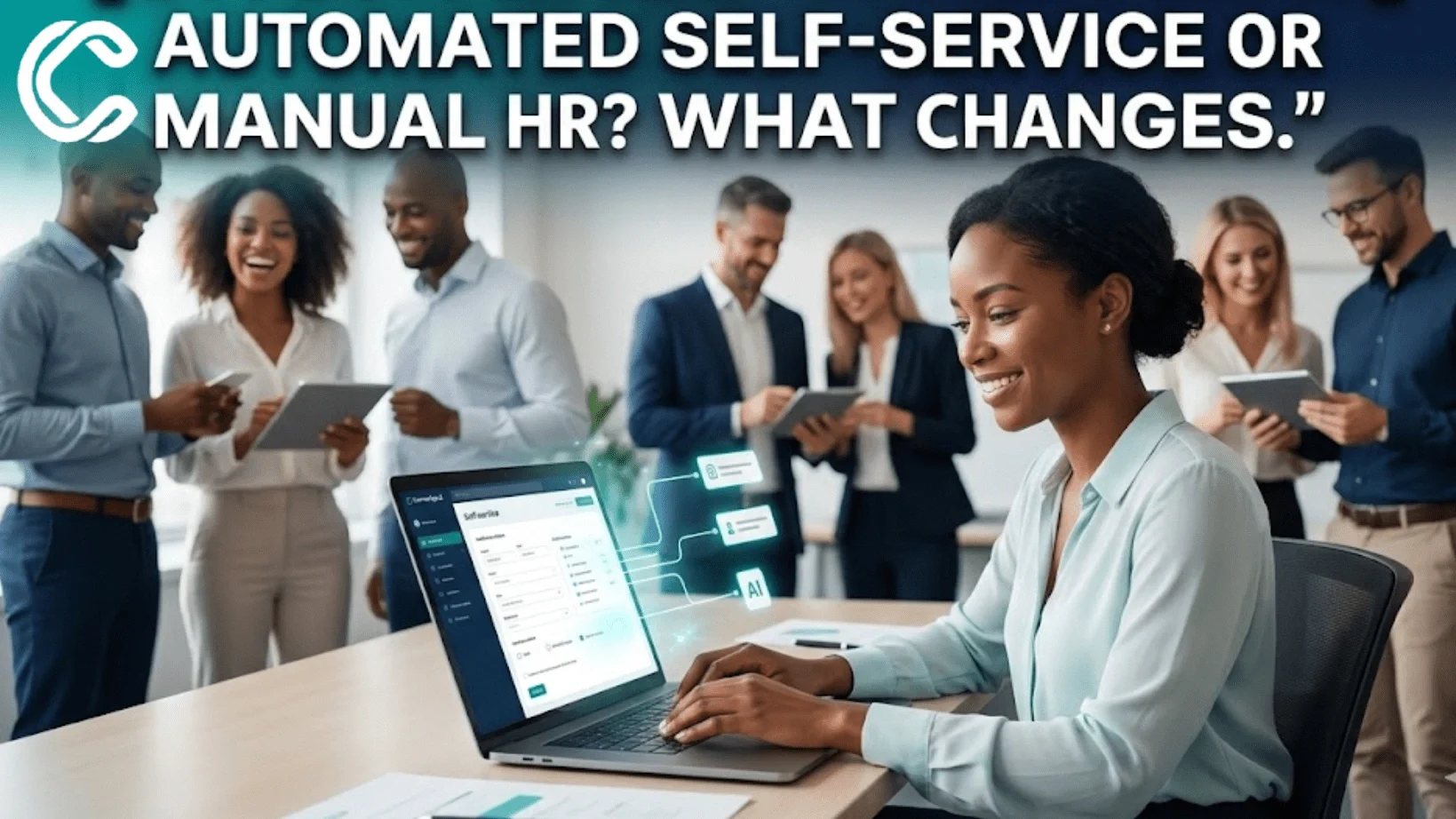
A lot of organizations still handle employee requests through email, chat messages, spreadsheets, and manual follow-up.
That often feels normal because it has been the default for years.
But it creates more internal service friction than most teams realize.
An employee needs a payslip. Someone from HR responds. An employee needs a leave clarification. Someone follows up manually. A reimbursement request is pending. The employee checks again through chat. An onboarding task is incomplete. Another reminder is sent manually.
That is how internal service becomes slower and more expensive to operate.
This is why the real comparison between manual HR request handling and employee self-service automation is not just about convenience.
It is about speed, consistency, employee experience, and internal team workload.
What manual employee request handling usually looks like
Manual handling often depends on:
- employees knowing who to contact
- HR or ops teams responding to repetitive queries
- approvals happening through email or chat
- follow-ups being managed manually
- status visibility being poor
- requests being tracked inconsistently
This can work at low complexity.
It usually breaks as employee count, request volume, and workflow diversity increase.
What employee self-service automation changes
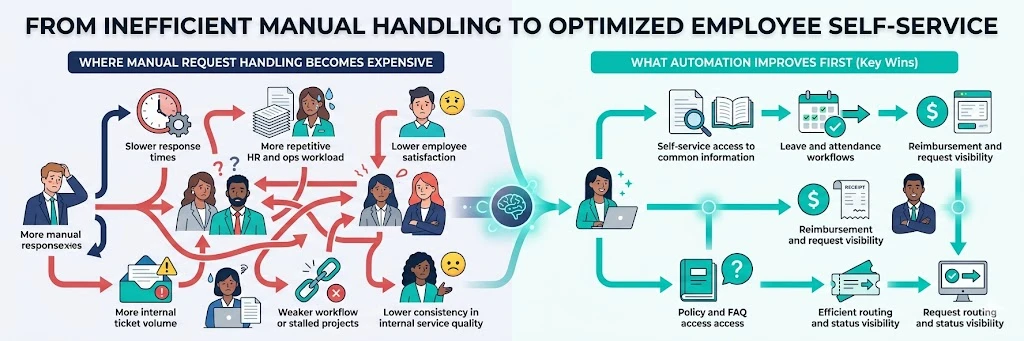
Employee self-service automation improves the workflow by creating structured paths for routine employee needs.
That can mean:
- direct access to documents and information
- leave, attendance, and reimbursement workflows
- policy access and acknowledgments
- onboarding and exit task support
- internal service request routing
- mobile and conversational access for routine support
Where manual request handling becomes expensive
The cost shows up as:
- slower response times
- more repetitive HR and ops workload
- lower employee satisfaction
- more internal ticket volume
- weaker workflow completion
- lower consistency in internal service quality
What automation improves first
The best first wins usually come from:
- self-service access to common information
- leave and attendance workflows
- reimbursement and request visibility
- policy and FAQ access
- request routing and status visibility
Conclusion
Manual HR request handling is not just slower.
It is internal service friction.
Employee self-service automation changes that by turning routine requests into accessible, structured workflows.
See Employee Self-Service Automation
FAQ
What is manual HR request handling?
Manual HR request handling is when employee requests are managed through emails chats spreadsheets or individual follow ups instead of structured workflows.
Why does manual HR request handling slow down operations?
It slows down operations because it depends on human response manual tracking and repeated follow ups which increases delays and workload.
What is employee self service automation?
Employee self service automation is the use of systems and AI to allow employees to access information raise requests and complete tasks without relying on manual support.
How does self service improve employee experience?
It improves employee experience by providing faster access clearer processes and better visibility into request status.
What are the first workflows to automate in HR?
The first workflows to automate are common information access leave attendance reimbursement requests policy access and request routing.
About the Author
Priya Maurya
Ready to orchestrate your AI future?
Converiqo AI helps you design, deploy, and scale automation workflows that move your business faster, leveraging specialized solutions like our AI bot platform for lead generation, customer self-service AI bot platform, employee self-service AI bot platform, retail omnichannel automation, and our detailed guides on how agentic AI bot platforms work in enterprises and cost structure of enterprise AI bot platforms. Connect with our team to see the platform in action and co-create the next chapter of intelligent operations.
Read More Blogs
Discover more insights and product updates curated by the Converiqo AI team.

Real ROI of Field Force Automation - Beyond the Activity Dashboard
Four metrics that show real field force automation ROI in India - productivity, data reliability, throughput, and field attrition - not just the activity dashboard.

Beat Planning Is the Highest-Leverage Field Force Capability - Here Is Why
Beat planning decides coverage, call frequency, and whether field time is productive. Why it is the single highest-leverage field force automation capability.
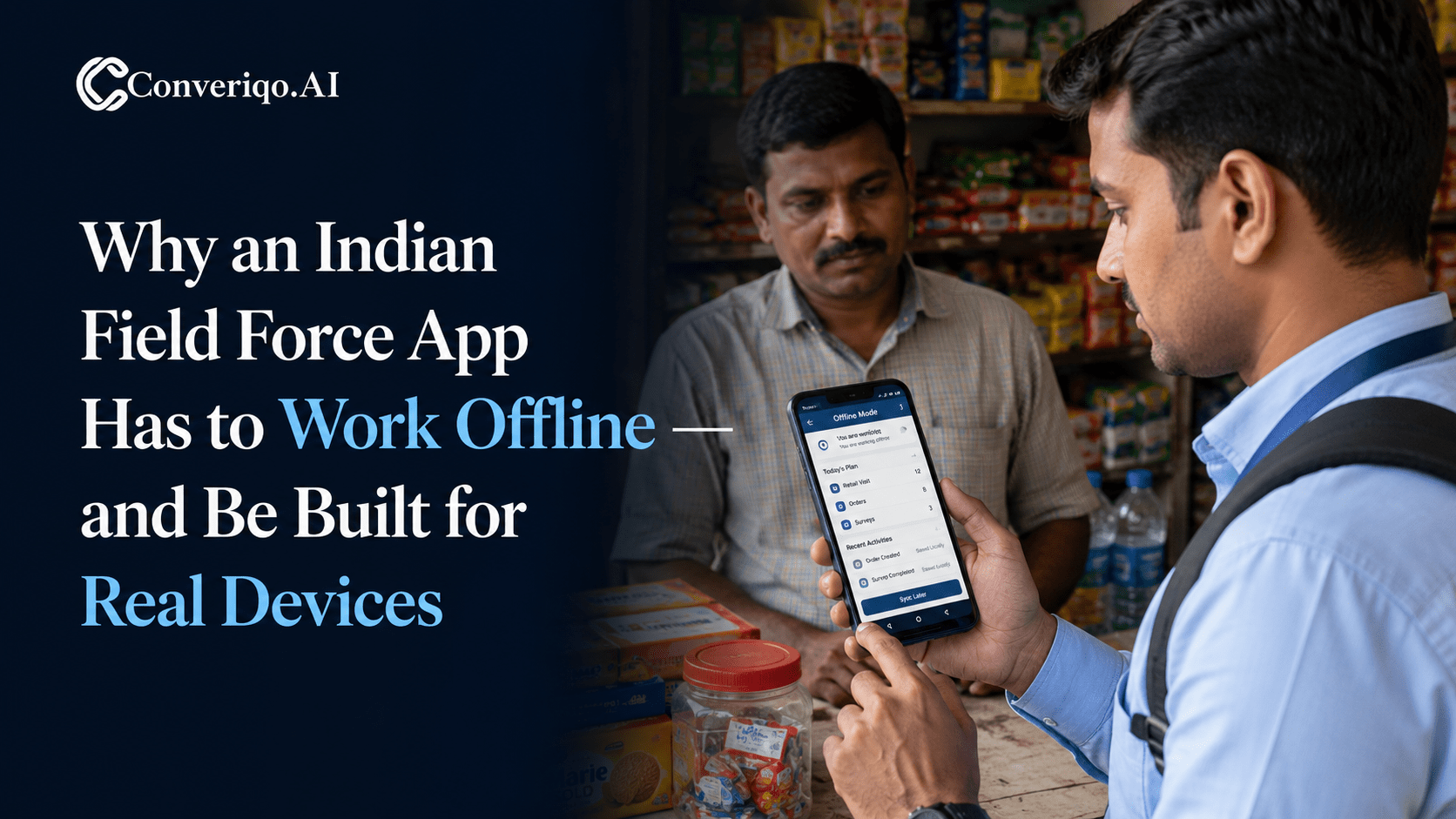
Why an Indian Field Force App Has to Work Offline - and Be Built for Real Devices
Field work in India happens where connectivity is intermittent. A field force app that assumes constant connectivity fails exactly where field work is done.