One of the biggest operational drains in onboarding is manual follow-up. Teams spend a significant amount of time chasing missing documents, incomplete forms, scheduling kickoff calls, and trying to move stalled customers forward.
As the number of customers increases, this approach becomes difficult to manage. What starts as manageable coordination quickly turns into inconsistency, delays, and internal pressure.
Automation can solve this problem, but only when designed carefully. If done poorly, it can make the experience feel rigid or impersonal. The goal is to reduce effort without reducing clarity or support.
What Makes Manual Onboarding Follow-Up Inefficient
Manual follow-up often breaks down because it depends too heavily on people rather than systems. This creates variability in how onboarding is handled.
Common issues include:
- Reminders relying on individual memory
- Different team members following up in different ways
- Lack of visibility into where customers are stuck
- Incomplete steps not being tracked clearly
- Repetition of the same messages across customers
These problems lead to internal inefficiency and create friction for customers who experience inconsistent communication.
How to Reduce Manual Follow-Up Properly
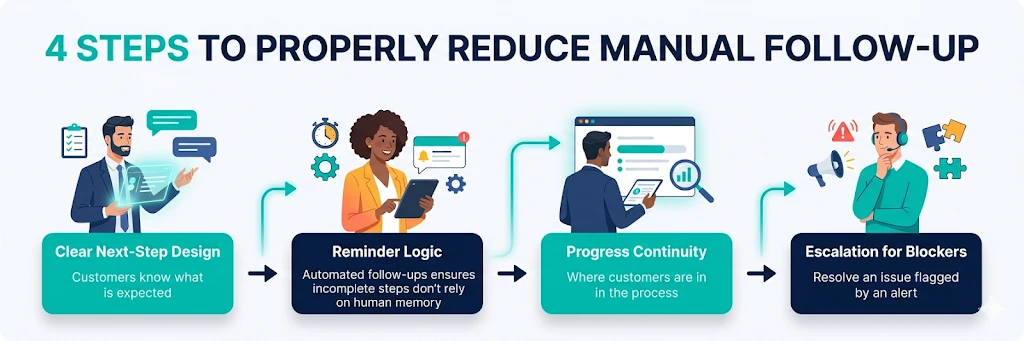
A better onboarding model focuses on structured workflows that guide customers while reducing unnecessary manual effort.
Clear Next-Step Design
Customers should always know what is expected of them. Clear instructions reduce confusion and prevent unnecessary delays.
Reminder Logic
Follow-ups should not depend on human memory. Automated reminders ensure that incomplete steps are addressed consistently and on time.
Progress Continuity
Customers should have visibility into where they are in the process. This helps maintain momentum and reduces uncertainty.
Escalation for Blockers
Not every delay requires human involvement. However, when a customer is stuck or facing an issue, the system should escalate to a human quickly and effectively.
This approach keeps the onboarding process moving while ensuring that customers still receive support when needed.
Conclusion
The goal of onboarding automation is not to reduce interaction with customers. It is to eliminate unnecessary manual effort and create a smoother, more consistent experience.
By structuring follow-up intelligently, businesses can reduce operational drag, improve onboarding speed, and deliver a better experience for both customers and teams.
CTA Section
Want to reduce onboarding follow-up without making the experience worse?
FAQs
Why is manual follow-up such a problem in onboarding?
Because it creates inconsistency, increases workload, and becomes difficult to scale as customer volume grows.
Can automation reduce manual chasing?
Yes. Automation ensures consistent reminders and follow-up without relying on manual effort.
Will automation make onboarding feel impersonal?
Not if it is designed with clarity, context, and proper escalation for human support when needed.
What should still remain human-led in onboarding?
Blockers, complex issues, and relationship-sensitive interactions should always involve human support.
How can businesses balance automation and personalization?
By automating repetitive steps while keeping human intervention available for important or complex situations.