A lot of AI automation companies make the same commercial mistake.
They market the platform in broad language like:
-
automate conversations
-
streamline workflows
-
use AI across channels
-
improve efficiency with automation
-
deploy AI assistants for business
None of that is technically wrong.
But it is often commercially weak.
Why?
Because buyers do not usually wake up looking for “AI automation” in the abstract.
They are trying to solve a specific operational or revenue problem inside a specific business context.
That usually sounds more like:
-
how do we reduce missed leads for our real estate team?
-
how do we automate appointment confirmations for our clinic?
-
how do we handle admission enquiries on WhatsApp for our education business?
-
how do we reduce repetitive support requests in our internal IT desk?
-
how do we improve follow-up for our service business without adding more staff?
This is why industry-specific workflow automation matters.
It turns generic product capability into buyer-relevant business outcomes.
And that matters because broad AI positioning often creates:
-
category confusion
-
weak page conversion
-
lower demo intent
-
slower sales cycles
-
poor trust
-
weak fit perception
-
unclear ROI expectations
A strong industry workflow story helps businesses do three things better:
-
make the buyer feel immediate relevance
-
connect automation to actual operational pain
-
improve conversion quality across landing pages, demos, and pipeline
That is where vertical workflow automation becomes commercially powerful.
It is not just better messaging.
It is better go-to-market alignment.
Why generic automation positioning underperforms
A lot of companies believe broad positioning gives them a larger market.
It can.
But it often also creates weaker conversion.
Why?
Because broad positioning makes the buyer do too much interpretation work.
The buyer has to figure out:
-
whether the solution is relevant to their industry
-
whether it understands their workflow
-
whether it can handle their channel mix
-
whether the use case is realistic
-
whether the implementation path will be simple or painful
-
whether the vendor has thought through their actual problem
This creates cognitive drag.
And in AI automation, cognitive drag kills conversion.
That is why broad platform messaging often leads to:
-
interest without action
-
traffic without demos
-
calls without urgency
-
demos without clear use-case fit
-
pipeline with weak qualification
Industry-specific positioning reduces that drag.
It helps the buyer see:
-
this is for businesses like mine
-
this fits workflows I already understand
-
this solves pain I already feel
-
this looks easier to imagine deploying
-
this is closer to an outcome I care about
That is why vertical relevance matters so much.
What industry-specific workflow automation actually means
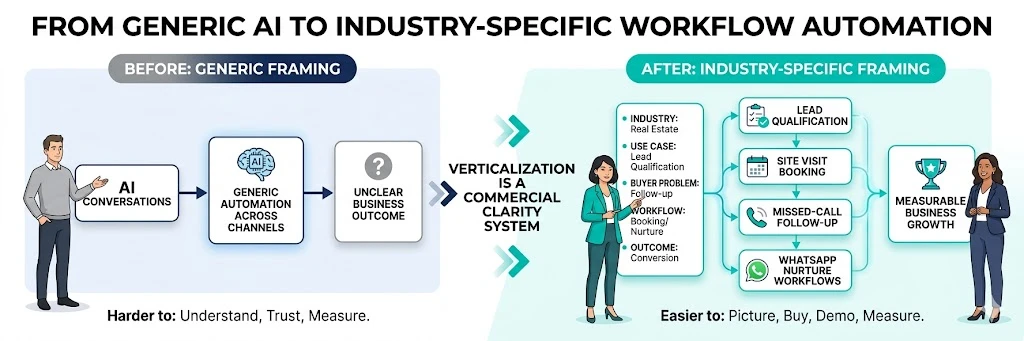
This is not just changing the headline on a webpage.
Real industry-specific workflow automation means the business is able to frame automation around:
-
an industry
-
a use case
-
a buyer problem
-
a channel mix
-
an operational workflow
-
a measurable outcome
For example:
Generic framing
Automate conversations across channels with AI.
Industry-specific framing
Automate real estate lead qualification, site visit booking, missed-call follow-up, and WhatsApp nurture workflows.
That difference matters.
The second version is easier to:
-
understand
-
trust
-
picture
-
buy
-
demo
-
measure
This is why verticalization is not just copywriting.
It is a commercial clarity system.
The biggest mistake businesses make with vertical GTM
A common mistake is trying to look relevant to every industry with one generic platform story.
That usually creates bland outcomes such as:
-
broad but forgettable copy
-
weak buyer resonance
-
generic demos
-
feature-dumping instead of use-case selling
-
low page-to-demo conversion
-
SDR conversations with weak specificity
-
slower enterprise trust-building
-
lower partner clarity
-
poor ICP prioritization
The opposite mistake is choosing industries but still talking about features instead of workflows.
That also underperforms.
The better model is:
pick a priority industry, define the workflow problem, map the channel journey, show the outcome
That is where conversion improves.
The 5 stages of a strong industry-specific automation strategy
1. Industry selection
Choose the vertical where pain, urgency, and workflow fit are strong enough to justify focused messaging.
Examples:
-
real estate
-
education
-
healthcare
-
hospitality
-
automotive
-
recruitment
-
internal IT service desk
-
local service businesses
Industry selection should reflect both demand and workflow suitability.
2. Workflow definition
Do not sell the platform first.
Sell the workflow.
Examples:
-
lead qualification
-
appointment booking
-
follow-up
-
missed-call recovery
-
support triage
-
onboarding continuity
-
document collection
-
internal request routing
This is what creates real buyer relevance.
3. Channel mapping
How does this industry actually communicate?
Examples:
-
website
-
WhatsApp
-
Instagram
-
voice
-
support desk
-
callback
-
internal ticket flow
Different industries need different channel emphasis.
4. Outcome framing
What business result matters?
Examples:
-
more booked site visits
-
faster admission response
-
fewer missed patient calls
-
lower support load
-
faster onboarding
-
fewer repetitive internal tickets
-
better lead continuity
This is what turns capability into commercial value.
5. Demo and conversion design
The workflow should then be translated into:
-
industry page copy
-
vertical offer
-
CTA
-
sales conversation
-
follow-up narrative
-
trust-building proof structure
That is what makes the vertical motion real.
Why industry-specific pages and demos convert better
A generic product page may explain the platform.
A good vertical page helps the buyer understand why the platform matters for them now.
That usually improves conversion because the page can reflect:
-
industry pain
-
familiar language
-
specific channels
-
real operational workflows
-
expected objections
-
use-case logic
-
more believable outcomes
The same applies to demos.
A generic product walkthrough forces the buyer to imagine relevance.
A vertical demo shows it directly.
That reduces time-to-belief.
And in AI sales, time-to-belief matters a lot.
Why industry workflow specificity improves sales efficiency too
This is not only a content advantage.
It also improves the sales motion.
Industry-specific workflow framing helps with:
-
better qualification
-
faster trust-building
-
easier meeting preparation
-
more relevant objections
-
more tailored demos
-
stronger stakeholder buy-in
-
better partner conversations
-
clearer implementation scoping
That means verticalization improves more than page copy.
It improves the entire commercial system.
Best industries for vertical workflow motions
The strongest industries are usually the ones where:
-
conversation volume is high
-
workflow pain is repetitive
-
response speed matters
-
booking or follow-up matters
-
support or enquiry handling is fragmented
-
channels like WhatsApp, voice, website, or internal ticketing matter
-
operational outcomes are measurable
For Converiqo-style motions, strong vertical opportunities often include:
-
real estate
-
education and admissions
-
clinics and diagnostics
-
hospitality
-
automotive dealerships
-
service businesses
-
recruitment and staffing
-
internal enterprise support workflows
-
multi-location businesses
-
consultation-led businesses
These are strong because the workflow pain is easy to explain and close to measurable outcomes.
What businesses should build first
Do not try to build 20 vertical motions at once.
The smartest first move is usually:
-
choose 1–3 strongest ICP/vertical combinations
-
define 1–2 priority workflows in each
-
build vertical landing pages
-
build vertical demo narratives
-
create vertical CTA and offer logic
-
create supporting content and outreach around those workflows
Good first vertical workflow combinations often look like:
-
Real estate → lead qualification + site visit booking + follow-up
-
Education → admissions enquiries + counselling booking + WhatsApp continuity
-
Clinics → appointment booking + reminder calls + support triage
-
IT/internal ops → repetitive internal requests + routing + self-service
These are easier to explain, sell, and demo than a generic “AI platform” story.
The difference between vertical messaging and vertical workflow GTM
This distinction matters.
Vertical messaging means changing the wording.
Vertical workflow GTM means changing the commercial story, demo structure, and conversion path around a specific industry use case.
That includes:
-
page structure
-
pain framing
-
channel logic
-
workflow example
-
CTA
-
offer
-
objections
-
demo narrative
-
post-demo follow-up
That is much more powerful than simply saying “for healthcare” or “for real estate.”
Businesses should not ask only:
“Should we create industry pages?”
They should also ask:
-
Which industry workflow is easiest to sell?
-
Which industry pain is strongest and most urgent?
-
Which channel mix is most relevant there?
-
Which outcome matters most to that buyer?
-
What would a vertical demo need to show?
-
What CTA is most natural for that use case?
That is where real pipeline value appears.
A practical industry workflow automation framework
Use this before launching or improving vertical GTM.
Industry Workflow Automation Framework
1. Choose a priority vertical
Where is the workflow pain clearest and the conversion path strongest?
2. Define the exact use case
Which workflow is being improved?
3. Identify the channel journey
How do enquiries, requests, or support interactions actually happen in that industry?
4. Translate the workflow into business outcomes
What measurable improvement matters?
5. Build the vertical conversion path
Create:
-
landing page
-
demo structure
-
CTA
-
follow-up sequence
-
sales narrative
6. Track vertical performance
Measure:
-
page-to-demo conversion
-
qualified meeting rate
-
demo-to-opportunity rate
-
sales-cycle speed
-
vertical-specific pipeline quality
This turns verticalization into a measurable GTM motion instead of a branding exercise.
Conclusion
Industry-specific workflow automation matters because buyers do not buy broad product possibility.
They buy solutions to familiar business problems.
That is why this pillar is so important.
It helps businesses:
-
improve buyer relevance
-
reduce category confusion
-
create better demos
-
improve page conversion
-
sharpen ICP focus
-
accelerate trust and pipeline quality
So before asking:
“How do we market our automation platform better?”
Ask a more useful question:
Which industry workflow can we explain so clearly that the buyer immediately sees themselves in the problem and the solution?
That is usually where the strongest conversion starts.
Want to identify the strongest industry workflow motion for your business?
FAQ
What is industry-specific workflow automation?
It is the practice of framing automation around a specific industry’s workflow, channels, pain points, and business outcomes rather than using generic AI platform messaging.
Why does industry-specific positioning matter?
Because buyers respond more strongly when the workflow, pain, and outcome are clearly relevant to their own business context.
What should businesses build first?
Usually one to three priority verticals with clear workflow use cases, landing pages, demo narratives, and CTAs.
Is this only for enterprise GTM?
No. It is valuable in SMB, mid-market, and enterprise motions wherever buyer relevance and trust matter.
How do you avoid weak verticalization?
Do not just rename the industry. Tie the story to a real workflow, real channels, real pain, and real outcomes.
About the Author
Himani chaudhary
Ready to orchestrate your AI future?
Converiqo AI helps you design, deploy, and scale automation workflows that move your business faster, leveraging specialized solutions like our AI bot platform for lead generation, customer self-service AI bot platform, employee self-service AI bot platform, retail omnichannel automation, and our detailed guides on how agentic AI bot platforms work in enterprises and cost structure of enterprise AI bot platforms. Connect with our team to see the platform in action and co-create the next chapter of intelligent operations.
Read More Blogs
Discover more insights and product updates curated by the Converiqo AI team.

Real ROI of Field Force Automation - Beyond the Activity Dashboard
Four metrics that show real field force automation ROI in India - productivity, data reliability, throughput, and field attrition - not just the activity dashboard.

Beat Planning Is the Highest-Leverage Field Force Capability - Here Is Why
Beat planning decides coverage, call frequency, and whether field time is productive. Why it is the single highest-leverage field force automation capability.
Why an Indian Field Force App Has to Work Offline - and Be Built for Real Devices
Field work in India happens where connectivity is intermittent. A field force app that assumes constant connectivity fails exactly where field work is done.