From Generic Chatbot to Industry Workflow Automation:
How Positioning Changes Conversion
A lot of automation products get commercially trapped by the word “chatbot.”
Why?
Because the buyer often hears:
-
low-value automation
-
simple FAQ tool
-
generic widget
-
limited strategic importance
That perception weakens the sales motion.
A stronger model is industry workflow automation.
That shifts the story from “a bot” to:
-
a conversion system
-
a support workflow
-
a booking engine
-
an internal ops layer
-
a vertical-ready automation path
That change in framing matters because buyers buy outcomes, not product labels.
Why this changes conversion
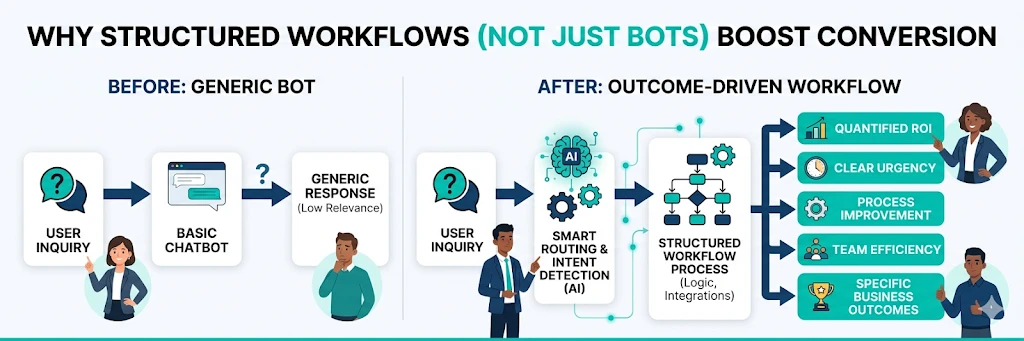
When the buyer sees a workflow instead of a generic bot, the product becomes easier to connect to:
-
ROI
-
urgency
-
process improvement
-
team efficiency
-
specific business outcomes
That is why positioning changes conversion.
Conclusion
A generic chatbot story often reduces perceived value.
An industry workflow story usually increases it.
That is why this shift matters so much.
Reposition Your Offer from Generic Bot Language to Vertical Workflow Value
FAQ
Why is “chatbot” often weak positioning?
Because buyers may associate it with low-value or narrow use cases.
What is a better framing?
Industry-specific workflow automation tied to clear business outcomes.
Does this affect demos too?
Yes. It improves how the product is introduced, explained, and evaluated.
Can this help sales velocity?
Yes. Better positioning often shortens explanation time and increases trust.
About the Author
Priya Maurya
Ready to orchestrate your AI future?
Converiqo AI helps you design, deploy, and scale automation workflows that move your business faster, leveraging specialized solutions like our AI bot platform for lead generation, customer self-service AI bot platform, employee self-service AI bot platform, retail omnichannel automation, and our detailed guides on how agentic AI bot platforms work in enterprises and cost structure of enterprise AI bot platforms. Connect with our team to see the platform in action and co-create the next chapter of intelligent operations.
Read More Blogs
Discover more insights and product updates curated by the Converiqo AI team.

Real ROI of Field Force Automation - Beyond the Activity Dashboard
Four metrics that show real field force automation ROI in India - productivity, data reliability, throughput, and field attrition - not just the activity dashboard.

Beat Planning Is the Highest-Leverage Field Force Capability - Here Is Why
Beat planning decides coverage, call frequency, and whether field time is productive. Why it is the single highest-leverage field force automation capability.
Why an Indian Field Force App Has to Work Offline - and Be Built for Real Devices
Field work in India happens where connectivity is intermittent. A field force app that assumes constant connectivity fails exactly where field work is done.