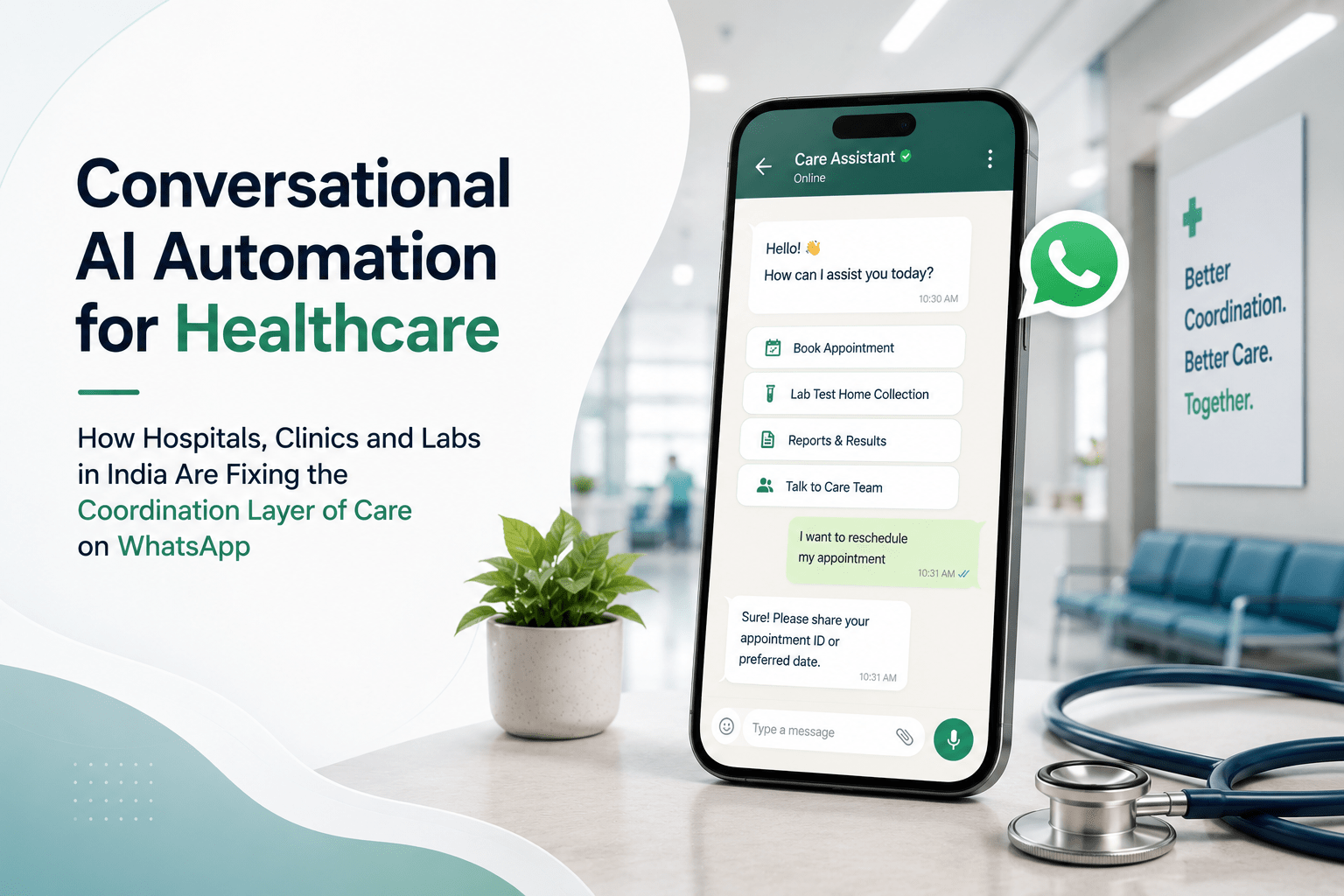
There are two layers to healthcare. There is the clinical layer - diagnosis, treatment, the judgement of trained professionals - and there is the operational layer that surrounds it: getting an appointment, being reminded of it, knowing how to prepare, receiving a report, understanding the next step, being followed up after a procedure. The clinical layer is what healthcare is. The operational layer is how patients experience it.
Ask patients in India where their healthcare experience actually breaks down, and the answer is rarely the clinical layer. It is the operational one. The phone line that does not get answered. The appointment that was hard to book and easy to forget. The report that took three calls to obtain. The follow-up that never came. The instruction that was unclear. None of these are failures of medicine. All of them are failures of coordination - and coordination, unlike medicine, is something software can carry.
This article explains what conversational AI automation means for healthcare in India in 2026. It is precise about the line conversational AI must never cross. It sets out where the technology genuinely belongs across the patient journey, why healthcare's operational layer is so broken, why WhatsApp is the right surface for fixing it, and how a hospital, clinic, lab or digital-health provider can deploy it responsibly - improving access and continuity of care without ever pretending to be a clinician.
The line conversational AI must not cross
Before describing what conversational AI should do in healthcare, it is essential to state plainly what it must not do. Conversational AI does not practise medicine. It does not diagnose. It does not interpret symptoms into conditions. It does not advise on treatment, recommend medication, or substitute for the judgement of a qualified healthcare professional. Any system that blurs this line is not an efficiency tool; it is a safety risk, and it should be rejected on that basis alone.
What conversational AI does in healthcare is everything around the clinical encounter. It helps a patient reach care, prepare for it, receive what the provider has issued, and stay connected to the care plan afterwards. It is a coordination layer, a logistics layer, an access layer, an information-delivery layer. It carries the instructions, reports and reminders the provider has already created - it does not create clinical content of its own.
Holding this line is not a limitation to apologise for. It is the foundation of responsible, deployable healthcare conversational AI - and, conveniently, the operational layer it is confined to is exactly where the largest patient friction and the largest provider revenue leakage actually sit. The boundary and the opportunity are the same place.
Conversational AI does not practise medicine. It removes everything that gets in the way of medicine. Hold that line and the rest of this is safe, valuable, and overdue.
Why healthcare's operational layer is broken
Healthcare providers in India are not careless about patient experience. They are overwhelmed by the operational volume of it - and the conventional tools for handling that volume were never adequate.
The phone line cannot absorb the demand
For most hospitals and clinics, the patient's primary channel is still a phone number. It is staffed by a finite number of people, open for finite hours, and capable of one conversation at a time per line. Against the volume of a busy provider, that means busy tones, long holds, calls that ring out, and a front desk forced to choose between the patient on the phone and the patient at the counter. The channel itself is the bottleneck.
Appointments are made manually and forgotten easily
Booking typically requires a call during working hours, and once booked, an appointment is easy to forget. There is no low-effort, automatic way to remind every patient, confirm attendance, and offer the slot to someone else when a patient cannot come. The result is the no-show - empty clinical capacity that was paid for and not used.
Reports and results sit waiting to be collected
Diagnostic results and reports are frequently delivered by making the patient come back or call repeatedly. The last mile of diagnostics - getting the result reliably and conveniently into the patient's hands - is often the slowest and most frustrating part of the whole episode.
Follow-up depends on the patient remembering
After a consultation, procedure or discharge, continuity of care frequently rests entirely on the patient: to remember the follow-up, to refill the prescription, to come back for the review. Providers rarely have the operational capacity to actively shepherd every patient through the care plan, so adherence quietly leaks - with real clinical and commercial consequences.
Every one of these is an operational failure, not a clinical one. And every one is the kind of high-volume, repetitive, time-sensitive coordination work that conversational AI is built to carry.
Where conversational AI fits - the patient journey
The clearest way to see the opportunity is to follow a patient through an episode of care, because conversational AI has a defined, non-clinical role at every stage.
Discovery and booking
A patient who wants an appointment should not have to wait for a phone line to be free. A conversational agent lets them request, book and reschedule an appointment in a WhatsApp conversation, at any hour - choosing a department, a doctor, a date and a slot - and confirms it instantly. The front desk is freed from being a switchboard.
Pre-visit preparation
Once an appointment is booked, the patient often needs to do something to prepare - fasting before a test, carrying particular documents, arriving early, completing a form. A conversational agent delivers these provider-issued instructions clearly and in good time, and answers the practical questions patients have about their visit. A well-prepared patient means a smoother, faster clinical encounter.
Reminders and confirmation
Ahead of the appointment, the agent sends timely reminders, lets the patient confirm or cancel with a tap, and - when a patient cannot attend - surfaces that the slot is free in time for it to be reused. This single capability is the most direct, most measurable win in healthcare conversational AI, and it has its own section below.
Visit-day coordination
On the day, the agent can help with arrival logistics, queue and wait-time information, and the small wayfinding and process questions that otherwise land on the front desk - making the in-person experience calmer for the patient and lighter for staff.
Reports and results
When the provider has issued a report or result, the agent delivers it conveniently and securely into the patient's WhatsApp, with the provider's guidance on next steps attached. The patient does not have to chase it. Crucially, the agent delivers and explains the logistics of the report; it does not interpret the clinical findings - that remains with the clinician.
Follow-up and adherence
After the encounter, the agent supports continuity of care: follow-up appointment reminders, prescription-refill nudges, post-procedure and post-discharge check-in messages that route any concern straight to the provider's care team. It is the operational memory that keeps a patient connected to a care plan the clinician designed.
Re-engagement and preventive care
Over the longer term, with the patient's consent, the agent supports timely health-check reminders, screening and vaccination prompts, and relevant preventive-care outreach - helping a provider keep a population engaged rather than only treating episodes as they present.
Four settings, one capability
Healthcare is not one kind of organisation, and conversational AI lands differently across its main settings. A serious deployment is specific about which one it is built for.
Hospitals
Multi-specialty hospitals carry the widest operational surface - many departments, high outpatient volume, inpatient journeys, diagnostics, discharge and follow-up. The opportunity is breadth and the relief of a perpetually overloaded front desk: a single conversational layer that absorbs booking, reminders, reports and follow-up coordination across the whole institution.
Clinics and specialty practices
Smaller clinics and single-specialty practices feel the front-desk bottleneck acutely because their staff is limited. For them conversational AI is leverage: it lets a small team behave like a much larger one, never missing a booking request or a follow-up, without adding headcount.
Diagnostic labs
Diagnostic chains are high-volume and report-centric, and their patient relationship is short and logistics-heavy: book a test, prepare for it, take it, receive the report. Conversational AI fits this end to end - particularly the report last mile, where convenient, secure delivery is a genuine differentiator.
Telemedicine and digital health
Digital-first health providers have no physical front desk at all; the conversation is the entire patient-facing experience. For them conversational AI is core infrastructure for the operational layer - coordinating consultations, delivering provider-issued information, supporting follow-up — wrapped around the clinical service that qualified professionals deliver, and operating within the applicable telemedicine practice guidelines.
The no-show problem - the clearest win
Of every use case in healthcare conversational AI, no-show reduction deserves a section of its own, because it is the most concrete, most measurable, and easiest to justify.
A no-show is a booked appointment a patient does not attend. Its cost is unusually pure: clinical capacity - a doctor's time, a slot, a room - that was reserved, paid for, and produced nothing. It is lost revenue for the provider and, often, a delayed slot for another patient who needed it. And it is common, because the conventional process gives a patient almost no support to remember and confirm.
Conversational AI attacks the no-show directly. Timely, friendly reminders ahead of the appointment. One-tap confirm or cancel, so the patient's intention is known in advance. Easy rescheduling, so a patient who genuinely cannot make it moves the appointment rather than abandoning it. And early visibility of cancellations, so a freed slot can be offered to a waiting patient instead of being lost. Because providers already measure their no-show rate, the impact of this is visible in a number the organisation already tracks - which makes appointment reminders one of the best possible first use cases for a healthcare provider. A dedicated supporting article in this cluster goes deeper on it.
Why WhatsApp fits healthcare in India
Conversational AI needs a channel, and for healthcare in India the answer is the same one patients already use for everything else. WhatsApp removes the access barrier: there is no app to download, no portal to register for, no password to recall - which matters enormously for healthcare, where the patient population spans every age and every level of digital comfort, and where the people who most need access are often the least served by a complex app.
WhatsApp also fits the content of healthcare coordination. It carries documents - reports, prescriptions, instructions, forms - both ways inside one thread. It is asynchronous, so a patient can deal with a booking or a reminder when it suits them rather than during clinic hours. The verified business identity helps a patient trust that a message about their health is genuinely from their provider, which is itself a defence against the health-related scams that prey on patients. And the conversation persists, so a patient can scroll back to an instruction, a report, or a reminder whenever they need it.
There is a discipline the channel imposes, and in healthcare it is welcome: WhatsApp business messaging runs on a permission model, with opt-in and approved templates for proactive outreach. For a sector handling sensitive personal information, communication that is consented to, expected and welcome is not a constraint - it is exactly the right default.
The privacy and trust layer
Healthcare data is among the most sensitive personal data there is, and a conversational AI deployment in healthcare must be built for that from the first design decision, in partnership with the provider's own compliance function. The following are the principles responsible deployments are built around; specifics must be validated against current regulation.
-
The no-diagnosis boundary - engineered in, not merely promised. The agent is designed and constrained so that it coordinates, informs and delivers provider-issued content, and does not offer diagnosis, symptom interpretation or treatment advice. Where a patient raises a clinical concern, the agent's job is to route it to the care team, not to answer it.
-
Consent and permission - patients are contacted because they have agreed to be, on topics they agreed to, consistent with India's data-protection regime and the permission model of business messaging. Consent is captured, recorded, and easy to withdraw.
-
Data protection and minimisation - health information is handled securely, and the agent collects and uses only what a given interaction genuinely requires. Sensitive personal data warrants the strictest minimisation.
-
Confidentiality by design - interactions are private to the patient, content is shared only with the patient and authorised provider staff, and the system is built so health information is not exposed beyond where it belongs.
-
Auditability - every automated interaction is logged and inspectable, so a provider can reconstruct what was communicated, when, and to whom.
-
Sound clinical escalation - anything that signals a clinical concern, urgency, or patient distress is routed promptly to qualified provider staff with full context. The escalation path is a core design element, not an afterthought.
Telemedicine and digital-health deployments additionally operate within the applicable telemedicine practice guidelines. As in every regulated sector, compliance here is a design input from the start and must be validated against current regulation with the provider's compliance and legal teams. A dedicated supporting article covers this layer in full.
What a healthcare conversational AI deployment needs
Moving from a promising idea to a system a healthcare provider can rely on takes more than a language model. A serious deployment needs integration with the provider's systems - the appointment and scheduling system, and the systems that hold reports and patient records - because an agent that cannot see real availability or deliver a real report is only a veneer. It needs the verified WhatsApp Business platform configured correctly, with the consent and template discipline the channel and the sector require. It needs the no-diagnosis boundary and the clinical-escalation path built into the system's guardrails, not left to chance. It needs strong privacy and security engineering appropriate to sensitive health data. It needs observability so every interaction is auditable. And it needs evaluation against real healthcare scenarios - including the difficult ones, like a patient raising a worrying symptom - measured on whether the agent coordinates correctly and escalates appropriately.
None of this is a reason to delay. It is the honest scope of doing healthcare conversational AI properly - and doing it properly is what separates a deployment that earns patient trust and clinical confidence from a chatbot that providers cannot safely stand behind.
How to start
Healthcare providers that succeed with conversational AI do not begin by trying to automate the entire patient journey. They begin with one high-volume, well-bounded, unambiguously non-clinical use case where the value is clear and measurable - appointment booking, appointment reminders and no-show reduction, or report delivery - and they get it genuinely right: integrated, private, compliant, resolving rather than deflecting, measured against a number the provider already tracks.
A first use case done well produces three things: a concrete result the provider can see - a lower no-show rate, a lighter front desk, faster report delivery - the reusable foundations of integration, channel setup and privacy patterns that make the next use case faster, and the organisational and clinical confidence to widen the programme. From there, conversational AI extends across the operational layer of care deliberately, one proven step at a time, until patients reach, prepare for, receive and stay connected to care without friction - and provider staff are concentrated on the work that genuinely needs people.
Healthcare's clinical layer belongs to clinicians, and always will. Its operational layer - the booking, reminding, delivering and following-up that decides how patients actually experience care - is overdue for the kind of help conversational AI can responsibly give. If you are a hospital, clinic, diagnostic chain or digital-health provider weighing where to start, Converiqo runs a healthcare conversational-AI assessment that identifies your highest-value first use case and maps the integration, privacy and escalation path to deploying it well.
About the Author

Himani Chaudhary
Ready to orchestrate your AI future?
Converiqo AI helps you design, deploy, and scale automation workflows that move your business faster, leveraging specialized solutions like our AI bot platform for lead generation, customer self-service AI bot platform, employee self-service AI bot platform, retail omnichannel automation, and our detailed guides on how agentic AI bot platforms work in enterprises and cost structure of enterprise AI bot platforms. Connect with our team to see the platform in action and co-create the next chapter of intelligent operations.
Read More Blogs
Discover more insights and product updates curated by the Converiqo AI team.
Real ROI of Field Force Automation - Beyond the Activity Dashboard
Four metrics that show real field force automation ROI in India - productivity, data reliability, throughput, and field attrition - not just the activity dashboard.

Beat Planning Is the Highest-Leverage Field Force Capability - Here Is Why
Beat planning decides coverage, call frequency, and whether field time is productive. Why it is the single highest-leverage field force automation capability.
Why an Indian Field Force App Has to Work Offline - and Be Built for Real Devices
Field work in India happens where connectivity is intermittent. A field force app that assumes constant connectivity fails exactly where field work is done.