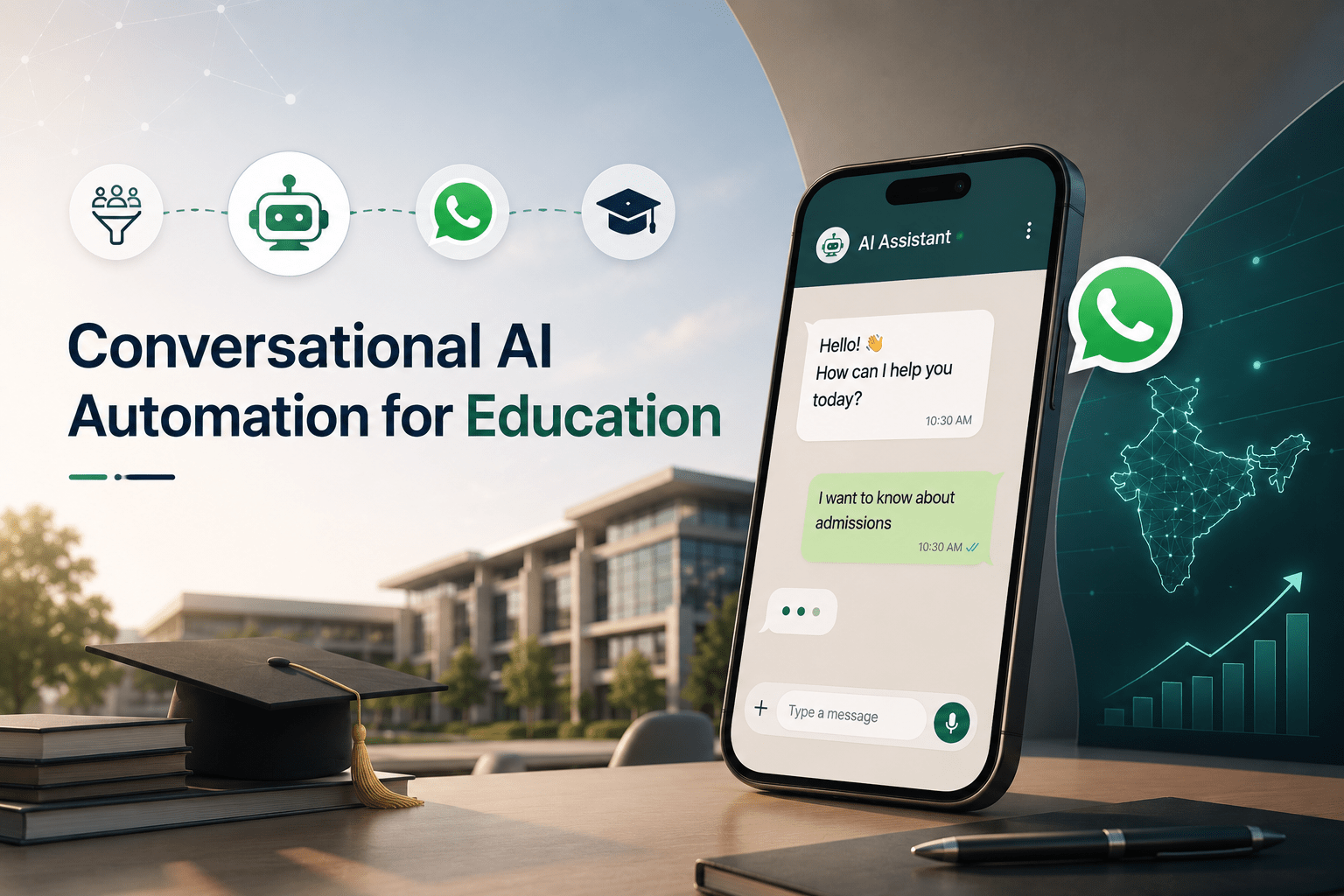
An education institution does an enormous amount of hard, genuine work. It builds courses and curricula. It recruits and develops faculty. It creates campuses, classrooms, labs and learning platforms. It assembles, at real cost, the capacity to educate. And then, with surprising regularity, it loses the very people that capacity was built for - not in the classroom, but in the gaps around it.
Those gaps take two main forms, and they are best understood as two distinct leaks. The first is the admissions leak: a prospective student expresses genuine interest, and the institution fails to convert that interest into an enrolment - usually because the follow-up was too slow, too generic, or too easily dropped. The second is the engagement leak: an enrolled student or learner gradually disengages, and the institution does not notice in time to do anything about it. The first leak loses students the institution could have had. The second loses students the institution already had.
Neither leak is a teaching failure. The courses are good; the faculty are capable; the learning works for the students who stay engaged enough to receive it. Both leaks are conversation failures - failures of responsiveness, follow-up, and timely communication at scale. And that is precisely the category of problem conversational AI automation is built to solve. This article explains what conversational AI means for education in India in 2026: where the two leaks come from, where the technology fits across the whole student lifecycle, why WhatsApp is the right channel for it, the line it should not cross, and how an institution can deploy it well.
Education runs on conversation - and that is where it leaks
Strip an education institution down to its operations and an enormous share of the work is conversation. Answering the questions of prospective students and their families. Guiding applicants through admission. Handling the steady stream of student queries about schedules, fees, exams, results and administration. Keeping learners engaged and on track. Communicating with parents. Coordinating placements and alumni relations.
None of this is the teaching itself - but all of it surrounds the teaching, and it decides who reaches the teaching, who stays with it, and how the institution is experienced. For decades this conversational work has been handled by the same overstretched tools: a phone line, an admissions office working through a list, an email no one opens, a faculty member answering the same question for the fortieth time, a parent newsletter that goes unread. These tools do not scale to the volume, and they do not move at the speed that interest and engagement actually require. The leaks are the predictable result.
Leak one - the admissions funnel
The admissions funnel in Indian education is, almost everywhere, leaky - and the leak has a specific, well-understood cause.
Interest in an education is perishable. A prospective student or parent who enquires about a course is, at that moment, engaged and considering. But they are also considering other institutions, and their attention moves on quickly. The institution that responds first, fastest, and most helpfully has an enormous advantage; the institution that responds slowly - a callback tomorrow, an email next week, a generic brochure - is often responding to interest that has already cooled or already committed elsewhere.
This makes speed of response a hidden admissions metric, and most institutions perform poorly on it without realising. Enquiries arrive at all hours and on every channel; the admissions team is finite and works office hours; follow-up is manual and easily delayed; and nurturing an undecided applicant over the weeks of a decision requires a consistency no busy team can sustain across a large list. The result is a funnel that loses prospective students at every stage - not because the institution was not good enough for them, but because the conversation was too slow to hold them.
Every applicant lost this way is doubly costly. The institution spent real money to generate that enquiry, through its marketing, and it lost the tuition revenue and the student the enquiry could have become. Conversational AI addresses this leak directly, and it is the subject of two of the supporting articles in this cluster.
Leak two - the engagement gap
The second leak opens after enrolment. A student or learner who has joined - who has paid, registered, and started - can still be lost, and frequently is, to gradual disengagement.
Engagement does not usually collapse suddenly; it erodes. A learner falls behind. A student stops attending. An online course goes unopened for a week, then a month. A deadline is missed. In a large institution or an edtech platform with many learners, this erosion is mostly invisible - by the time it shows up in a result, a dropout, or an unrenewed enrolment, the moment to intervene has long passed.
This is felt most sharply in edtech and online learning, where the completion gap is a well-known structural problem: a large share of learners who enrol never finish, and the institution loses not only that learner's outcome but their renewal, their advocacy, and their lifetime value. But the engagement leak exists everywhere - in colleges where students quietly fall behind, in schools where the home-school connection is too thin to catch a struggling child early, in coaching institutes where attendance fades before an exam.
Conversational AI addresses the engagement leak by being the attentive, tireless layer no institution has the human capacity to staff: noticing the signals, sending the timely nudge, re-engaging the learner who has gone quiet, and routing the student who needs real help to a person who can give it. A dedicated supporting article covers the edtech engagement problem in depth.
Where conversational AI fits - the student lifecycle
Both leaks, and much else, become addressable when conversational AI is placed across the full student lifecycle. It has a role at every stage.
Enquiry and discovery
When a prospective student or parent enquires, a conversational agent engages immediately - at any hour, on the channel the enquiry arrived through - answering real questions about courses, eligibility, fees and admissions, and qualifying the lead. Perishable interest is met while it is still warm, instead of cooling in a callback queue.
Application and admission
Through the admission process, the agent guides applicants step by step, explains requirements, helps with document submission, answers the questions that otherwise stall an application, and nurtures undecided applicants with timely, relevant, consistent follow-up across the whole decision period.
Enrolment and onboarding
Once a student decides to join, the agent supports the practical journey into enrolment — fee payment guidance, document collection, registration steps, and the orientation information a new student needs — so the gap between deciding and starting does not become a place to lose them.
Ongoing student support
Through the academic year, the agent resolves the high volume of routine student queries — timetables and schedules, exam and result information, fee and administrative questions, campus and process information — instantly, on the student's own channel, instead of through office queues and overloaded phone lines.
Engagement and retention
The agent supports the second leak directly: deadline and class reminders, learning and progress nudges, attendance follow-up, and timely re-engagement of students or learners who have gone quiet - with anything that signals a struggling student routed to faculty or a student-success team.
Parent communication
Particularly for schools, the agent carries the home-school connection: attendance and update notifications, fee reminders, meeting scheduling, and a responsive channel for parent queries - keeping families informed and engaged in a way newsletters and notices never achieved.
Placement and alumni
Toward the end of the journey and beyond it, the agent supports placement coordination and communication, and helps keep alumni engaged and connected - extending the relationship past graduation.
Four settings, one capability
Education is not one kind of institution, and conversational AI lands differently across its main settings. A serious deployment is specific about which one it serves.
Schools (K-12)
Schools have a defining characteristic: the primary communication relationship is with parents, not only students. Conversational AI for schools is largely about the home-school connection - admissions enquiries from parents, fee communication, attendance and updates, meeting coordination - handled appropriately and with care for the fact that it concerns minors.
Colleges and universities
Higher-education institutions carry a large, competitive admissions funnel and a substantial enrolled-student population. The opportunity is on both leaks at once: converting more of a high-volume, fast-moving admissions funnel, and supporting and retaining students across long programmes.
Edtech and online learning
Digital-first education providers live and die by two numbers: the conversion of high-volume online interest into paid enrolment, and the engagement and completion of learners afterwards. For them conversational AI is core growth and retention infrastructure - the engagement leak, in particular, is an existential issue, not a marginal one.
Coaching and skilling institutes
Test-prep, coaching and skilling providers operate intense, time-bound admissions cycles and need sustained learner engagement through to an exam or a credential. Conversational AI fits both the high-pressure enquiry rush and the attendance-and-engagement work that decides outcomes.
The line - conversational AI carries the conversation, not the teaching
It is worth being clear about what conversational AI automation does and does not do in education, because the word 'AI' in education invites a particular confusion.
Conversational AI automation, in the sense this pillar describes, handles the communication, coordination and engagement layer of education. It manages enquiries, guides admissions, supports students with information, sends nudges and reminders, communicates with parents, and routes students who need real help to the right people. It is the responsive conversational layer the institution never had the capacity to staff.
It does not replace teaching. It does not deliver the curriculum, exercise pedagogical judgement, or take the place of a teacher's assessment of a student. Faculty teach; the agent makes sure students reach the teaching, stay connected to it, and get timely help around it. When a conversation reveals a genuine academic or pastoral need, the agent's job is to route that student to a qualified human - a teacher, an advisor, a student-success team — not to attempt to be one. Holding this line keeps the technology in the lane where it is genuinely strong, and keeps human educators doing the work that only they can do.
The institution builds the education. Conversational AI makes sure students find it, enrol in it, stay engaged with it, and get help around it. Teaching stays with teachers.
Why WhatsApp fits education in India
Conversational AI needs a channel, and for education in India the answer is clear: the audience is already on WhatsApp. Prospective students, enrolled students, and parents alike use it every day, which means there is nothing to download, register for, or learn. For admissions, that removes friction at the exact moment interest is most perishable. For parent communication, it reaches families on the channel they actually check - unlike the app, the portal, or the printed circular.
WhatsApp also fits the content of education communication. It carries documents - prospectuses, forms, fee receipts, schedules, results - both ways inside one thread. It is asynchronous, so a working parent or a busy student can engage when it suits them. The verified business identity helps a prospective student or parent trust that a message about admissions or fees is genuinely from the institution, which matters in a sector where education-related scams exist. And the conversation persists, so an applicant can scroll back to a fee detail or a deadline whenever they need it.
The channel's permission model - opt-in and approved templates for proactive outreach - is, again, a healthy discipline. Education communication built on consent, reaching people on a channel they have agreed to and actually use, is communication that is welcome rather than ignored.
The trust layer
Education involves young people, families, and personal data, and a conversational AI deployment must be built with that responsibility in mind from the start. The following are the principles responsible deployments are built around; specifics should be validated with the institution's own leadership and against current regulation.
-
Consent and permission - students and parents are contacted on the basis of genuine opt-in, on topics they agreed to, consistent with India's data-protection regime and the permission model of business messaging.
-
Care with minors - where communication concerns school-age children, it is designed appropriately: parent-facing where it should be, age-appropriate in tone and content, and mindful that data about children warrants particular care.
-
Data protection and minimisation - student, applicant and family data is handled securely, and the agent collects and uses only what a given interaction genuinely requires.
-
Honesty and accuracy - admissions and academic information is accurate and not misleading; the agent is transparent that it is an automated service, with a clear route to a person.
-
Sound human escalation - anything that signals a struggling student, a pastoral concern, a complaint, or a situation needing judgement is routed promptly to qualified staff with full context.
As in any deployment touching personal data and young people, compliance and appropriate use are design inputs from the start, and every deployment should be validated with the institution's own leadership and legal advice. A dedicated supporting article touches on student support and the trust considerations around it.
What an education conversational AI deployment needs
Moving from a promising idea to a system an institution can rely on takes more than a language model. A serious deployment needs integration with the institution's systems - the enquiry and CRM system that admissions runs on, and the student-information and learning systems that hold schedules, fees, results and progress — because an agent that cannot see real data or update real records is only a veneer. It needs the verified WhatsApp Business platform configured correctly, with the consent and template discipline the channel requires. It needs guardrails that keep the agent in the communication-and-coordination lane and define when it must escalate to a human. It needs the privacy and minimisation engineering appropriate to student and family data. It needs observability so every interaction is auditable. And it needs evaluation against real education scenarios - the anxious applicant, the disengaged learner, the worried parent - measured on whether the agent communicates correctly and escalates appropriately.
This is simply the honest scope of doing education conversational AI properly - and doing it properly is what separates a deployment institutions and families can trust from a chatbot that frustrates the very people it was meant to serve.
How to start
Institutions that succeed with conversational AI do not begin by trying to automate the entire student lifecycle. They begin with one high-volume, well-bounded use case where the value is clear and measurable - most often admissions enquiry handling, because the leak is large, the interest is perishable, and the result is visible in enrolment numbers the institution already tracks - and they get it genuinely right: integrated, fast, consented, resolving rather than deflecting.
A first use case done well produces three things: a concrete result the institution can see - more enquiries answered fast, more applicants nurtured, a measurable lift in conversion - the reusable foundations of integration, channel setup and privacy patterns that make the next use case faster, and the organisational confidence to widen the programme. From there, conversational AI extends across the lifecycle deliberately, one proven step at a time, until prospective students are met instantly, applicants are guided and nurtured, enrolled students are supported and kept engaged, and faculty and staff are freed from repetitive conversational work to focus on educating.
Education's hard work - the courses, the faculty, the campuses and platforms - is real and valuable. The two leaks waste a great deal of it. Conversational AI automation is, finally, a way to close them: to make sure the students an institution could win are won, and the students it has already won are kept. If you are a school, college, university or edtech provider weighing where to start, Converiqo runs an education conversational-AI assessment that identifies your highest-value first use case - usually somewhere along the admissions funnel - and maps the integration and trust path to deploying it well.
About the Author

Md Ashik Alam
Ready to orchestrate your AI future?
Converiqo AI helps you design, deploy, and scale automation workflows that move your business faster, leveraging specialized solutions like our AI bot platform for lead generation, customer self-service AI bot platform, employee self-service AI bot platform, retail omnichannel automation, and our detailed guides on how agentic AI bot platforms work in enterprises and cost structure of enterprise AI bot platforms. Connect with our team to see the platform in action and co-create the next chapter of intelligent operations.
Read More Blogs
Discover more insights and product updates curated by the Converiqo AI team.

Real ROI of Field Force Automation - Beyond the Activity Dashboard
Four metrics that show real field force automation ROI in India - productivity, data reliability, throughput, and field attrition - not just the activity dashboard.

Beat Planning Is the Highest-Leverage Field Force Capability - Here Is Why
Beat planning decides coverage, call frequency, and whether field time is productive. Why it is the single highest-leverage field force automation capability.
Why an Indian Field Force App Has to Work Offline - and Be Built for Real Devices
Field work in India happens where connectivity is intermittent. A field force app that assumes constant connectivity fails exactly where field work is done.