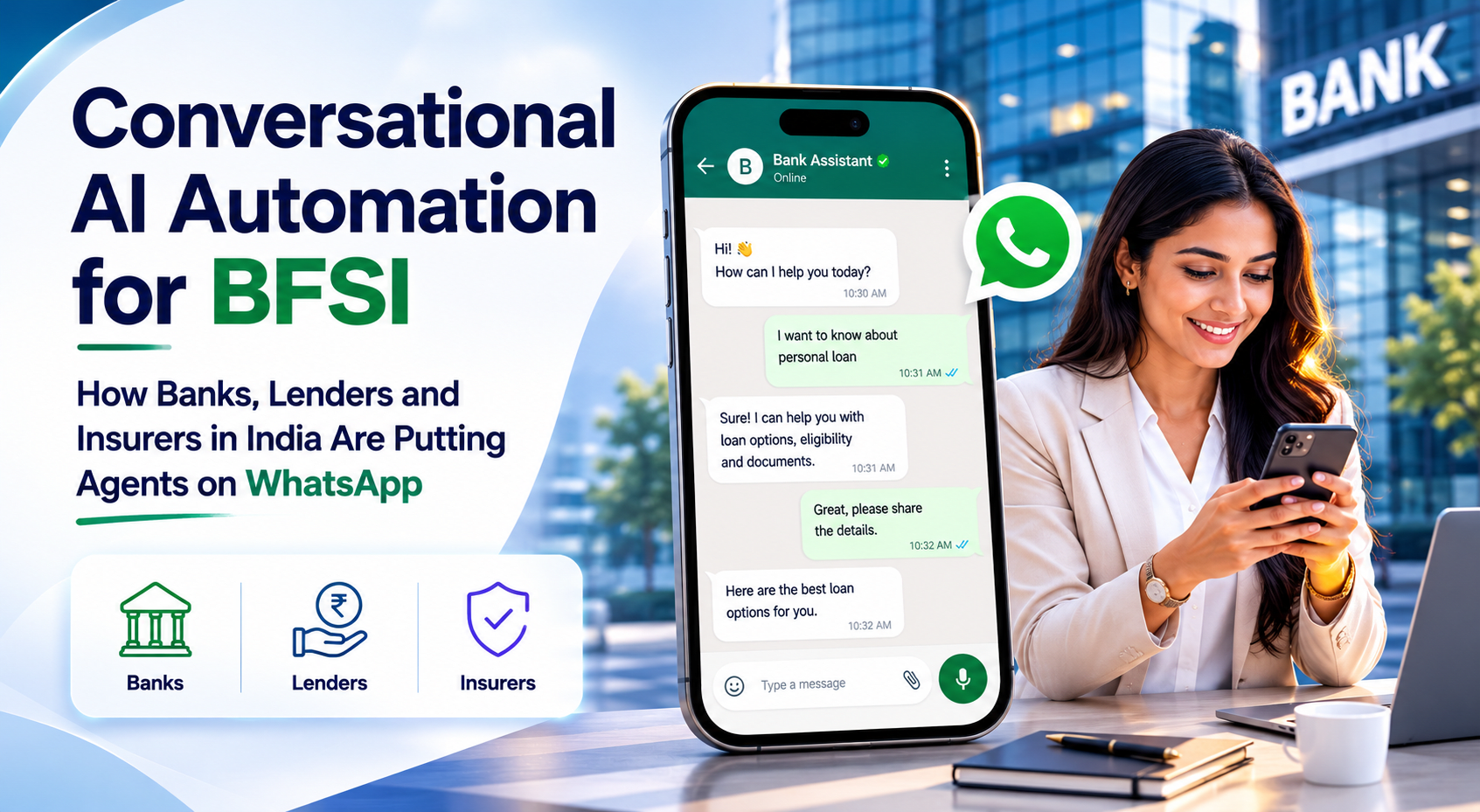
Banking, lending and insurance have always been conversational industries. Before they were industries of branches, call centres, apps and portals, they were industries of conversations - a customer asking whether they qualify, a borrower explaining why a payment will be late, a policyholder trying to understand what a claim covers. Every product in BFSI is, underneath, a promise that has to be explained, sold, serviced and honoured through dialogue.
For two decades the sector tried to move those conversations into self-service: IVR menus, web portals, mobile apps. Each shifted some volume and each left a residue of customers who dropped out, gave up, or simply called anyway. The reason was consistent. Those channels asked the customer to come to the institution, learn its interface, and complete the task on the institution's terms. Most people, most of the time, would rather just ask a question and get an answer.
In India, that is now possible at scale - because the channel customers already use for everything else has become a channel BFSI can build on. This article explains what conversational AI automation means for BFSI in 2026: why the sector is the strongest fit for the technology, where it creates value across the customer lifecycle, why WhatsApp is the right surface for it in India, what separates a genuine conversational agent from yet another chatbot, and how to deploy it without falling foul of the regulatory and trust requirements the sector cannot compromise on.
Why BFSI is the strongest fit for conversational AI automation
Conversational AI is useful in many industries. In BFSI it is close to a natural fit, for four structural reasons that compound on each other.
The work is overwhelmingly communication
A large share of a financial institution's operating cost is the cost of talking to customers - answering balance and statement queries, chasing payments, explaining products, processing changes, handling grievances. This is not peripheral work; it is the work. An industry whose cost base is conversation is an industry where automating conversation moves real numbers.
The volume is enormous and repetitive
A mid-sized Indian bank, NBFC or insurer handles millions of customer interactions a month, and the overwhelming majority follow a small number of patterns. The same questions, the same requests, the same reminders, repeated at scale. High volume with high repetition is the exact profile where automation earns its place - and where every point of automation is a large absolute saving.
The interactions are time-sensitive and outcome-shaped
BFSI conversations are not idle chat. An EMI reminder has a due date. An onboarding journey has a drop-off cliff. A renewal has an expiry. A fraud alert has minutes that matter. These are interactions with a clear goal and a clock - precisely the interactions where an always-available, instantly-responding agent outperforms a channel that makes the customer wait.
The customer relationship is long and worth protecting
A BFSI customer is not a single transaction; they are years of relationship and a stream of cross-sell. That changes the economics of service. A poor experience does not cost one interaction - it costs retention and lifetime value. Conversational AI that makes every routine interaction fast, correct and respectful is not just a cost play; it is a relationship investment.
An industry whose cost base is conversation, whose volume is vast and repetitive, whose interactions run on a clock, and whose relationships are long - that is the textbook profile for conversational AI automation. BFSI is not a use case for it. BFSI is the use case.
Four sub-sectors, one capability
BFSI is not monolithic. Conversational AI automation lands differently across its four broad sub-sectors, and a serious deployment starts by being specific about which one it is built for.
Banks
Retail banks carry the widest interaction surface - account servicing, card queries, payments, statements, service requests, branch and ATM information, and a constant cross-sell motion. The opportunity is breadth: a conversational agent that resolves the long tail of routine servicing on the customer's own channel, deflecting volume from branches and call centres while keeping the experience consistent.
NBFCs and lenders
For lenders - including the fast-growing digital-lending segment - the centre of gravity is the loan lifecycle: generating and qualifying leads, moving applicants through onboarding without losing them, and, critically, collections. Collections is where conversational AI is most quietly transformative for lenders, because it replaces an expensive, hard-to-scale, often abrasive calling operation with consistent, respectful, customer-friendly reminders that recover money without burning the relationship.
Insurers
Insurance lives or dies on two moments: renewal and claim. Renewals lapse silently when no one follows up; claims frustrate customers when the process is opaque. Conversational AI addresses both - proactive, helpful renewal journeys that prevent silent lapse, and claim-status conversations that turn an anxious black box into a transparent, guided process. It also carries the heavy servicing load of policy queries and document requests.
Fintechs
Digital-first fintechs have no branch network to fall back on; the conversation is the entire relationship. For them conversational AI is not an efficiency layer added to a physical business - it is core infrastructure. The bar is correspondingly high: the agent has to carry acquisition, onboarding, servicing and support as the primary face of the brand.
One capability, four shapes. The supporting articles in this cluster go deeper on the highest-value of these - WhatsApp banking, loan collections, digital onboarding, and insurance servicing - each as its own focused piece.
Where conversational AI creates value - the BFSI lifecycle
The clearest way to see the opportunity is to walk the customer lifecycle, because conversational AI automation has a role at every stage.
Acquisition and lead qualification
Interest in a financial product is perishable. A prospect who asks about a loan, card or policy and is met with a form, a callback promise, or silence is a prospect who cools. A conversational agent engages the moment interest appears, answers the real questions, qualifies the lead against eligibility criteria, and hands a warm, pre-qualified prospect to a human or a digital journey - at any hour, without a queue.
Onboarding and KYC
Onboarding is where BFSI loses the most customers it had already won. Account opening, loan onboarding and policy issuance are multi-step, document-heavy journeys, and every step is a place to drop out. A conversational agent guides the customer through the journey conversationally, collects and checks documents, explains what is needed and why, chases what is missing, and turns an abandonment-prone form into a supported dialogue.
Servicing and self-service
The largest volume of all: balance and statement requests, transaction queries, limit and detail changes, product information, service requests. These are the interactions that fill call centres and branches with work that does not need a human. A conversational agent resolves them instantly on the customer's own channel - and resolution, not deflection, is the measure.
Collections and payments
EMI and premium reminders, payment confirmations, and early-stage collections follow-up are repetitive, time-sensitive, and expensive to do well by phone. Conversational AI handles them consistently and at scale — a timely, polite, easy-to-act-on reminder with a payment path attached. It recovers money earlier, costs a fraction of a calling operation, and is far less abrasive to the customer relationship.
Claims, renewals and lifecycle events
Renewal nudges that prevent silent lapse, claim-status updates that replace anxiety with transparency, maturity and lifecycle notifications - these proactive, event-driven conversations protect revenue and trust at exactly the moments that matter most to a customer.
Grievance and support
Complaints and grievances need fast acknowledgement, accurate routing, and honest status. A conversational agent acknowledges instantly, captures the issue cleanly, routes it correctly, keeps the customer informed, and escalates to a human with full context when judgement is required - turning a frustrating process into a managed one.
Why WhatsApp is the right surface for BFSI in India
Conversational AI needs a channel, and in India the channel question has a clear answer. WhatsApp is where customers already are. The institution does not have to persuade anyone to download an app, remember a portal, or learn an interface - the customer is already fluent in the medium and uses it every day with family, merchants and everyone else.
For BFSI specifically, the WhatsApp Business platform brings four properties that matter. It is verified - a green-tick business identity helps customers trust that a message about their money is genuinely from their institution, which is itself a defence against the impersonation scams the sector battles. It is rich - it carries documents, statements, payment links, buttons and structured replies, so a full servicing or onboarding journey can happen inside one thread. It is asynchronous - a customer can answer a renewal or onboarding message when it suits them, which fits financial decisions far better than a live call. And it is universal in reach across the customer base in a way no proprietary app can match.
There is a discipline that comes with the channel. WhatsApp business messaging operates on a permission model - proactive outreach uses approved message templates and respects opt-in - and that constraint is healthy: it pushes BFSI institutions toward communication that is consented to, relevant and welcome rather than intrusive. Used well, WhatsApp is not merely a cheaper channel. It is the channel that finally lets BFSI meet customers where they already are, on terms they already understand.
From chatbot to agent - what actually changes for BFSI
BFSI has been sold chatbots before, and many institutions carry the scars: a menu-driven bot that handled three questions, frustrated customers into typing 'agent', and quietly became a routing screen in front of the call centre. It is worth being precise about why a conversational AI agent is a different proposition.
A traditional chatbot followed a script. It recognised a fixed set of intents, offered a fixed set of buttons, and broke the moment a customer phrased something its own way or asked something off the menu. Its job ended with a response - and if the response did not resolve the issue, a human still had to.
A conversational AI agent understands rather than matches. It interprets what a customer means in their own words and language, holds the context of the conversation, and - the decisive difference - acts. It does not just tell a customer how to update a detail or where to pay; within its defined permissions it completes the request, retrieves the real information, and confirms the outcome. For BFSI the practical consequence is the gap between deflection and resolution. A chatbot deflects: it postpones the work. An agent resolves: it completes the work. Only the second one actually removes cost and genuinely satisfies a customer - and only the second one is worth deploying.
The compliance and trust layer
BFSI is a regulated industry, and any conversational AI deployment has to be built for that from the first design decision, not retrofitted. This is a layer to treat with care, in partnership with the institution's own compliance function - the following are the principles that responsible deployments are built around.
-
Consent and permission - proactive outreach is built on genuine opt-in and clear customer consent, consistent with India's data-protection regime and the permission model of business messaging. Customers are contacted because they agreed to be, on topics they agreed to.
-
Data protection and minimisation - the agent collects and uses only the data a given interaction genuinely needs, handles it securely, and respects data-protection obligations on storage, processing and customer rights.
-
Auditability - every automated interaction is logged and inspectable: what was said, what the agent did, what was decided. A regulated institution must be able to reconstruct any conversation, and the system has to make that straightforward.
-
Fair and transparent conduct - particularly in collections and lending communication, the agent's tone and content follow fair-practice principles: respectful, non-coercive, accurate, and clear that the customer is dealing with an automated service with a route to a human.
-
Sound human escalation - for sensitive matters, disputes, vulnerable customers and anything requiring judgement or regulatory discretion, there is a clean, well-placed path to a qualified human with full context.
Compliance specifics evolve, and they differ across banking, lending and insurance. The right posture is not to treat compliance as a constraint bolted on at the end, but as a design input from the start - and to validate every deployment against current regulation with the institution's compliance and legal teams. A dedicated supporting article in this cluster covers this layer in full.
What a BFSI conversational AI deployment actually needs
Moving from a promising idea to a system that runs in a regulated institution takes more than a language model. A serious deployment needs core integration with the systems of record - the agent is only as useful as the live data and actions it can reach, whether that is a core banking system, a loan management system or a policy administration system. It needs the verified WhatsApp Business platform set up correctly, with the template and consent discipline the channel requires. It needs guardrails and policy that define exactly what the agent may do, with which data, and where it must stop and escalate. It needs observability - the logging and monitoring that make every interaction auditable and every problem visible. It needs evaluation against real BFSI scenarios, including the difficult and sensitive ones, measured on correct resolution rather than fluent language. And it needs a deliberate human-in-the-loop design so that escalation is a smooth handover, not a dead end.
None of this is a reason to hesitate. It is simply the honest scope of doing it properly - and doing it properly is what separates a deployment that earns trust and survives audit from another chatbot that quietly becomes a routing screen.
How to start
The institutions that succeed with conversational AI do not begin by trying to automate everything. They begin with one high-volume, well-bounded use case where the value is clear and measurable - a single servicing journey, EMI reminders, a renewal flow - and they get it genuinely right: integrated, compliant, resolving rather than deflecting, measured against a real number.
A first use case done well produces three things: a concrete result the business can see, the reusable foundations - integration, the WhatsApp setup, the compliance and guardrail patterns - that make the second and third use cases faster, and the organisational confidence to widen the programme. From there, conversational AI automation extends across the lifecycle deliberately, one proven step at a time, until the routine conversational work of the institution is genuinely handled and human teams are concentrated on the interactions that need them.
BFSI was always a conversational industry. Conversational AI automation is, finally, the technology that fits the shape of the work - and on WhatsApp, it fits the shape of how Indian customers already live. If you are a bank, NBFC, insurer or fintech weighing where to start, Converiqo runs a BFSI conversational-AI assessment that identifies the highest-value first use case for your institution and maps the integration and compliance path to deploying it well.
About the Author

Yash Soni
Ready to orchestrate your AI future?
Converiqo AI helps you design, deploy, and scale automation workflows that move your business faster, leveraging specialized solutions like our AI bot platform for lead generation, customer self-service AI bot platform, employee self-service AI bot platform, retail omnichannel automation, and our detailed guides on how agentic AI bot platforms work in enterprises and cost structure of enterprise AI bot platforms. Connect with our team to see the platform in action and co-create the next chapter of intelligent operations.
Read More Blogs
Discover more insights and product updates curated by the Converiqo AI team.

Real ROI of Field Force Automation - Beyond the Activity Dashboard
Four metrics that show real field force automation ROI in India - productivity, data reliability, throughput, and field attrition - not just the activity dashboard.

Beat Planning Is the Highest-Leverage Field Force Capability - Here Is Why
Beat planning decides coverage, call frequency, and whether field time is productive. Why it is the single highest-leverage field force automation capability.

Why an Indian Field Force App Has to Work Offline - and Be Built for Real Devices
Field work in India happens where connectivity is intermittent. A field force app that assumes constant connectivity fails exactly where field work is done.