Hospitals today stand at a critical crossroads. On one side, medical science, diagnostics, and treatment capabilities are advancing at record speed. On the other, most administrative and communication systems remain stuck in the past, creating a painful gap between clinical excellence and patient experience.
Even in hospitals with world-class doctors and cutting-edge equipment, day-to-day operations often still depend on phone calls, manual front-desk processes, paper-driven workflows, overloaded staff, and fragmented communication channels. The result is a patient journey full of delays, uncertainty, confusion, and frustration problems that are rarely medical but almost always operational.
This is now starting to change. AI voice + chat automation delivered through WhatsApp, website chat, voice IVR, and mobile apps is emerging as the new digital front desk and always-on patient engagement hub. Instead of patients chasing information, the system responds instantly, organizes journeys, and keeps everyone informed.
Platforms like Converiqo.ai enable hospitals to automate communication, provide instant answers, streamline patient flow, and remove coordination chaos across departments. Done right, AI voice + chat automation can:
- Reduce call volume and front-desk overload
- Improve appointment management and reduce no-shows
- Accelerate report and document delivery
- Increase billing clarity and transparency
- Support elderly patients and caregivers more effectively
- Streamline internal and vendor operations
The result is a hospital that feels faster, more reliable, and more patient-centric without burning out staff.
The Silent Crisis: Why Hospitals Lose 60–70% of Operational Efficiency Today
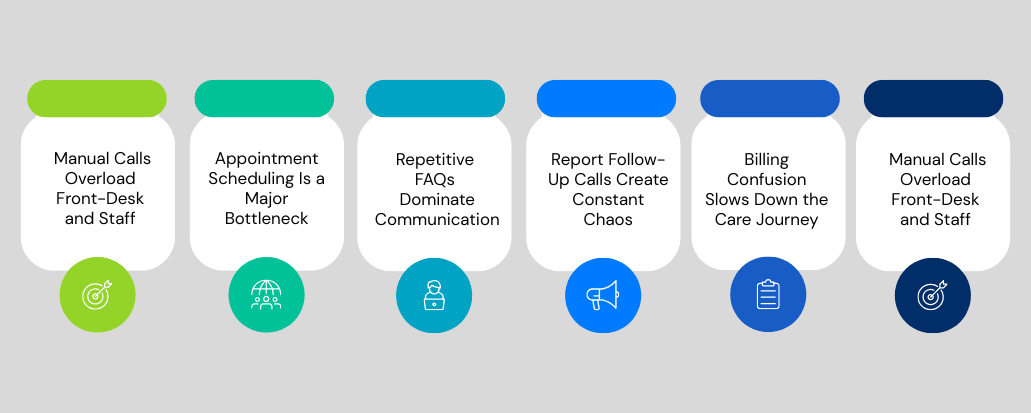
Across the world, hospitals rarely struggle because of medical capabilities. Most operational damage happens outside clinical care in communication, coordination, and administration. These bottlenecks create long waiting lines, unanswered calls, frustrated patients, and exhausted staff.The biggest friction points show up in a predictable pattern. Below are six operational gaps almost every hospital faces.
1. Manual Calls Overload Front-Desk and Staff
For many hospitals, the phone is still the primary channel for information. Patients and caregivers call repeatedly to ask about doctor availability, consultation timings, fees, room or bed availability, report readiness, directions, and other simple details. Front-desk teams end up answering the same questions dozens of times per day.
This creates a cycle where phone lines are constantly busy, patients are kept on hold, and many calls go unanswered. Staff are overworked, response times are slow, and the experience feels stressful for everyone involved. What should be a simple information exchange turns into a daily operational crisis.
2. Appointment Scheduling Is a Major Bottleneck
Appointment workflows consume an enormous amount of human time. Teams spend their day booking, rescheduling, cancelling, and confirming appointments, along with explaining pre-visit instructions over and over.
Every missed call can easily translate into a missed appointment—and missed appointments mean lost revenue and dissatisfied patients. When this entire process is manually coordinated through phone calls and registers, it becomes fragile, error-prone, and impossible to scale.
3. Repetitive FAQs Dominate Communication
Basic questions such as “What are the visiting hours?”, “What documents do I need to bring?”, or “Where is the lab located?” still require human responses in most hospitals. These queries are predictable, repetitive, and similar across hundreds of patients every week.
Instead of being automated and self-service, they keep front-desk and nursing teams stuck in low-value, repetitive communication. This reduces the time staff can spend on complex, high-touch interactions that truly require a human.
4. Report Follow-Up Calls Create Constant Chaos
Report status is another hidden drain. Patients frequently call to check if their blood test, MRI, CT scan, or pathology report is ready, or to request that results be shared with them.
Staff then manually check systems, confirm status, and sometimes send reports through email or messaging apps. This one workflow alone consumes a huge number of hours each week, and every delay increases anxiety for patients and their families.
5. Billing Confusion Slows Down the Care Journey
Billing is one of the most sensitive parts of the hospital experience. Patients and caregivers often lack clarity about consultation charges, procedure costs, room tariffs, insurance coverage, and discharge billing timelines.
Without structured, transparent communication, small doubts quickly escalate into complaints or delays. Staff are pulled into long explanations, disputes at the time of discharge, and constant clarifications that slow down the entire care journey.
6. Internal Staff Coordination Is Slow and Unstructured
Inside the hospital, departments like nursing, housekeeping, IT, biomedical, maintenance, and administration frequently operate in silos. Requests are passed through calls, personal messages, or ad-hoc notes with no proper ticketing or tracking system.
This leads to delayed responses, unclear ownership, and poor escalation management. Something as simple as a non-functioning AC, missing linen, or a technical issue in a diagnostic machine can affect patient comfort and safety because the process to fix it is manual and chaotic.
Together, these six inefficiencies compound and silently drain 60–70% of hospital operational efficiency even in institutions that deliver excellent clinical care.
AI Voice + Chat Automation: The New Operating System for Modern Hospitals
AI in hospitals is no longer just about clinical decision support or radiology interpretation. A new layer of AI voice + chat automation is emerging as the operating system for communication and coordination.
Modern AI automation is:
• Conversational and natural to use
• Context-aware and able to follow patient journeys
• Multilingual and accessible to diverse populations
• Integrated with hospital systems like HMS/ERP
• Able to complete real workflows, not just answer FAQs
• Available 24×7 with consistent performance
• Accurate, auditable, and dependable
Platforms like Converiqo.ai bring together voice AI, WhatsApp AI, web chat, internal workflow engines, and deep HMS/ERP integration into a single layer. This creates a continuous, automated communication fabric that supports patients, staff, and vendors—without relying solely on phone calls or walk-ins.
What emerges is a hospital where information flows automatically, tasks are triggered without delay, and the system itself becomes proactive in guiding patients and supporting staff.
AI Automation Use Cases That Transform Patient & Hospital Operations
1. 24×7 Voice & Chat Support for Doctor Timings, Fees & Room Availability
One of the biggest drivers of call volume in hospitals is basic information:
“Is the doctor available today?”,
“What are the OPD timings?”,
“How much is the consultation fee?”,
“Are private rooms available right now?”,
“What are the visiting hours?”
With AI voice + chat automation, patients can ask these questions through voice or chat and receive instant, accurate responses. For example, they can say or type:
• “Is Dr. Anderson available today?”
• “Show me tomorrow’s cardiology timings.”
• “Do you have any single rooms free right now?”
The AI system checks the hospital management system in real time and replies with correct, up-to-date information. This:
• Reduces incoming call volume by 30–40%
• Gives front-desk teams more bandwidth for complex cases
• Ensures patients aren’t kept waiting for basic answers
2. Automated Appointment Booking, Rescheduling & Reminders
Appointment scheduling workflows are ideal for automation. With AI, patients can book, reschedule, or cancel appointments via:
• Voice IVR or phone-based AI
• Website chat widgets
• Mobile apps
• Even social/chat channels like Instagram
The AI checks doctor availability, time slots, scheduling rules, and required patient details, then completes the booking or rescheduling instantly. It also sends:
• Confirmation messages
• Reminder notifications
• Pre-visit instructions (e.g., fasting, documents, arrival time)
Hospitals that automate appointments typically see:
• 50–60% reduction in front-desk scheduling workload
• 30–40% drop in no-shows due to automated reminders
• Higher outpatient satisfaction thanks to smooth, predictable scheduling
3. Elderly-Friendly Voice Journeys for Accessibility
A large share of hospital callers are elderly patients, caregivers, or people who are not comfortable with apps and complex digital interfaces. They often feel excluded when everything moves to “online only” systems.
Voice-based AI automation solves this by offering slow-paced, natural, and multilingual interactions. Patients can ask the system to repeat information, change the language, or call back with an update. Typical commands include:
• “Repeat that slowly.”
• “Say it in Spanish.”
• “Tell me the visiting hours again.”
This makes AI feel more like a supportive assistant than a cold machine—accessible, humane, and inclusive for older patients and families.
4. Patient Self-Service for Reports, Invoices & Discharge Documents
Report-related queries are one of the biggest hidden workloads in hospitals. Patients continuously ask when their reports will be ready, how they can receive them, and whether discharge summaries or invoices are available.
By connecting AI directly with HMS/ERP systems, hospitals can enable self-service for:
• Checking report readiness status
• Retrieving lab and radiology reports
• Sharing PDFs via WhatsApp or chat
• Delivering invoices and discharge summaries
• Sending post-discharge instructions
Patients no longer need to call for every update; they can simply ask the AI or tap a link. This leads to:
• 70–80% reduction in report follow-up calls
• Faster access to critical documents
• Less manual checking and coordination for staff
5. Billing Transparency Through Automated, Real-Time Updates
Billing is one of the most emotionally charged aspects of hospitalization. Lack of clarity creates fear and distrust. AI brings structure and transparency by providing clear, step-by-step information on:
• Consultation fees and OPD charges
• Procedure and surgery costs
• Room tariffs and category-wise pricing
• Insurance tie-ups and coverage policies
• Documents required for cashless claims
• Estimated costs and pre-authorization status
When patients can simply ask, “What will be my approximate cost?” or “Is my insurance pre-authorization approved?” and get clear answers, confusion and last-minute disputes reduce dramatically. Staff spend less time firefighting and more time guiding.
6. Internal Staff Ticketing to Bring Order to Hospital Operations
Hospitals need fast, reliable internal coordination to maintain quality of care. With AI-powered internal ticketing, staff can raise structured requests for:
• IT issues
• Housekeeping needs
• Maintenance and facility repairs
• Biomedical equipment problems
• Nursing support tasks
• Inventory and supply requests
A nurse or staff member might simply send, “Create a ticket for AC not working in Room 212,” and the AI will:
• Create a ticket with the right category and priority
• Assign it to the responsible department
• Track progress and send reminders
• Escalate if it’s not resolved in time
This replaces chaotic phone calls and informal messages with a predictable, trackable workflow.
7. Vendor Support Automation: The Missing Link in Hospital Efficiency
Hospitals rely heavily on vendors for medicines, equipment, linen, catering, consumables, and technical services. Coordination with vendors is usually done through emails, calls, or scattered messages.
AI can centralize and automate vendor interactions by managing:
• Stock refill and reorder requests
• Delivery updates and confirmations
• Equipment servicing schedules
• Invoice reminders and dispute resolution
• Escalation of delayed services
With this, supply chain reliability improves and clinical operations are less likely to be disrupted by missing materials or delayed servicing.
Why Hospitals Are Moving to AI-First Communication Systems
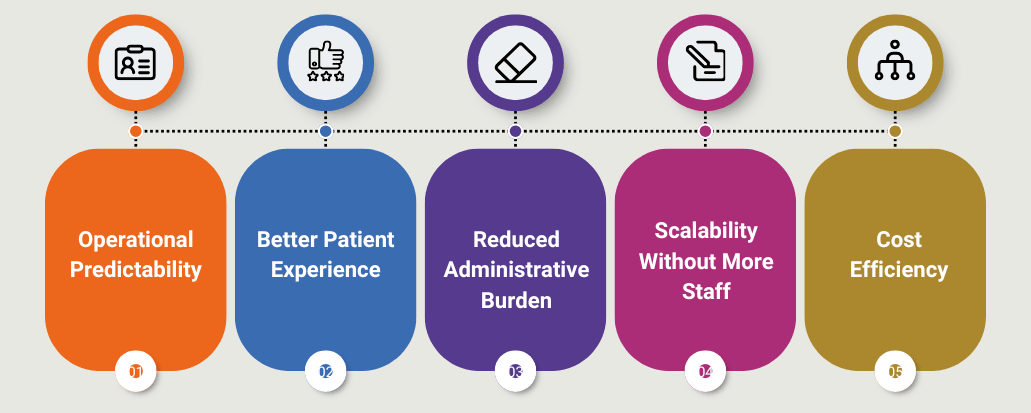
Hospitals are adopting AI-first communication systems not because it’s trendy, but because it directly addresses their operational pain. The gains are practical and measurable.
Key reasons include:
• Operational Predictability – AI ensures that every routine task, from reminders to report notifications, is handled promptly and consistently.
• Better Patient Experience – Patients receive clear, instant answers instead of calling multiple times for basic information.
• Reduced Administrative Burden – Front-desk, nursing, and support teams save three to five hours a day otherwise lost to repetitive communication.
• Scalability Without More Staff – Whether the hospital is handling 50 or 5,000 conversations, AI can scale without proportional increases in headcount.
• Cost Efficiency – Automation lowers the cost per interaction and helps hospitals do more with the same or smaller teams.
• Better Staff Experience – Employees focus on meaningful work instead of being stuck in constant coordination and repetitive tasks.
• Accurate Documentation & Compliance – AI systems automatically generate logs, audit trails, and structured workflows that support compliance and quality standards.
How Converiqo.ai Powers AI-First Hospitals
Converiqo.ai provides a complete AI automation layer tailored for hospitals. Instead of using scattered tools for each function, hospitals get a unified engine that combines:
• Voice AI for phone and IVR automation
• WhatsApp automation for patient communication
• Web chat for website and portal interactions
• Internal workflow engines for staff coordination
• Deep integration with healthcare systems (HMS/ERP)
• Vendor coordination modules for supply and servicing
This single AI engine powers:
• Patient engagement before, during, and after visits
• Front-desk automation for information and appointments
• Internal coordination across departments
• Vendor workflows and supply chain communication
• Report and document delivery
• Appointment and reminder systems
By centralizing all of this on Converiqo.ai, hospitals move away from fragmented solutions and build a cohesive, AI-first communication backbone.
Conclusion AI Is Not Replacing Humans, It’s Redefining the Hospital Experience
AI voice + chat automation is not about removing human touch; it’s about removing human bottlenecks. It takes over repetitive, predictable tasks so people can focus where they matter most.
In an AI-first hospital:
• Doctors focus on diagnosis, treatment, and patient conversations—not chasing information.
• Nurses focus on clinical priorities and bedside care rather than manual coordination.
• Admin teams focus on optimization and quality instead of firefighting.
• Patients feel informed, supported, and valued throughout their journey.
Hospitals that adopt AI-first systems in 2025 will set new benchmarks for efficiency, care quality, and patient experience. In a world where speed, clarity, and reliability define healthcare excellence, AI automation is no longer optional it is essential. Platforms like Converiqo.ai are at the center of this transformation.
FAQ - AI Voice & Chat Automation for Hospitals
1. What is AI voice and chat automation for hospitals?
AI voice and chat automation uses intelligent systems to handle patient and staff communication automatically. It can answer queries, schedule appointments, share reports, and trigger internal workflows without human intervention. Platforms like Converiqo.ai integrate with channels such as WhatsApp, voice IVR, and web chat to provide 24×7, hospital-aware support.
2. How does AI improve patient experience?
AI improves patient experience by making information and actions available instantly. Patients can quickly check doctor schedules, fees, room availability, appointment slots, and report status without waiting on hold or standing in queues. This reduces uncertainty, improves transparency, and makes the entire care journey feel more organized and predictable.
3. Can AI reduce hospital call volume?
Yes. AI can reduce call volume by 60–70% for common use cases such as FAQs, appointment confirmations, report follow-ups, and basic billing queries. Instead of every question becoming a phone call, AI answers most of them automatically and only routes complex cases to human staff.
4. Does AI help elderly patients or caregivers?
Absolutely. Voice AI is particularly helpful for elderly patients and caregivers who may not be comfortable with apps or forms. It supports natural speech, slower responses, and multilingual instructions, making it easier for non-tech-savvy users to get the help they need.
5. What documents can patients access through AI?
AI can securely send and share key documents such as:
• Lab test results
• Radiology reports
• Discharge summaries
• Prescriptions
• Invoices and payment receipts
• Visit or follow-up instructions
Patients receive these directly on channels like WhatsApp or secure links, without repeated calls.
6. Does AI automate appointment booking and reminders?
Yes. AI can handle the entire appointment lifecycle—booking, rescheduling, cancellation, confirmation, and reminders. This reduces front-desk workload, cuts no-shows, and gives patients a smoother, more reliable scheduling experience.
7. Can AI provide transparent billing information?
AI can explain consultation charges, room tariffs, procedure costs, insurance coverage, and required documentation in a clear, structured way. It helps patients understand their financial responsibility and reduces last-minute disputes or confusion at the time of discharge.
8. How does AI automation support hospital staff?
AI supports staff by powering internal ticketing and coordination. Teams can create and track requests for IT, housekeeping, biomedical, maintenance, and nursing support with a simple message, while the system manages assignment, reminders, and escalation. This reduces manual follow-ups and clears operational bottlenecks.
9. Can AI help hospitals interact with vendors?
Yes. AI can streamline vendor interaction for stock requests, delivery updates, equipment servicing, and invoice reminders. By centralizing communication and tracking, it reduces delays, improves supply chain reliability, and helps ensure that clinical operations are never disrupted due to avoidable vendor issues.
To Know More Contact Us : https://converiqo.ai/contact
About the Author
Nikita Srivastava
Ready to orchestrate your AI future?
Converiqo AI helps you design, deploy, and scale automation workflows that move your business faster, leveraging specialized solutions like our AI bot platform for lead generation, customer self-service AI bot platform, employee self-service AI bot platform, retail omnichannel automation, and our detailed guides on how agentic AI bot platforms work in enterprises and cost structure of enterprise AI bot platforms. Connect with our team to see the platform in action and co-create the next chapter of intelligent operations.
Read More Blogs
Discover more insights and product updates curated by the Converiqo AI team.

Real ROI of Field Force Automation - Beyond the Activity Dashboard
Four metrics that show real field force automation ROI in India - productivity, data reliability, throughput, and field attrition - not just the activity dashboard.

Beat Planning Is the Highest-Leverage Field Force Capability - Here Is Why
Beat planning decides coverage, call frequency, and whether field time is productive. Why it is the single highest-leverage field force automation capability.
Why an Indian Field Force App Has to Work Offline - and Be Built for Real Devices
Field work in India happens where connectivity is intermittent. A field force app that assumes constant connectivity fails exactly where field work is done.