Introduction
Enterprises don’t fail at automation because they lack tools. They fail because they start with generic workflows that don’t match how their industry actually operates. The language is different. The customer expectations are different. The approval chains are different. The compliance boundaries are different. And when those realities aren’t built into the workflow design, automation becomes a fragile layer that creates more confusion than value.
This is exactly why Converiqo.ai’s Industries approach matters. Instead of forcing every business into the same automation template, it helps you start from what’s true in your sector your operational constraints, typical use cases, and the workflows that deliver measurable outcomes fast. If your goal is not “AI for the sake of AI,” but a practical path to ROI, an industry-led approach is the fastest, lowest-risk way to begin.
This blog gives you a clear, enterprise-grade blueprint: how to choose the right workflows by industry, how to pilot safely, how to measure outcomes, and how to scale automation without turning your operations into a patchwork of disconnected tools.
Why Industry-Specific Automation Wins
Industry language changes the workflow logic
What one industry calls a “ticket,” another calls a “case,” “incident,” “service request,” or “query.” That may sound small, but it affects everything: routing categories, urgency definitions, agent workflows, reporting, and even how customers describe their problems.
If the automation doesn’t speak the user’s language, adoption drops. People revert to calls, emails, and manual escalation. Industry-specific workflows improve adoption because they feel native to how teams already work.
Compliance and risk thresholds differ by sector
In some industries, speed is the primary constraint. In others, accuracy and auditability matter more than fast replies. For example, a BFSI workflow may require strict identity checks and controlled actions. A healthcare workflow often needs privacy-first handling. A government workflow may require formal approvals and traceability.
Industry-led automation starts with those constraints upfront so the system is designed with guardrails not patched later after a failure.
Adoption improves when automation feels “native”
When automation matches real processes real approvals, real escalation paths, real service expectations teams trust it. And when teams trust it, they use it. This is the hidden success factor behind every automation initiative: not “how smart AI is,” but whether users believe the workflow is reliable.
What You’ll Find on the Converiqo Industries Page
Industry-specific use cases and outcomes
The Industries hub is built to help you quickly identify where automation creates the most value in your sector. Instead of reading generic feature lists, you see the kinds of problems your industry faces and the outcomes automation is meant to deliver.
Recommended workflows to start with
Most automation initiatives stall because they don’t start with one clear workflow. The Industries approach nudges you toward shortlisting a small number of high-impact workflows so you can pilot fast, prove results, then scale.
How to move from industry page → pilot → scale
The real advantage of an industries hub is speed. It helps you go from “we should automate” to “here is the workflow, the module, the rules, and the pilot plan” without months of analysis.
The 5-Step Framework to Choose the Right Industry Setup
Step 1 - Identify the primary business constraint
Every industry has a dominant constraint. Name it before you choose workflows:
- If speed is your constraint: prioritize customer service routing and self-service.
- If compliance is your constraint: prioritize controlled workflows with governance, approvals, and audit trails.
- If cost is your constraint: prioritize high-volume deflection and standardized triage.
- If coordination is your constraint: prioritize procurement, vendor, and operations workflows.
This single step prevents most “wrong start” automation failures.
Step 2 - Pick 1-2 high-volume workflows with measurable impact
Start with workflows that repeat every day and drain time:
- support tickets and service routing
- lead generation and qualification
- employee HR/IT self-service
- procurement approvals and vendor onboarding
- field-force task coordination
If the workflow isn’t high-volume, ROI will be slow and stakeholders will lose patience.
Step 3 - Confirm integrations
Automation is not “real” unless it can trigger actions in your systems. Before you pilot, confirm what must connect:
- CRM for lead workflows
- helpdesk/ticketing system for support workflows
- HRMS/internal portals for employee workflows
- ERP/procurement tools for operations workflows
Skipping integrations creates “automation theatre” nice conversations that still require manual work behind the scenes.
Step 4 - Define routing rules + escalation + approvals
This is where enterprises win or fail.
Define:
- ownership: which team handles which category
- priority: severity levels and SLAs
- escalation: when humans must take over
- approvals: which actions require validation
- exceptions: what happens when the query is unclear
If your workflow doesn’t include escalation logic, it will frustrate users at the moment they need help most.
Step 5 - Run a 2-4 week pilot, then expand
A pilot isn’t about proving the platform. It’s about proving adoption and measurable outcomes. Once the first workflow delivers impact, scaling becomes predictable: you reuse the same operating model and expand into adjacent workflows.
Top Cross-Industry Workflows That Deliver Fast ROI
Customer support and service routing
This is the fastest ROI area for many organizations because repetitive questions are high-volume. Automation should resolve common issues and route complex issues instantly, with context preserved during escalation.
Lead generation and qualification
Leads don’t just “come in.” They must be captured, qualified, routed, and followed up consistently. Automation improves response speed, reduces drop-offs, and standardizes qualification logic.
Employee self-service (HR/IT/admin requests)
Internal requests are an invisible cost center. Automation reduces repetitive HR and IT load and gives employees 24/7 access to answers, forms, and routing.
Procurement and vendor workflows
Procurement delays and vendor onboarding bottlenecks kill productivity. Automating approvals, document collection, onboarding steps, and status tracking reduces cycle time and improves compliance.
Field force and operations coordination
Field operations often rely on manual coordination and fragmented updates. Automating task assignment, tracking, and escalation improves predictability and performance.
Explore the full details in our AI automation workflows to understand how this works, why it matters, and how you can apply these insights effectively for better results.
Industry Snapshots
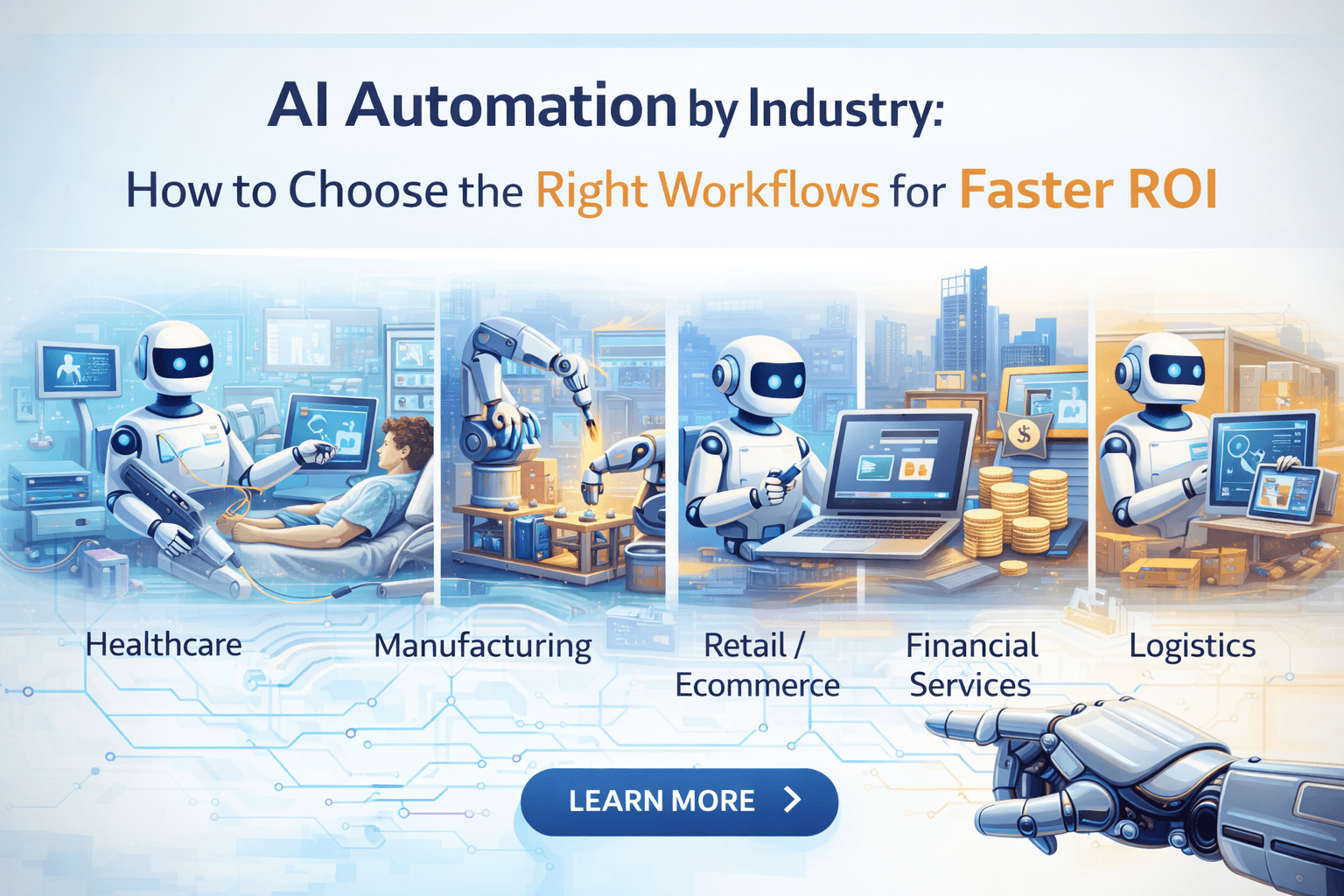
Education and EdTech - admissions, onboarding, student support
Education workflows often involve multiple stakeholders: students, parents, admin teams, and faculty. Automation wins by guiding admissions processes, answering repetitive student queries, supporting onboarding, and improving engagement. The key is consistency across channels-especially during peaks like admissions season.
Manufacturing and Industrial - maintenance, downtime, supply chain visibility
Manufacturing automation is driven by operational continuity. Workflows often prioritize reducing downtime, improving maintenance coordination, and streamlining reporting across teams. Automation here is less about “chat” and more about orchestrating tasks, alerts, and escalations with clear ownership.
Healthcare and life sciences - patient support, scheduling, compliance-first routing
Healthcare workflows demand privacy-first handling, high accuracy, and risk-aware routing. Automation typically helps with patient queries, appointment scheduling, intake steps, and routing to the right department, while ensuring high-risk or sensitive queries escalate immediately.
Read the complete guide to explore detailed insights, step-by-step explanations, and practical information that will help you understand this topic thoroughly.
How to Pilot Industry Automation Without Disrupting Operations
Week 1 - workflow mapping and success baseline
Choose one workflow. Define categories, routing rules, escalation triggers, and baseline KPIs.
Week 2 - knowledge and integration setup
Upload the core FAQs/SOPs/policies for that workflow. Connect the required system of record. Keep scope minimal.
Week 3 - controlled rollout and escalation tuning
Deploy to one segment (one team or region). Monitor failure points. Tune escalation and routing rules.
Week 4 - outcomes review and scale decision
Compare results vs baseline. Decide whether to scale to more channels or expand to the next workflow.
Security, Compliance, and Governance Considerations
Role-based access control
Different teams and stakeholders must see different information. RBAC ensures the right boundaries.
Audit trails and accountability
Enterprises need traceability: what was asked, what was answered, what action was taken, and why.
Escalation policies for high-risk queries
Sensitive cases must escalate to humans with full context, not be “handled” automatically.
Data residency and deployment flexibility
Industry constraints often vary by geography. A mature automation strategy supports controlled data residency choices.
How to Measure ROI
Operational KPIs- Cycle time reduction, deflection rate, first-contact resolution, SLA adherence, routing accuracy, manual hours saved.
Revenue KPIs- Lead response time, qualification accuracy, lead-to-meeting conversion, pipeline velocity.
Experience KPIs- CSAT improvements, complaint reduction, employee satisfaction for internal service workflows.
Conclusion and Next Steps
If you want automation that produces ROI, don’t start with generic workflows. Start with the reality of your industry your terminology, your compliance thresholds, your routing needs, and your service expectations. Then shortlist 1–2 workflows, run a short pilot, measure outcomes, and expand with discipline.
Explore Converiqo AI industry automation workflows and find your best-fit setup.
FAQs
What is industry-specific automation?
Industry-specific automation means workflows are designed around your sector’s terminology, approvals, and compliance constraints so automation fits naturally and scales faster.
Which industry workflows should we automate first?
Start with the highest-volume friction points: support routing, lead qualification, employee self-service, procurement approvals, vendor onboarding, or field operations coordination.
How do we select the right module for our industry?
Pick one workflow outcome, confirm required integrations, define routing and escalation rules, then pilot one module before scaling to adjacent workflows.
How long does a pilot take?
Most pilots can run in 2-4 weeks if scope is controlled: one workflow, one system of record, and clear KPI targets.
What integrations do we need?
Typically CRM for leads, helpdesk for support, HRMS for employee workflows, and ERP/procurement tools for operations depending on the workflow.
Can we run multiple industry setups?
Yes. Enterprises with multiple business units can tailor workflows by industry while maintaining centralized governance and reporting.
What’s the most common reason automation projects fail?
Trying to automate too much too soon, without clear rules, integrations, and measurable KPI baselines.
Want to evaluate the best module for your workflow? Book a Live Demo or Talk to an Automation Strategist.
About the Author
Md Ashik Alam
Ready to orchestrate your AI future?
Converiqo AI helps you design, deploy, and scale automation workflows that move your business faster, leveraging specialized solutions like our AI bot platform for lead generation, customer self-service AI bot platform, employee self-service AI bot platform, retail omnichannel automation, and our detailed guides on how agentic AI bot platforms work in enterprises and cost structure of enterprise AI bot platforms. Connect with our team to see the platform in action and co-create the next chapter of intelligent operations.
Read More Blogs
Discover more insights and product updates curated by the Converiqo AI team.

Real ROI of Field Force Automation - Beyond the Activity Dashboard
Four metrics that show real field force automation ROI in India - productivity, data reliability, throughput, and field attrition - not just the activity dashboard.

Beat Planning Is the Highest-Leverage Field Force Capability - Here Is Why
Beat planning decides coverage, call frequency, and whether field time is productive. Why it is the single highest-leverage field force automation capability.
Why an Indian Field Force App Has to Work Offline - and Be Built for Real Devices
Field work in India happens where connectivity is intermittent. A field force app that assumes constant connectivity fails exactly where field work is done.