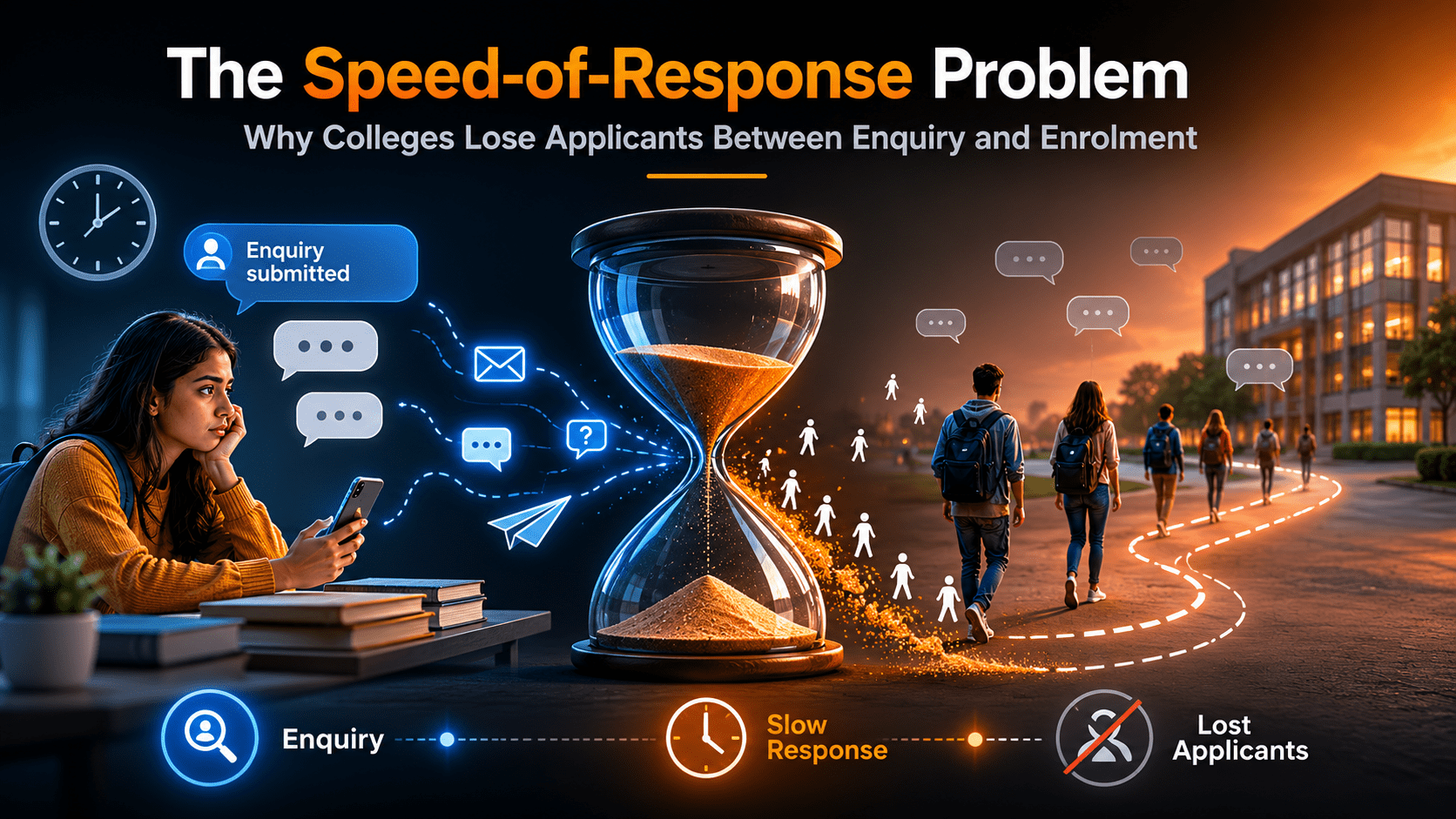
Every college and university tracks enrolment. Most track enquiries. Far fewer track the metric that quietly connects the two and decides much of the outcome: how fast the institution responds when a prospective student first reaches out. Speed of response is the hidden admissions metric, and on it most institutions are losing applicants they never realise they had.
Why interest is perishable
When a prospective student or parent enquires about a course, something specific is happening. They are, in that moment, actively engaged and seriously considering. That state is valuable - and it is temporary. The same person is almost always considering other institutions at the same time. Their attention is in motion. Within hours, sometimes minutes, that peak of engagement begins to fade, and competing options begin to fill the space.
This is what makes interest perishable. An enquiry is not a standing invitation the institution can answer at its convenience. It is a brief window. The institution that reaches the prospective student inside that window - quickly, helpfully, in a real conversation - has an enormous advantage. The institution that responds after the window has closed is often talking to someone who has already cooled, already shortlisted others, or already committed.
Why institutions are slow
Slow response is rarely negligence. It is structural. Enquiries arrive around the clock and across many channels - the website, social media, calls, messages, education portals. The admissions team is a finite group of people working defined hours. An enquiry that arrives in the evening, or over a weekend, or during a peak-season rush, waits in a queue. By the time a human works down to it, hours or days have passed, and the window has often closed.
Then there is the second half of the problem. Even enquiries that are answered are frequently not nurtured. An applicant deciding between institutions needs consistent, relevant, well-timed follow-up across the weeks of a decision. Sustaining that for a large list of applicants, by hand, is beyond what any busy admissions team can do - so undecided applicants drift away in the gaps between contacts.
How conversational AI closes the gap
A conversational agent on WhatsApp attacks the speed-of-response problem at both ends.
-
Instant first response - every enquiry, on any channel, at any hour, is met immediately with a genuine conversation rather than a queue. The perishable window is caught while it is open.
-
Real answers, not a holding message - the agent answers the prospective student's actual questions about courses, eligibility, fees and admissions, so the first contact is genuinely useful.
-
Qualification - the agent understands where the prospective student is in their decision and what they need, so the admissions team receives warm, informed, prioritised leads.
-
Consistent nurturing - the agent maintains timely, relevant follow-up across the whole decision period, for every applicant, without the institution depending on a person to remember each one.
-
Clean handover to people - when a prospective student is ready for a deeper conversation, or has a complex question, the agent hands them to the admissions team with full context.
A measurable, attributable win
The value of fixing the speed-of-response problem is visible in numbers the institution already owns: more enquiries answered fast, more applicants actively nurtured, and a measurable lift in the conversion of enquiry to application to enrolment. Because the institution already spent money to generate each enquiry, recovering applicants that were leaking is a direct return on marketing already paid for.
The natural place to start
Admissions enquiry handling is, for most colleges and universities, the single best place to begin with conversational AI: the leak is large, the interest is perishable, the result is measurable, and the use case is well-bounded. Done well - integrated with the enquiry and CRM system, fast, genuinely helpful - it converts more of a funnel the institution is already paying to fill. The pillar article this supports places the admissions leak within the full education conversational-AI picture.
About the Author

Ankur Singh
Ready to orchestrate your AI future?
Converiqo AI helps you design, deploy, and scale automation workflows that move your business faster, leveraging specialized solutions like our AI bot platform for lead generation, customer self-service AI bot platform, employee self-service AI bot platform, retail omnichannel automation, and our detailed guides on how agentic AI bot platforms work in enterprises and cost structure of enterprise AI bot platforms. Connect with our team to see the platform in action and co-create the next chapter of intelligent operations.
Read More Blogs
Discover more insights and product updates curated by the Converiqo AI team.

Real ROI of Field Force Automation - Beyond the Activity Dashboard
Four metrics that show real field force automation ROI in India - productivity, data reliability, throughput, and field attrition - not just the activity dashboard.

Beat Planning Is the Highest-Leverage Field Force Capability - Here Is Why
Beat planning decides coverage, call frequency, and whether field time is productive. Why it is the single highest-leverage field force automation capability.
Why an Indian Field Force App Has to Work Offline - and Be Built for Real Devices
Field work in India happens where connectivity is intermittent. A field force app that assumes constant connectivity fails exactly where field work is done.