A lot of businesses misread interest.
They assume:
-
the lead replied
-
the lead asked questions
-
the lead sounded positive
-
the lead said they wanted a call or appointment
So they conclude the opportunity is strong.
Sometimes it is.
But interest is not the same as commitment.
And many leads drop between those two stages.
That is where booking friction lives.
Common reasons interested leads still do not book
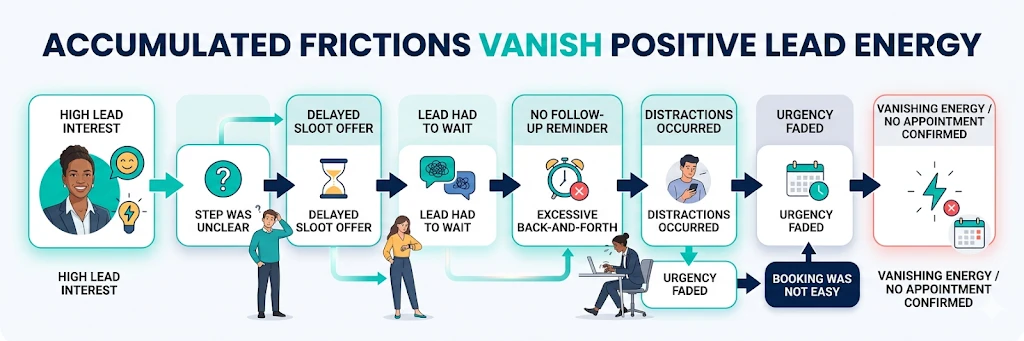
The problem is usually not one big failure.
It is a series of small frictions:
-
the next step was unclear
-
a slot was not offered quickly
-
the lead had to wait
-
there was too much back-and-forth
-
no reminder followed
-
the lead got distracted
-
the urgency faded
-
the business did not make booking easy enough
This is why positive lead energy often disappears before the appointment is confirmed.
Why this matters commercially
Many teams blame lead quality too early.
But sometimes the issue is not poor-quality leads.
It is a poor scheduling path.
That matters because it means the business may be spending on acquisition while leaking value later in the funnel.
Conclusion
If a lead is interested but does not book, that does not automatically mean the lead was weak.
It may mean the booking workflow was weaker than the lead’s intent.
That is an important distinction.
Improve Appointment Conversion
FAQ
Why do interested leads still fail to book?
Usually because of scheduling friction, delayed next steps, unclear booking paths, or weak reminder and follow-up logic.
Is this a lead quality issue or a booking issue?
Sometimes it is lead quality, but often it is workflow friction between interest and commitment.
What should businesses fix first?
Usually speed, next-step clarity, and booking ease.
Can automation improve this?
Yes. Good booking workflows reduce friction and help capture intent before it cools down
About the Author
Tanishka Raina
Ready to orchestrate your AI future?
Converiqo AI helps you design, deploy, and scale automation workflows that move your business faster, leveraging specialized solutions like our AI bot platform for lead generation, customer self-service AI bot platform, employee self-service AI bot platform, retail omnichannel automation, and our detailed guides on how agentic AI bot platforms work in enterprises and cost structure of enterprise AI bot platforms. Connect with our team to see the platform in action and co-create the next chapter of intelligent operations.
Read More Blogs
Discover more insights and product updates curated by the Converiqo AI team.
Real ROI of Field Force Automation - Beyond the Activity Dashboard
Four metrics that show real field force automation ROI in India - productivity, data reliability, throughput, and field attrition - not just the activity dashboard.

Beat Planning Is the Highest-Leverage Field Force Capability - Here Is Why
Beat planning decides coverage, call frequency, and whether field time is productive. Why it is the single highest-leverage field force automation capability.
Why an Indian Field Force App Has to Work Offline - and Be Built for Real Devices
Field work in India happens where connectivity is intermittent. A field force app that assumes constant connectivity fails exactly where field work is done.