One of the biggest mistakes businesses make with service desk automation is trying to automate the most complex requests first.
While this may seem like a good strategy, it often leads to frustration, low trust, and poor employee adoption. The better approach is to begin with internal requests that are repetitive, structured, and easy to measure.
Ideal characteristics of requests to automate first:
- Repetitive: Frequently occurring issues or questions
- Structured: Issues with clear steps and predictable resolutions
- High-frequency: Requests that happen often across the organization
- Low-variance: Consistent requests that don’t change significantly
- Operationally expensive: Time-consuming tasks that waste resources when done manually
- Easier to measure: Tasks that can be tracked for efficiency improvements
Focusing on these areas creates early wins by reducing manual workload and improving employee support speed.
The Best Requests to Automate First
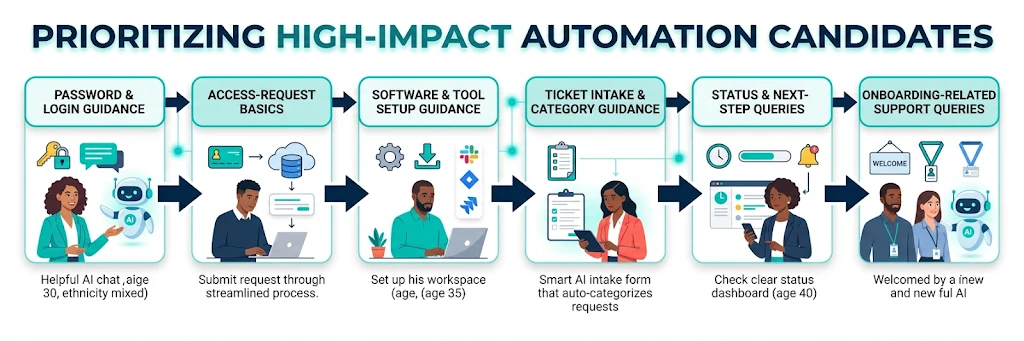
1. Password and Login Guidance
This is one of the most common and repetitive requests, which makes it ideal for automation.
2. Access-Request Basics
Automating basic access requests helps reduce confusion and ensures that requests are routed properly.
3. Software and Tool Setup Guidance
This is a common and repeatable task that becomes operationally expensive when handled manually every time.
4. Ticket Intake and Category Guidance
Automating ticket intake ensures that employees submit requests correctly from the start, improving the accuracy and efficiency of the workflow.
5. Status and Next-Step Queries
This reduces the need for repeated follow-ups on existing tickets or service requests.
6. Onboarding-Related Support Queries
Automating these queries is especially useful when many employees are joining or changing roles.
These are excellent starting points because they reduce the noise in queues and speed up employee support.
What Not to Automate First
While automation is powerful, it’s important to know when to keep human intervention. Avoid automating:
- Complex troubleshooting
- Outage diagnosis
- Security-sensitive issue resolution
- High-risk exception cases
- Emotionally charged escalations
- Highly ambiguous technical problems
These types of issues require human judgment, expertise, and sensitivity. Automation can assist with these cases later but should not take the lead at the start.
Conclusion
The goal of service desk automation is not complexity. It is to reduce repetitive burdens, improve request flow, and create an efficient system that enhances employee productivity.
The most significant gains come from starting with simple, high-impact tasks that are repetitive and operationally expensive to handle manually.
Not sure which IT and service desk requests your business should automate first?
FAQs
What service desk requests are easiest to automate first?
Password guidance, access questions, onboarding support, status queries, and request intake guidance are often good starting points.
Why not automate complex tickets first?
Because complex technical issues require more human diagnosis, judgment, and expertise.
Can automation still help with more complex workflows later?
Yes. Once the basic workflows are automated, more complex cases can be handled with added automation.
How do we know what is repetitive enough?
Look at ticket frequency, predictability, and how often the same issue arises to determine which tasks are best suited for automation.
About the Author
Priya Maurya
Ready to orchestrate your AI future?
Converiqo AI helps you design, deploy, and scale automation workflows that move your business faster, leveraging specialized solutions like our AI bot platform for lead generation, customer self-service AI bot platform, employee self-service AI bot platform, retail omnichannel automation, and our detailed guides on how agentic AI bot platforms work in enterprises and cost structure of enterprise AI bot platforms. Connect with our team to see the platform in action and co-create the next chapter of intelligent operations.
Read More Blogs
Discover more insights and product updates curated by the Converiqo AI team.

Real ROI of Field Force Automation - Beyond the Activity Dashboard
Four metrics that show real field force automation ROI in India - productivity, data reliability, throughput, and field attrition - not just the activity dashboard.

Beat Planning Is the Highest-Leverage Field Force Capability - Here Is Why
Beat planning decides coverage, call frequency, and whether field time is productive. Why it is the single highest-leverage field force automation capability.

Why an Indian Field Force App Has to Work Offline - and Be Built for Real Devices
Field work in India happens where connectivity is intermittent. A field force app that assumes constant connectivity fails exactly where field work is done.