
A common mistake businesses make is collapsing sales support and sales automation into one concept.
While these two are related, they serve very different purposes. Understanding the distinction is crucial for building effective workflows.
Sales Support Automation
Sales support automation focuses on improving the workflow around the sales conversation. It addresses tasks that help sales teams perform more efficiently without directly influencing the selling process itself.
This often includes:
- Qualification of leads
- Lead routing to the right rep
- Scheduling and reminders
- Pre-demo questions
- Context collection for the meeting
- Meeting readiness
Sales Automation
On the other hand, sales automation is often aimed at automating deeper parts of the selling process itself-such as direct communication with prospects, nurturing, or closing sales.
This distinction matters because the safest and most valuable starting point is usually the support layer around the sale, rather than automating the selling process prematurely.
Why This Difference Matters
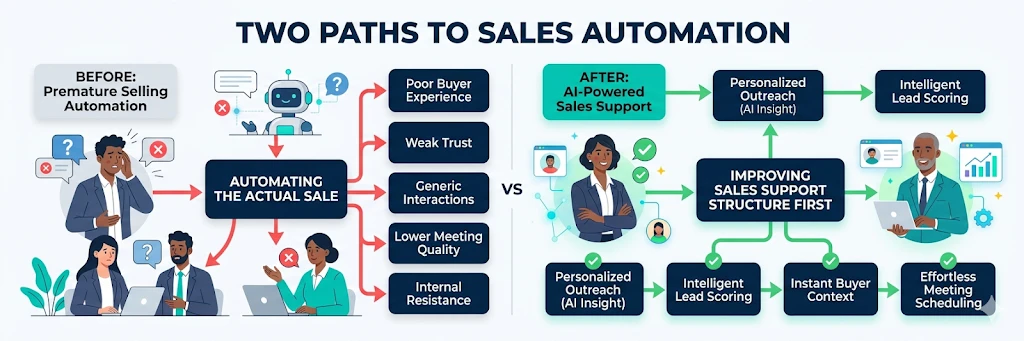
If businesses attempt to automate too much of the sales process too early, they often face:
- Poor buyer experience
- Weak trust and engagement
- Generic or impersonal interactions
- Lower meeting quality
- Internal resistance from sales teams
However, if the focus is placed on improving the support structure around the sale-like qualification, routing, and preparation-sales teams can engage prospects more effectively and without diminishing the personal touch that is critical to successful selling.
Conclusion
The most valuable early automation in sales is not necessarily the selling itself.
It is the workflow that makes selling more effective. Improving the support structure first allows businesses to achieve better results while preserving the human element of the sales process.
CTA Section
FAQs
What is the difference between sales support automation and sales automation?
Sales support automation improves tasks around selling (e.g., qualification, routing, scheduling), while sales automation attempts to automate deeper aspects of the selling process itself.
Why should businesses start with sales support automation?
Because it is lower-risk, easier to measure, and often provides immediate efficiency gains without affecting the quality of human interactions.
What should be structured before a sales call?
Before the sales call, businesses should focus on qualification, routing, context collection, meeting preparation, reminders, and readiness continuity.
Can automation still help the actual sales process later?
Yes, sales automation can help with the actual sales process later, but starting with the support layer is generally the smarter approach.
How does sales support automation improve the sales process?
By streamlining repetitive tasks and ensuring that the sales team is prepared with the right context, support automation improves the efficiency and effectiveness of the sales conversation.
About the Author
Avni Chadha
Ready to orchestrate your AI future?
Converiqo AI helps you design, deploy, and scale automation workflows that move your business faster, leveraging specialized solutions like our AI bot platform for lead generation, customer self-service AI bot platform, employee self-service AI bot platform, retail omnichannel automation, and our detailed guides on how agentic AI bot platforms work in enterprises and cost structure of enterprise AI bot platforms. Connect with our team to see the platform in action and co-create the next chapter of intelligent operations.
Read More Blogs
Discover more insights and product updates curated by the Converiqo AI team.

Real ROI of Field Force Automation - Beyond the Activity Dashboard
Four metrics that show real field force automation ROI in India - productivity, data reliability, throughput, and field attrition - not just the activity dashboard.

Beat Planning Is the Highest-Leverage Field Force Capability - Here Is Why
Beat planning decides coverage, call frequency, and whether field time is productive. Why it is the single highest-leverage field force automation capability.
Why an Indian Field Force App Has to Work Offline - and Be Built for Real Devices
Field work in India happens where connectivity is intermittent. A field force app that assumes constant connectivity fails exactly where field work is done.