One of the biggest concerns businesses have with service desk automation is whether it will make employees feel like support is harder to reach.
This concern is valid. Poorly designed self-service and automation systems can feel like a barrier rather than a help path.
However, the issue isn’t with automation itself it’s with poor workflow design. The goal of automation should not be to block employees from receiving support. Instead, it should reduce avoidable repetition while maintaining clear help paths for more complex or unresolved issues.
What Makes Repetitive Request Reduction Fail
Repetitive request reduction often fails when automation is poorly implemented. Here’s what typically causes problems:
- Self-service is hard to use: Employees struggle to find the right answers.
- Guidance is too generic: Employees can’t find what they need in a straightforward way.
- No next-step clarity: Employees don’t know what to do next after receiving an answer.
- Weak escalation: When automation can’t solve an issue, employees are stuck with no proper escalation path.
- Employees have to repeat themselves: Lack of context retention results in employees having to re-explain their issue.
- The system feels like an obstacle: Automation becomes a hindrance instead of a help, leading employees to bypass it altogether.
These are the pitfalls businesses should avoid when designing self-service or automation systems.
What Makes It Work
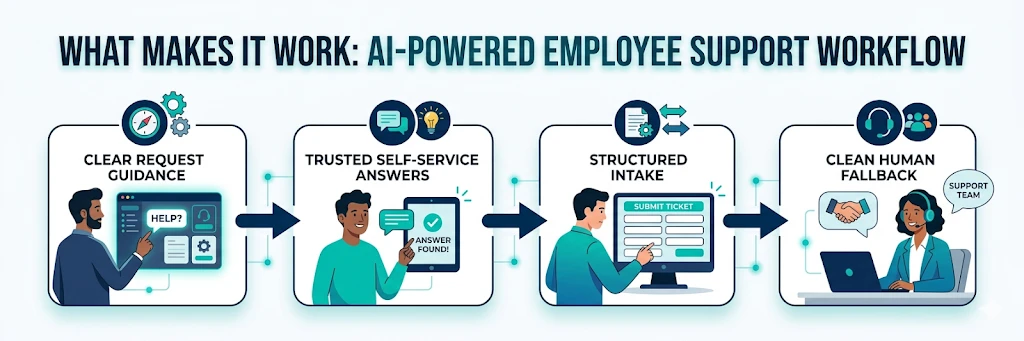
A more effective approach to reducing repetitive requests includes creating a system that guides employees smoothly through the process while ensuring they can access human support when necessary.
Key features of a well-designed service desk automation model:
- Clear Request Guidance: Help employees quickly identify and choose the right path, reducing confusion and frustration.
- Trusted Self-Service Answers: Provide accurate, reliable answers for common issues, reducing unnecessary ticket volume.
- Structured Intake: Collect useful context before escalation to ensure efficient support.
- Clean Human Fallback: Make sure employees can easily reach a human representative when automation is insufficient, without getting stuck in endless loops.
This approach reduces the repetitive support load while maintaining trust in the system.
Conclusion
The goal of service desk automation isn’t to reduce the number of employees asking for help—it’s to reduce the need for human intervention on simple, repetitive issues.
When automation is designed well, it improves efficiency, reduces frustration, and frees up support teams to focus on more complex tasks.
Want to reduce repetitive IT support requests without making the experience worse?
Streamline your support workflows while keeping the employee experience smooth and efficient.
FAQs
Why are repetitive IT requests such a problem?
Repetitive IT requests flood support queues, consume technician time, and slow down the resolution of more urgent or complex issues.
Can automation reduce repetitive ticket burden?
Yes. Automation is one of the most practical solutions for reducing repetitive ticket loads by handling common issues and self-service tasks.
Will self-service make support harder to access?
Not if it is designed with clear guidance, easy escalation paths, and the ability to connect employees with human support when needed.
What should still stay human-led?
Complex troubleshooting, exceptions, sensitive issues, and higher-risk technical problems should still be handled by humans.