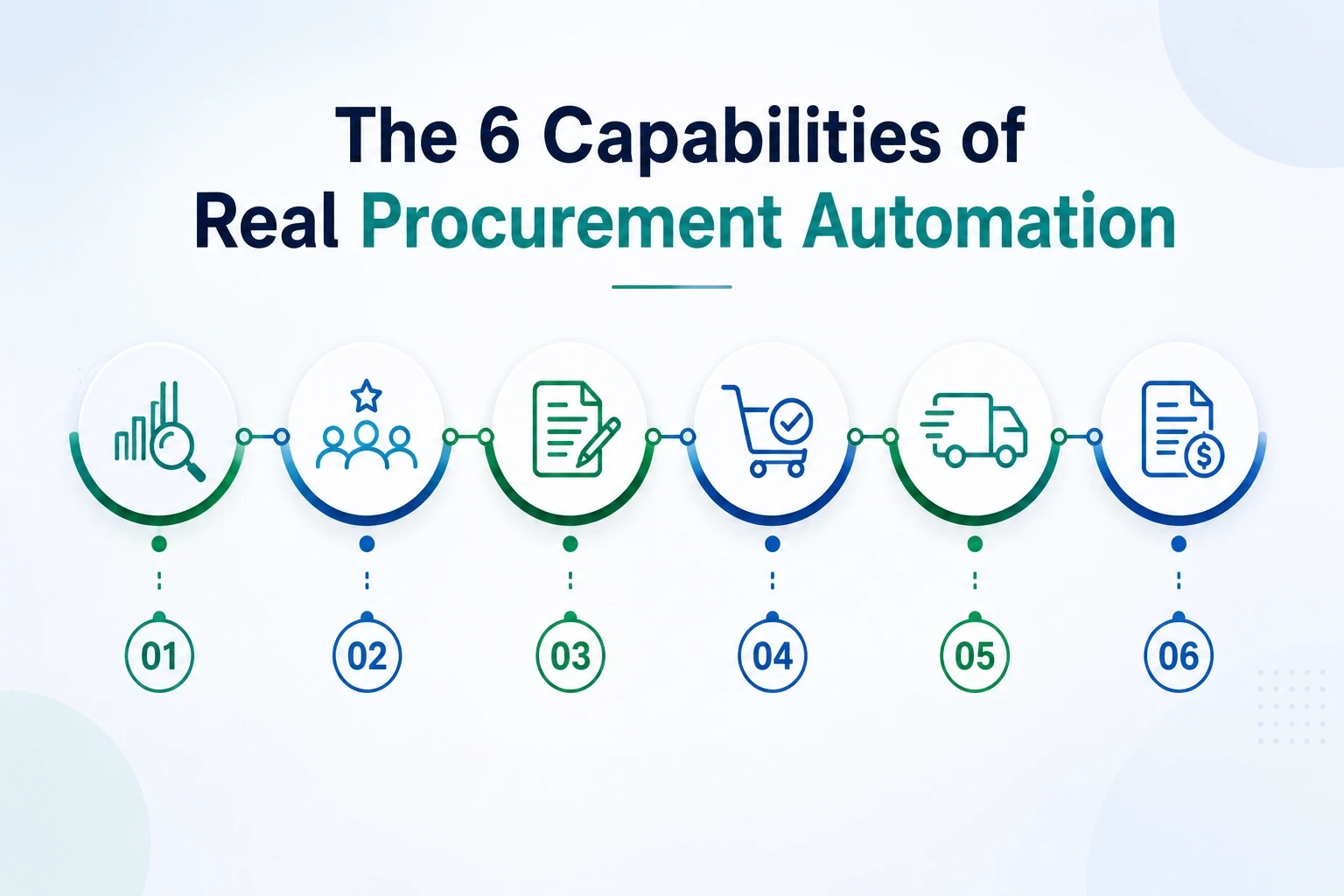
Real procurement automation is six capabilities working together as a layer above the ERP. Each one replaces a specific manual workflow that today either runs through email and Excel or sits as a partially automated stage in the ERP. Walking through each - what it does, what it replaces, what breaks when it is missing.
Capability 1 - Intelligent intake
What it does. Purchase requests get classified at intake across any channel - email, web form, Slack, MS Teams, WhatsApp, in-app from operational systems. AI identifies the spend category, validates against policy (approved expense types for the requester's role, budget availability against cost centre), checks contract coverage (preferred vendor with negotiated rates), and determines the appropriate approval flow. The request lands in the right queue with metadata attached.
What it replaces. Email-based purchase requests that take days to triage. Manual spend categorisation by the procurement coordinator. Budget verification by manually checking cost-centre balance. Vendor pre-selection based on procurement team memory of available contracts.
What breaks when it is missing. Requests sit in email for days awaiting first-touch handling. Misclassification routes requests to wrong queues or wrong approvers. Budget overruns surface at approval time rather than at intake. Existing contracts get missed because the procurement coordinator doesn't remember them all.
Capability 2 - Vendor discovery and evaluation
What it does. For purchases where existing contracts do not cover the requirement, the system recommends vendors based on historical performance, capability match, geographic coverage, MSME status (where preferences apply), and risk scoring from due diligence data. RFx (RFP/RFQ/RFI) processes execute through automation - templates generated, vendors invited, responses collected in structured form, comparison scoring automated. The two-week Excel comparison cycle becomes a structured evaluation in hours.
What it replaces. Procurement coordinator searching memory and shared drives for past vendors. Manual RFQ emails to a handful of remembered vendors. Manual Excel comparison sheets built from copied-and-pasted vendor responses. Subjective vendor selection without structured criteria.
What breaks when it is missing. RFx cycles run on procurement coordinator memory and time. New and emerging vendors get missed. MSME-status vendors who deserve preference get under-considered. Vendor comparisons become arguments about subjective scoring rather than evidence-based decisions.
Capability 3 - Contract intelligence
What it does. Contracts get ingested into a queryable repository with clause extraction - payment terms, delivery SLAs, pricing schedules, termination clauses, liability caps, renewal terms, MSME status declarations. Risk scoring flags unusual terms. Renewal management surfaces contracts approaching expiry with negotiation lead time. Deviation flagging catches when a PO is being raised against a contract on terms that differ from the contract.
What it replaces. PDF contracts in shared drives that nobody systematically queries. Manual renewal tracking that surfaces only when the legal team flags it. Subjective recall of contract terms during PO generation. Discovery at audit time that the company paid above contract rates because nobody checked.
What breaks when it is missing. Contracts auto-renew at suboptimal terms because nobody noticed the renewal window. POs get raised on terms that differ from contract terms and nobody catches the deviation until audit. Vendor relationships continue under unfavourable terms past their natural reset points. The legal and procurement teams operate on parallel contract knowledge that they have not reconciled.
Capability 4 - PO and approval orchestration
What it does. POs get generated from approved purchase requests with contract terms automatically populated where contracts exist. Multi-level approval routing respects delegation of authority and sector-specific thresholds. Escalation handles approvers on leave or unresponsive within SLA. The PO is generated with context from upstream intake intelligence and contract intelligence, not from a blank starting point.
What it replaces. Manual PO drafting by the procurement coordinator from purchase requests. Approval routing built into the ERP without context from upstream stages. The PO approval workflow as a standalone capability rather than an orchestrated outcome.
What breaks when it is missing. POs get raised without contract context - the approver sees the request without knowing the underlying contract terms. Approval delays accumulate because escalation rules are crude. PO data quality varies based on procurement coordinator attention. The PO approval workflow runs as the centre of procurement rather than as one stage of it.
Capability 5 - Invoice and three-way matching automation
What it does. Invoices arrive through email, e-invoicing portal, vendor self-service, or paper. OCR converts non-electronic invoices to structured data. AI matches line items against PO and GRN, identifies matches that pass straight-through (70% to 85% of invoices) and exceptions for human review. GST input credit reconciles against GSTR-2A/2B. TDS applicability calculates and deducts. MSME status drives payment timeline enforcement.
What it replaces. Manual three-way matching by accounts payable team - checking line items, quantities, prices, GST amounts, TDS applicability against PO and GRN. Manual GST reconciliation against vendor filings. Manual TDS determination per invoice. Manual MSME payment timing tracking.
What breaks when it is missing. AP team capacity consumed by routine matching across hundreds or thousands of invoices monthly. GST input credit leakage of 3% to 8% from reconciliation gaps. TDS errors that surface in tax audits months later. MSME 45-day breaches that produce compound interest costs and reputational consequences.
Capability 6 - Spend analytics with maverick detection
What it does. AI analyses the full spend population - POs, invoices, payments - to surface patterns single-transaction review cannot reveal. Maverick spend gets flagged with category, vendor, and requester attribution. Contract savings realisation gets measured (negotiated rates versus actual rates paid). Category trend analysis surfaces emerging spend that may warrant contract negotiation. Vendor consolidation opportunities surface where the company pays multiple vendors for the same category at different rates.
What it replaces. Quarterly procurement reports built by exporting ERP data to Excel and manually aggregating. Periodic spend reviews that look at top vendors and miss long-tail patterns. The blind spot where systemic procurement issues remain invisible because no single transaction diagnoses them.
What breaks when it is missing. Maverick spend continues invisibly at 15% to 35% of total spend. Contract savings stay theoretical because nobody tracks realisation against negotiated rates. Vendor consolidation opportunities go unidentified for years. The CFO and CPO operate on lagging quarterly summaries rather than ongoing visibility.
Why all six matter together
Intelligent intake without contract intelligence means the AI cannot tell the requester whether a contract exists for this category. Contract intelligence without three-way matching automation means the contracts are queryable but invoice deviations still slip through. Three-way matching without spend analytics means each invoice gets processed cleanly but the pattern of maverick spend stays hidden. The capabilities form a layer; gaps between them are where the procure-to-pay cycle reverts to email and Excel.
Procurement automation built as a unified layer addresses each of the structural reasons ERP-PO-only deployments hit a procurement effectiveness ceiling. Built as point tools - an invoice processing vendor here, a contract management vendor there, a spend analytics tool somewhere else - leaves seams. Seams in procurement are where the cycle time accumulates, where the maverick spend leaks, and where the compliance exposure builds.
About the Author

Md Ashik Alam
Ready to orchestrate your AI future?
Converiqo AI helps you design, deploy, and scale automation workflows that move your business faster, leveraging specialized solutions like our AI bot platform for lead generation, customer self-service AI bot platform, employee self-service AI bot platform, retail omnichannel automation, and our detailed guides on how agentic AI bot platforms work in enterprises and cost structure of enterprise AI bot platforms. Connect with our team to see the platform in action and co-create the next chapter of intelligent operations.
Read More Blogs
Discover more insights and product updates curated by the Converiqo AI team.
Real ROI of Field Force Automation - Beyond the Activity Dashboard
Four metrics that show real field force automation ROI in India - productivity, data reliability, throughput, and field attrition - not just the activity dashboard.
Beat Planning Is the Highest-Leverage Field Force Capability - Here Is Why
Beat planning decides coverage, call frequency, and whether field time is productive. Why it is the single highest-leverage field force automation capability.
Why an Indian Field Force App Has to Work Offline - and Be Built for Real Devices
Field work in India happens where connectivity is intermittent. A field force app that assumes constant connectivity fails exactly where field work is done.