
Healthcare is not an industry where conversational AI can be deployed first and made responsible later. Patient safety and patient privacy are not features to add; they are preconditions. The good news is that responsible healthcare conversational AI is entirely achievable - it simply has to be designed for from the first decision. This article sets out the principles. The specifics must always be validated against current regulation with the provider's own compliance, legal and clinical leadership.
The no-diagnosis line, engineered in
The single most important principle in healthcare conversational AI is the boundary the agent must never cross. It does not diagnose. It does not interpret symptoms. It does not advise on treatment or recommend medication. It does not substitute for clinical judgement.
Crucially, this boundary must be engineered, not merely promised in marketing copy. The system is designed and constrained so that its function is coordination, information delivery and access - and so that when a patient raises a clinical question or describes a symptom, the agent's designed response is to route that to qualified provider staff, not to attempt an answer. A responsible deployment treats the no-diagnosis line as a hard architectural constraint, and tests against it deliberately, including with the difficult cases where a patient is clearly seeking clinical reassurance.
Consent and permission
Patients must be contacted on the basis of genuine, informed consent. India's data-protection regime sets expectations around consent for collecting and using personal data, and the WhatsApp Business platform itself runs on a permission model with opt-in and approved templates for proactive messaging. A responsible deployment treats both as features: patients receive healthcare communication because they agreed to, on topics they agreed to, with consent recorded and straightforward to withdraw.
Sensitive data, handled with the strictest care
Health information is among the most sensitive categories of personal data, and it warrants the strictest handling. Two principles matter most. Security: health data is protected with strong, appropriate security throughout. Minimisation: the agent collects and uses only the information a given interaction genuinely requires - a booking does not need a medical history - which keeps the amount of sensitive data in play, and therefore the risk, as small as possible.
Confidentiality by design
Healthcare interactions are private. A responsible deployment is built so that a patient's health information is visible only to the patient and to authorised provider staff, that messages reach the correct patient and no one else, and that confidentiality is preserved across the whole flow - from booking to report delivery to follow-up. Confidentiality is treated as an architectural property, not a hope.
Auditability and clinical escalation
Two operational safeguards complete the picture. Auditability: every automated interaction is logged and inspectable, so a provider can always reconstruct what was communicated, when, and to whom. Clinical escalation: there is a clear, well-placed, well-tested path that routes anything signalling a clinical concern, urgency or patient distress promptly to qualified provider staff, with full context. The escalation path is not a fallback - in healthcare it is one of the most important parts of the design.
Telemedicine and digital health
Where conversational AI supports telemedicine and digital-health services, it additionally operates within the applicable telemedicine practice guidelines. The conversational layer coordinates and supports the service; the clinical care itself is delivered by qualified professionals within that regulatory framework.
Responsible by design, not by accident
The theme running through all of this is that responsibility in healthcare conversational AI is a design discipline. The no-diagnosis boundary, consent, data minimisation, confidentiality, auditability and clinical escalation are not constraints bolted on at the end - they are the architecture. Built that way, and validated against current regulation with the provider's own compliance and clinical teams, conversational AI is something a healthcare provider can responsibly and confidently stand behind. The pillar article this supports places this responsibility layer within the complete healthcare conversational-AI picture.
About the Author

Tanishka Raina
Ready to orchestrate your AI future?
Converiqo AI helps you design, deploy, and scale automation workflows that move your business faster, leveraging specialized solutions like our AI bot platform for lead generation, customer self-service AI bot platform, employee self-service AI bot platform, retail omnichannel automation, and our detailed guides on how agentic AI bot platforms work in enterprises and cost structure of enterprise AI bot platforms. Connect with our team to see the platform in action and co-create the next chapter of intelligent operations.
Read More Blogs
Discover more insights and product updates curated by the Converiqo AI team.

Real ROI of Field Force Automation - Beyond the Activity Dashboard
Four metrics that show real field force automation ROI in India - productivity, data reliability, throughput, and field attrition - not just the activity dashboard.

Beat Planning Is the Highest-Leverage Field Force Capability - Here Is Why
Beat planning decides coverage, call frequency, and whether field time is productive. Why it is the single highest-leverage field force automation capability.
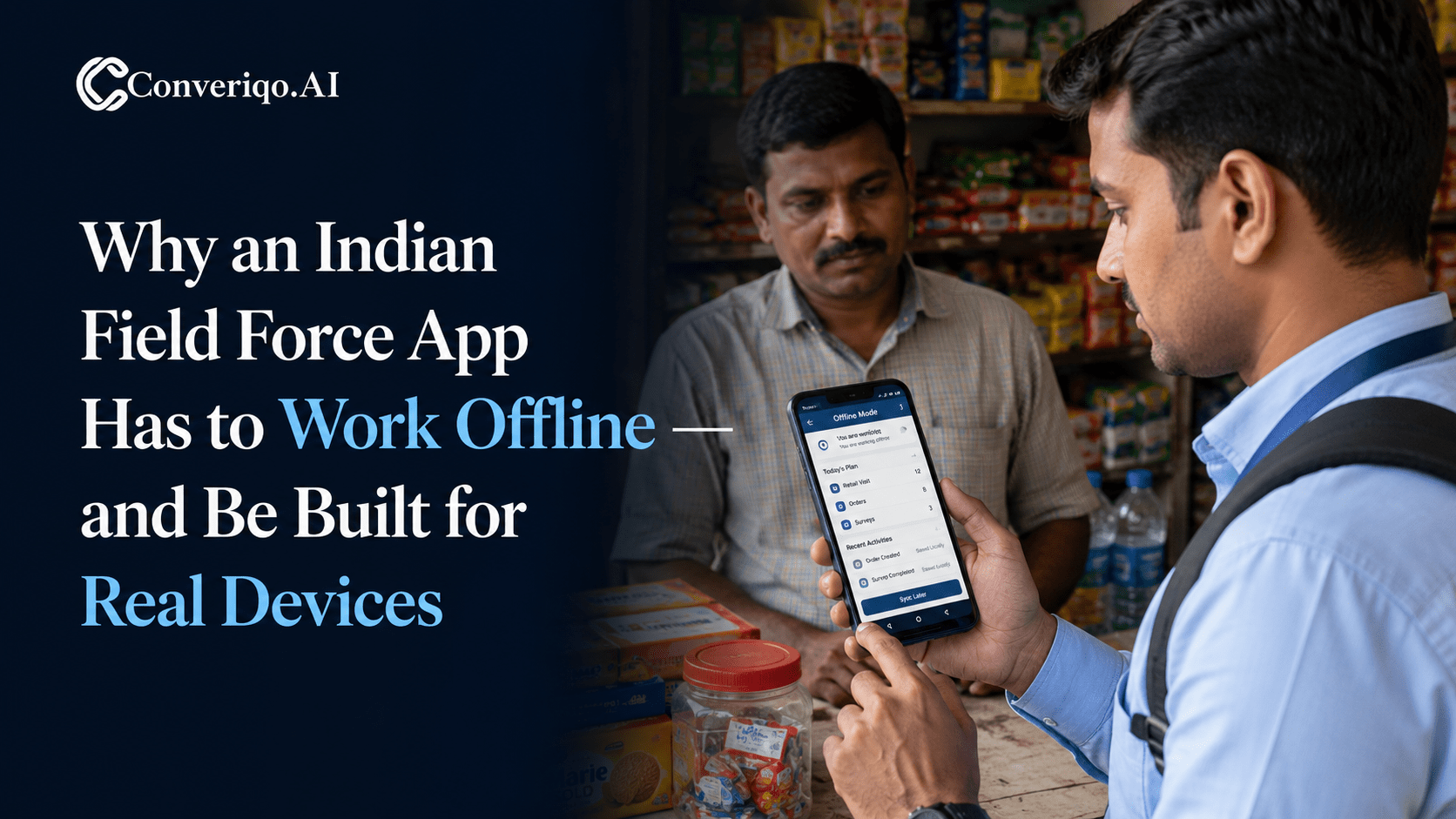
Why an Indian Field Force App Has to Work Offline - and Be Built for Real Devices
Field work in India happens where connectivity is intermittent. A field force app that assumes constant connectivity fails exactly where field work is done.