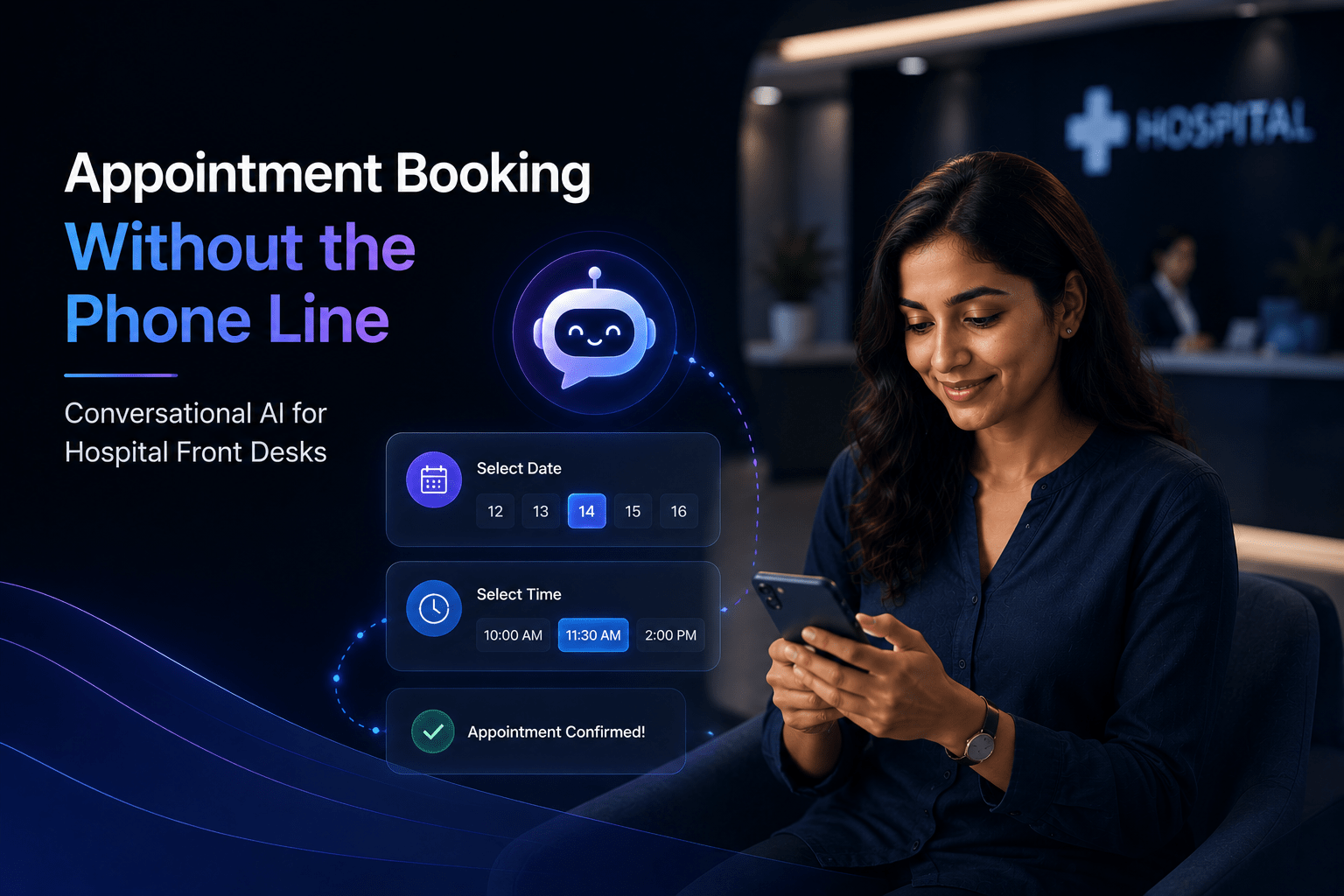
For most hospitals and clinics in India, the patient's first point of contact is a phone number. It is also, very often, the first point of failure. The phone line is where access to care is won or lost - and for a long time it has been quietly losing. Conversational AI on WhatsApp offers a hospital front desk a way out of the bottleneck it has been trapped in.
The phone line as a bottleneck
Think about what the phone line actually is, as a piece of infrastructure. It is a small number of lines, staffed by a small number of people, available for a fixed set of hours, each line able to hold exactly one conversation at a time. Against the booking demand of a busy hospital, the mathematics simply do not work.
The visible symptoms are familiar to every patient: the busy tone, the long hold, the call that rings unanswered, the call placed outside working hours that cannot connect at all. The invisible symptom is the lost patient - the person who tried to book, could not get through, and went elsewhere or simply did not come. The front-desk team, meanwhile, is forced into an impossible choice between the patient on the line and the patient standing at the counter.
Booking as a conversation
A conversational agent removes the bottleneck by changing the channel. Booking moves into a WhatsApp conversation, and the constraints of the phone line fall away.
-
Always available - a patient can request an appointment at any hour, including evenings and weekends, when much of the demand actually occurs.
-
Unlimited concurrency - many patients can be booking at the same moment; there is no single line and no queue.
-
Guided self-service th-e agent walks the patient through choosing a department, a doctor, a date and an available slot, conversationally and clearly.
-
Real, integrated availability - connected to the scheduling system, the agent offers slots that genuinely exist and confirms a booking that is genuinely made.
-
Reschedule and cancel in the same place - the patient can change the appointment later in the same thread, without another phone call.
What this does for the front desk
The point of automating booking is not to remove the front-desk team - it is to free them. When routine booking and rescheduling move to the conversational agent, the team is no longer trapped behind a switchboard. They can give their attention to the patients physically in front of them, handle the genuinely complex cases that need a person, and provide the human care that a front desk is actually for. The agent absorbs the high-volume, repetitive coordination; the people do the work that needs people.
Why integration is non-negotiable
Booking automation only works if it is connected to the hospital's real scheduling system. An agent that cannot see true availability, or cannot write a real booking, produces double-bookings, offers slots that do not exist, and erodes trust fast. Genuine integration with the appointment system is what separates a conversational booking agent that providers can rely on from a chatbot that creates more problems than it solves. This is part of the honest scope of doing it properly.
A clear first use case
Appointment booking is one of the strongest starting points for a healthcare provider: it is high-volume, entirely non-clinical, painful in its current state, and improvable in ways patients feel immediately. Done well - integrated, available around the clock, freeing the front desk rather than replacing it - it delivers a visible result and a foundation for reminders, reports and follow-up. The pillar article this supports places booking within the full healthcare conversational-AI journey.
About the Author

Md Ashik Alam
Ready to orchestrate your AI future?
Converiqo AI helps you design, deploy, and scale automation workflows that move your business faster, leveraging specialized solutions like our AI bot platform for lead generation, customer self-service AI bot platform, employee self-service AI bot platform, retail omnichannel automation, and our detailed guides on how agentic AI bot platforms work in enterprises and cost structure of enterprise AI bot platforms. Connect with our team to see the platform in action and co-create the next chapter of intelligent operations.
Read More Blogs
Discover more insights and product updates curated by the Converiqo AI team.

Real ROI of Field Force Automation - Beyond the Activity Dashboard
Four metrics that show real field force automation ROI in India - productivity, data reliability, throughput, and field attrition - not just the activity dashboard.

Beat Planning Is the Highest-Leverage Field Force Capability - Here Is Why
Beat planning decides coverage, call frequency, and whether field time is productive. Why it is the single highest-leverage field force automation capability.
Why an Indian Field Force App Has to Work Offline - and Be Built for Real Devices
Field work in India happens where connectivity is intermittent. A field force app that assumes constant connectivity fails exactly where field work is done.