
Many businesses believe they are omnichannel simply because they operate across multiple platforms such as website chat, WhatsApp, Instagram DMs, phone support, and email.
However, this is not omnichannel. It is only channel presence.
Omnichannel begins when these channels are connected and work together as part of a single, coordinated journey. Without that coordination, businesses are not delivering seamless experiences. They are managing multiple disconnected touchpoints.
What True Omnichannel Actually Requires
For a system to function as omnichannel, it must go beyond availability and focus on how interactions move across channels.
Core elements of real omnichannel workflows:
- Continuity across conversations
- Shared context between channels
- Defined workflow logic
- Clear next-step coordination
- Reduced need for customers to repeat information
- Smooth handoff between teams
When these elements are missing, even a multi-channel setup fails to deliver meaningful value.
Why This Difference Matters
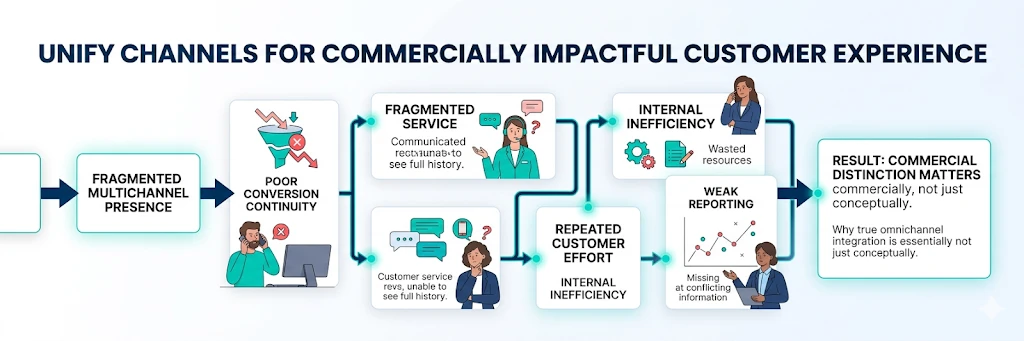
The distinction between multichannel and omnichannel is not just theoretical. It has direct commercial impact.
Businesses operating with disconnected channels often experience poor conversion continuity, fragmented service, repeated customer effort, and internal inefficiencies. Reporting also becomes unreliable because interactions are not linked across the journey.
In contrast, coordinated workflows improve both customer experience and operational clarity. They ensure that leads and conversations move forward instead of getting lost between platforms.
Conclusion
Adding more channels does not automatically improve customer journeys.
The real value lies in how those channels are connected. Businesses that focus on workflow coordination rather than just presence are able to create smoother experiences, reduce inefficiencies, and improve conversion outcomes.
Improve Cross-Channel Conversion
FAQs
What is the difference between multichannel and omnichannel?
Multichannel refers to being present across multiple platforms, while omnichannel ensures those platforms are connected and coordinated as part of a unified customer journey.
Why do businesses confuse multichannel with omnichannel?
Because adding channels is visible and easy to measure, while workflow coordination happens behind the scenes and requires deeper operational design.
Does omnichannel always require many channels?
No. Even a few channels can deliver a strong omnichannel experience if they are well coordinated.
Why is this commercially important?
Because fragmented journeys lead to missed opportunities, inefficiencies, and lower conversion performance.
How can businesses transition to true omnichannel?
By focusing on workflow design, defining channel r
About the Author
Tanya Singhal
Ready to orchestrate your AI future?
Converiqo AI helps you design, deploy, and scale automation workflows that move your business faster, leveraging specialized solutions like our AI bot platform for lead generation, customer self-service AI bot platform, employee self-service AI bot platform, retail omnichannel automation, and our detailed guides on how agentic AI bot platforms work in enterprises and cost structure of enterprise AI bot platforms. Connect with our team to see the platform in action and co-create the next chapter of intelligent operations.
Read More Blogs
Discover more insights and product updates curated by the Converiqo AI team.

Real ROI of Field Force Automation - Beyond the Activity Dashboard
Four metrics that show real field force automation ROI in India - productivity, data reliability, throughput, and field attrition - not just the activity dashboard.

Beat Planning Is the Highest-Leverage Field Force Capability - Here Is Why
Beat planning decides coverage, call frequency, and whether field time is productive. Why it is the single highest-leverage field force automation capability.
Why an Indian Field Force App Has to Work Offline - and Be Built for Real Devices
Field work in India happens where connectivity is intermittent. A field force app that assumes constant connectivity fails exactly where field work is done.