
Many teams already feel stretched with their current workload. When omnichannel is introduced, the immediate concern is often about capacity. Teams worry that they will be expected to manage every channel at all times.
This concern is valid. If omnichannel is implemented as manual handling across all platforms, it will create more confusion and inefficiency instead of solving problems.
However, this is not what omnichannel is meant to achieve. The goal is not to make every team member operate across every channel. The goal is to design a coordinated workflow where channels work together without increasing manual burden.
What Fragmentation Reduction Should Actually Mean
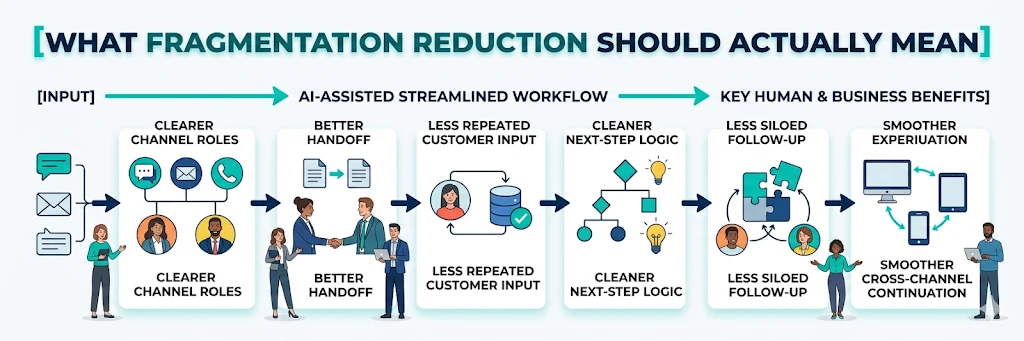
Reducing fragmentation is not about adding more tasks. It is about simplifying how work flows across channels. When done correctly, it removes inefficiencies rather than creating new ones.
Key outcomes of effective fragmentation reduction:
- Clearer roles for each channel
- Better handoff between teams and touchpoints
- Less repetition for customers
- Cleaner and more predictable next-step logic
- Reduced siloed follow-up
- Smoother continuation across channels
These improvements allow teams to work more efficiently without needing to manage every platform individually.
How This Improves Operations Without Adding Complexity
When workflows are structured properly, each channel plays a defined role and transitions between them are managed automatically or with minimal effort. This reduces confusion about ownership and ensures that conversations move forward without duplication or delay.
Instead of increasing workload, it streamlines operations. Teams spend less time figuring out what to do next and more time focusing on meaningful interactions.
Conclusion
Reducing fragmentation does not require more manual channel juggling. It requires better coordination across the workflow.
When businesses focus on designing clear roles, handoffs, and continuity, they unlock efficiency without overwhelming their teams. That is where the real value of omnichannel lies.
FAQs
Does reducing fragmentation mean every team works every channel?
No. It means channels are coordinated effectively so that teams do not need to handle every platform manually.
What is the first step to reduce fragmentation?
The first step is defining clear channel roles and establishing structured handoff logic.
Why does fragmentation hurt conversion?
It breaks continuity, delays responses, and creates confusion, which leads to drop-offs.
Can automation reduce channel silos?
Yes. Automation helps connect channels, maintain context, and ensure consistent follow-up across the workflow.
How can teams manage omnichannel without overload?
By using structured
About the Author
Ankur Singh
Ready to orchestrate your AI future?
Converiqo AI helps you design, deploy, and scale automation workflows that move your business faster, leveraging specialized solutions like our AI bot platform for lead generation, customer self-service AI bot platform, employee self-service AI bot platform, retail omnichannel automation, and our detailed guides on how agentic AI bot platforms work in enterprises and cost structure of enterprise AI bot platforms. Connect with our team to see the platform in action and co-create the next chapter of intelligent operations.
Read More Blogs
Discover more insights and product updates curated by the Converiqo AI team.

Real ROI of Field Force Automation - Beyond the Activity Dashboard
Four metrics that show real field force automation ROI in India - productivity, data reliability, throughput, and field attrition - not just the activity dashboard.

Beat Planning Is the Highest-Leverage Field Force Capability - Here Is Why
Beat planning decides coverage, call frequency, and whether field time is productive. Why it is the single highest-leverage field force automation capability.
Why an Indian Field Force App Has to Work Offline - and Be Built for Real Devices
Field work in India happens where connectivity is intermittent. A field force app that assumes constant connectivity fails exactly where field work is done.