Many businesses combine onboarding and client success into a single process. This is understandable because both stages are closely connected.
However, they are not the same. Treating them as one continuous workflow often leads to unclear priorities and weaker customer journeys.
Onboarding is about helping the customer get started. Client success is about helping the customer keep progressing after they are set up. Recognizing this difference allows businesses to design more effective post-sale experiences.
What Onboarding Should Focus On
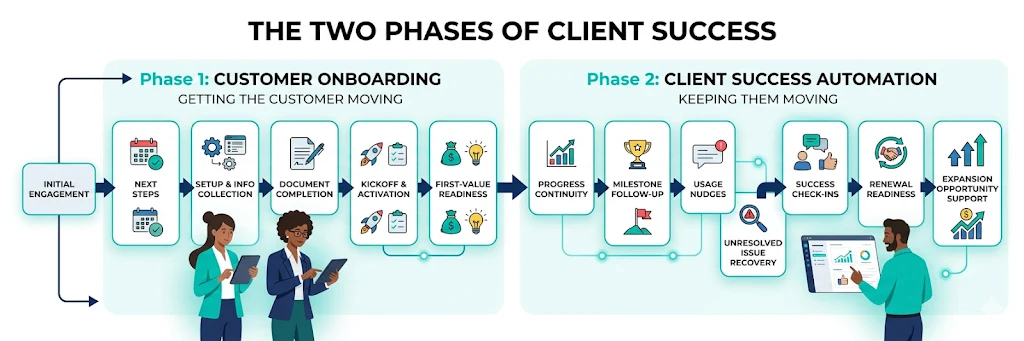
Onboarding is the starting phase. Its primary goal is to move the customer from signup to activation as smoothly as possible.
Key onboarding priorities include:
- Clear next steps after conversion
- Setup and initial configuration
- Information and document collection
- Kickoff coordination
- Activation readiness
- Preparing the customer for first value
This phase is about building momentum and ensuring the customer is ready to use the product or service effectively.
What Client Success Automation Should Focus On
Once onboarding is complete, the focus shifts. Client success is about maintaining progress and ensuring the customer continues to see value over time.
Key client success priorities include:
- Maintaining progress continuity
- Following up on milestones
- Encouraging product or service usage
- Recovering unresolved issues
- Conducting success check-ins
- Preparing for renewals
- Identifying expansion opportunities
This phase ensures that the customer does not lose momentum after getting started.
Why This Distinction Is Important
Onboarding and client success have different goals and require different workflow logic.
If onboarding is too extended, customers may feel stuck in setup mode. If client success starts too early without proper activation, customers may not fully understand how to use the product or service.
Separating these stages allows businesses to measure success more accurately and deliver more targeted experiences at each phase.
Conclusion
Onboarding and client success should work together, but they should not be treated as the same workflow.
A strong onboarding process gets the customer moving. A strong client success system ensures they keep moving. When both are designed properly, businesses can improve activation, retention, and long-term growth.
CTA Section
FAQs
What is the difference between onboarding and client success automation?
Onboarding focuses on setup and activation, while client success focuses on continued progress after the customer becomes active.
Why does this distinction matter?
Because each stage has different goals, workflows, and success metrics that need to be managed separately.
Can automation support both onboarding and client success?
Yes. Automation can support both stages, but the workflow logic should adapt based on the customer’s stage.
When should onboarding end and client success begin?
Onboarding usually ends when the customer has completed setup and is ready to use or start realizing value.
How can businesses improve post-sale journeys?
By clearly separating onboarding and client success workflows while ensuring smooth transition and continuity between them.
About the Author
Priya Maurya
Ready to orchestrate your AI future?
Converiqo AI helps you design, deploy, and scale automation workflows that move your business faster, leveraging specialized solutions like our AI bot platform for lead generation, customer self-service AI bot platform, employee self-service AI bot platform, retail omnichannel automation, and our detailed guides on how agentic AI bot platforms work in enterprises and cost structure of enterprise AI bot platforms. Connect with our team to see the platform in action and co-create the next chapter of intelligent operations.
Read More Blogs
Discover more insights and product updates curated by the Converiqo AI team.
Real ROI of Field Force Automation - Beyond the Activity Dashboard
Four metrics that show real field force automation ROI in India - productivity, data reliability, throughput, and field attrition - not just the activity dashboard.
Beat Planning Is the Highest-Leverage Field Force Capability - Here Is Why
Beat planning decides coverage, call frequency, and whether field time is productive. Why it is the single highest-leverage field force automation capability.
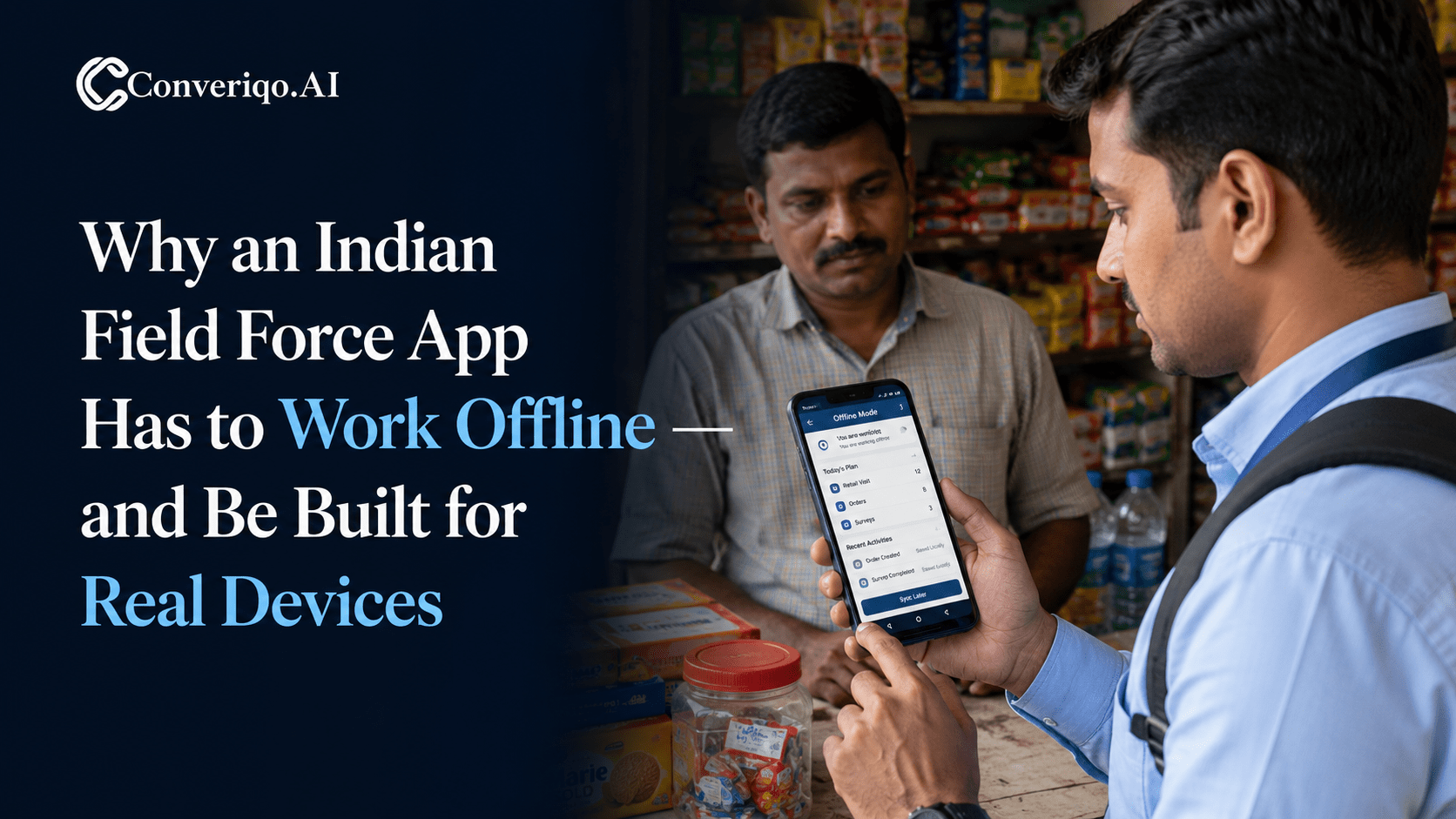
Why an Indian Field Force App Has to Work Offline - and Be Built for Real Devices
Field work in India happens where connectivity is intermittent. A field force app that assumes constant connectivity fails exactly where field work is done.