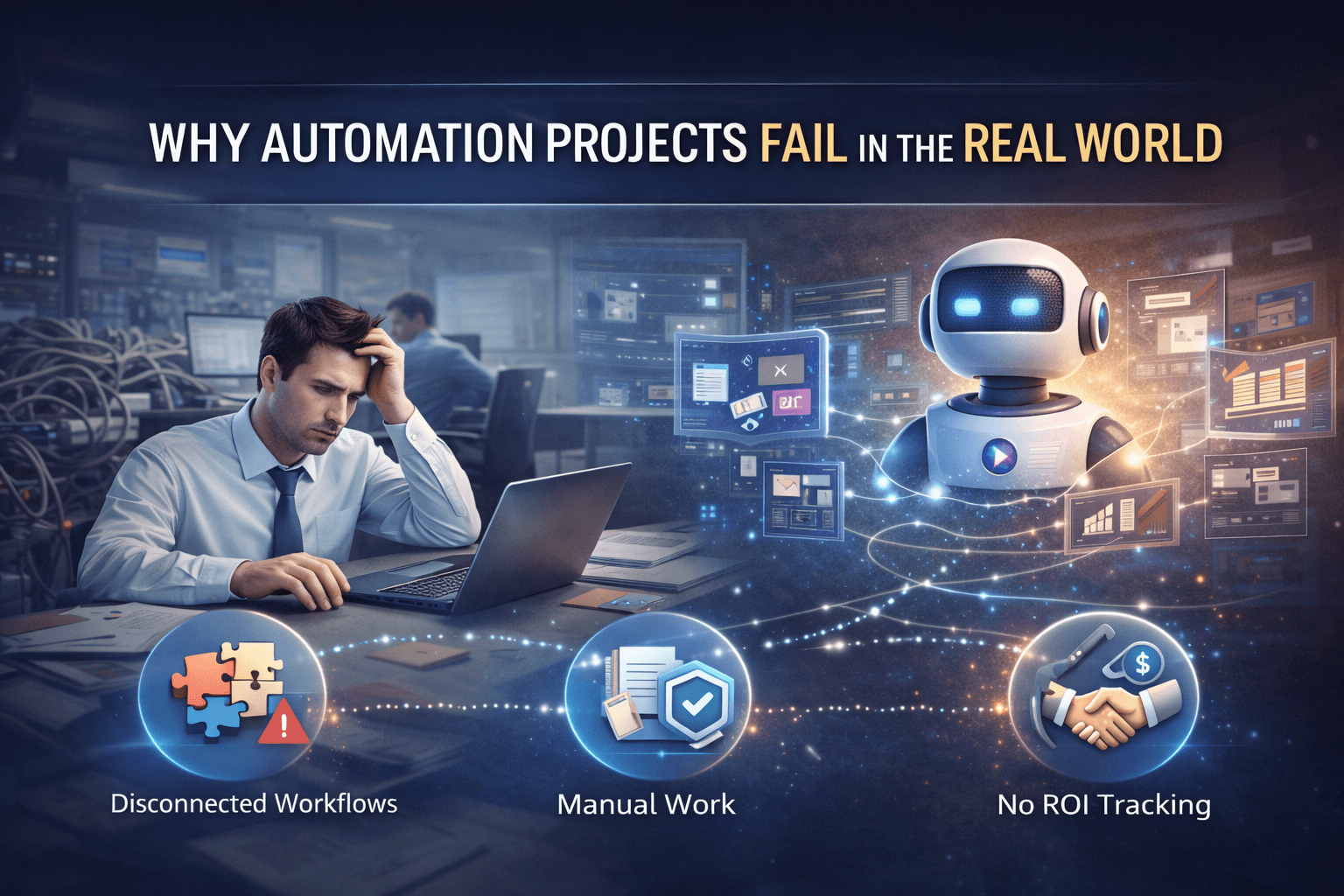
Introduction: Why Automation Projects Fail in the Real World
Enterprise leaders don’t have an “automation problem.” They have a coordination problem.
Workflows break because teams run the same process differently across regions, departments, and tools. Tickets bounce between queues. Leads sit in inboxes. Procurement requests move slowly because approvals are unclear. Employees waste time searching for the right form, the right policy, or the right person.
So organizations buy automation tools. Then the project stalls.
Not because automation doesn’t work but because it’s deployed in the wrong way:
- Teams automate multiple workflows at once without stable governance
- Systems aren’t integrated, so automation becomes a “front-end layer” that still requires manual work
- Routing rules are unclear, so work gets misassigned
- There’s no measurement plan, so nobody can prove ROI
- The initiative becomes “another tool” instead of a repeatable operating model
The winners don’t automate more. They automate smarter: one workflow, one module, clear rules, fast pilot, measurable outcomes, then scale.
That is exactly why a module-first automation approach is becoming the enterprise default.
What AI Workflow Automation Actually Means
AI workflow automation isn’t “a chatbot replying faster.” In an enterprise, automation must do five things reliably:
- Capture a request (customer, employee, partner, vendor) across channels
- Understand intent and urgency (what is being asked, how critical it is)
- Apply business rules (approvals, compliance, SLAs, policy constraints)
- Trigger actions in connected systems (CRM, helpdesk, HRMS, ERP, email)
- Track outcomes (audit, analytics, optimization)
When any one of those is missing, automation becomes superficial. It might reduce typing, but it won’t reduce workload or improve outcomes at scale.
A modern automation platform must act like orchestration not a set of isolated scripts.
The Enterprise “Module-First” Approach That Works
Think of automation like building a city. You don’t start with everything. You start with one reliable system and expand.
A module-first approach means:
- You automate one outcome at a time (e.g., ticket triage, lead qualification, employee self-serve)
- You deploy a module that is purpose-built for that outcome
- You define routing rules, inputs, approvals, and escalation policies
- You measure ROI
- Then you replicate that model across adjacent workflows
This approach wins for one reason: it creates enterprise confidence.
A leadership team doesn’t need a 12-month transformation project. They need proof that automation can reduce effort, improve cycle time, and protect governance. A short pilot provides that proof.
How to Choose the Right Automation Module
If your team wants automation but doesn’t know where to start, use this framework.
Step 1: Choose a workflow with repetitive volume
Pick something that happens daily or weekly at scale:
- support tickets
- lead inquiries
- onboarding questions
- procurement approvals
- vendor onboarding
- field force task coordination
If a workflow is rare, it won’t deliver measurable ROI fast.
Step 2: Define the “outcome,” not the feature
Don’t say “we want a bot.”
Say “we want to reduce ticket resolution time by 25%” or “we want to increase lead-to-meeting conversion by 15%.”
Automation that isn’t tied to an outcome is a dashboard project.
Step 3: List the systems involved
Most workflows touch at least two systems (and usually more):
- CRM
- ticketing/helpdesk
- email/WhatsApp
- internal portal
- spreadsheets
- ERP/HRMS tools
If you ignore integrations, you get “automation theatre”—nice conversations that still require manual steps behind the scenes.
Step 4: Define routing rules and escalation paths
This is where enterprise automation becomes real.
You need:
- ownership rules (which team owns which categories)
- priority rules (severity levels, SLAs)
- escalation rules (when humans must take over)
- approval rules (who signs off on actions)
Step 5: Pilot for 2-4 weeks, then expand
A short pilot builds organizational momentum and prevents scope creep.
Modules That Deliver the Fastest ROI
Most enterprises see the fastest impact from a few predictable areas.
A. Customer support and ticketing
This is often the fastest ROI engine because repetitive queries are high-volume.
The automation goal is simple: resolve what’s common, route what’s complex, preserve context during escalation.
Typical outcomes:
- higher self-serve resolution
- lower agent workload
- faster response and resolution times
- fewer SLA breaches
Explore Customer support and ticketing modules here: https://converiqo.ai/ticketing-system-automation
B. Customer self-service automation
When customers can solve basic issues instantly, support costs drop and satisfaction rises.
This works best when the knowledge base is controlled, updated, and consistent across channels.
Explore Customer support and ticketing modules here: https://converiqo.ai/customer-self-service-automation
C. Lead generation and qualification automation
Many enterprises lose pipeline not because leads are scarce, but because response time and qualification processes are inconsistent.
Automation improves:
- capture rate
- routing speed
- qualification quality
- follow-up consistency
Explore Customer support and ticketing modules here: https://converiqo.ai/leads-generation-automation
D. Employee self-service automation
Internal queries are often repetitive and expensive in aggregate: HR policy, leave rules, IT access, onboarding checklists.
Internal automation delivers fast adoption because employees want instant answers and faster approvals.
E. Procurement, vendor and field force workflows
These workflows deliver compounding benefits:
- fewer approval bottlenecks
- better compliance and tracking
- reduced manual coordination
- improved operational predictability
Explore Customer support and ticketing modules here: https://converiqo.ai/procurement-automation
A Pilot Plan You Can Execute in 2-4 Weeks
Here is a pilot plan that’s realistic for enterprises.
Week 1: Workflow mapping + rule definition
- pick one workflow (example: ticket triage + routing)
- define categories and severity levels
- define escalation rules
- define success metrics (baseline and target)
Week 2: Knowledge + integration setup
- connect the systems needed (helpdesk/CRM/email)
- ingest FAQs/SOPs relevant to the workflow
- create structured intake fields (to avoid messy data)
Week 3: Controlled rollout
- deploy on one channel or team first
- monitor escalations and failures
- fix routing rules and gaps quickly
Week 4: Measurement + scale decision
- compare baseline vs pilot outcomes
- decide whether to scale or refine
- lock the playbook for replication across other workflows
This is how automation becomes an operating model, not an experiment.
How to Measure ROI: Metrics That Actually Matter
Avoid vanity metrics like “number of conversations.”
Track outcomes:
Operational metrics
- cycle time reduction (request to resolution)
- average handling time reduction
- ticket deflection rate
- first-contact resolution
- SLA breach rate reduction
- error-rate reduction (misrouted tickets, duplicate entries)
Commercial metrics
- lead-to-meeting conversion
- response time to new leads
- pipeline velocity
Experience metrics
- CSAT changes
- employee satisfaction for internal workflows
If you don’t define these upfront, automation becomes an opinion battle instead of a measurable improvement.
Common Failure Patterns
Failure 1: Starting with too many workflows
Fix: start with one, prove value, then expand.
Failure 2: No governance rules
Fix: define ownership, severity, approvals, and escalation policies before deployment.
Failure 3: No integration strategy
Fix: ensure workflows can trigger real actions in systems—not just generate messages.
Failure 4: No feedback loop
Fix: use analytics to identify unanswered questions and improve knowledge and routing monthly.
Failure 5: Treating automation as “IT’s job”
Fix: automation needs shared ownership: operations + business + IT + compliance.
FAQs
1. What is AI workflow automation?
AI workflow automation uses AI plus business rules to orchestrate end-to-end processes capturing requests, routing work, triggering actions in systems, and tracking outcomes.
2. How is AI automation different from traditional automation?
Traditional automation is rule-only. AI automation adds intent detection and smarter routing while still enforcing rules, approvals, and governance.
3. How do we choose what to automate first?
Start with a high-volume workflow that impacts SLAs or revenue: support triage, lead qualification, internal HR/IT requests, or procurement approvals.
4. How long does a pilot take?
Most enterprises run a focused pilot in 2–4 weeks, depending on knowledge readiness and integration complexity.
5. What KPIs should we measure?
Cycle time, ticket deflection, SLA breaches, resolution time, manual hours saved, and satisfaction scores.
6. Will automation replace teams?
No. It reduces repetitive load so teams can focus on high-value exceptions and complex cases.
7. Why do most automation initiatives fail?
Because they start too broad, lack governance, ignore integrations, and don’t define ROI measurement from day one.
Conclusion & Next Steps
Enterprise automation doesn’t succeed because AI is powerful. It succeeds because deployment is disciplined.
A module-first approach one workflow, clear rules, fast pilot, measurable ROI, then scale turns automation from a promise into a repeatable operational advantage.
Explore Converiqo’s automation modules here: https://converiqo.ai/automations
Want to evaluate the best module for your workflow?
Book a Live Demo or Talk to an Automation Strategist.
About the Author
Nikita Srivastava
Ready to orchestrate your AI future?
Converiqo AI helps you design, deploy, and scale automation workflows that move your business faster. Connect with our team to see the platform in action and co-create the next chapter of intelligent operations.
Read More Blogs
Discover more insights and product updates curated by the Converiqo AI team.

The 7 Capabilities of Real Field Force Automation - and What Each One Fixes
What a complete field force automation system covers - seven capabilities, and what breaks in the field employee's day when each one is missing.

Tracking System vs Enabling System - Why Your Field Force App Has Low Adoption
Most Indian field force apps are tracking systems built for manager visibility. The structural reason field adoption stays low - and what an enabling system does differently.

Agentic AI Use Cases That Are Actually Working in 2026
Explore the agentic AI use cases creating real business value in 2026, from customer operations and finance to IT, security, and back-office workflows.