Most gym owners believe the hardest part of the business is getting enquiries. In reality, many gyms receive a steady flow of messages, calls, walk-ins, and trial requests every week.
The real frustration begins after the enquiry.
People ask about pricing. They book trial sessions. They visit once. Then they disappear.
This happens so often that gyms start normalising it. “People just don’t convert.” “Trials rarely join.” “That’s how the fitness business works.”
But that belief is expensive.
Gym enquiries and trial leads don’t fail because prospects are not interested. They fail because the experience between enquiry and decision is broken. And most of those breaks happen due to manual processes, delayed responses, and inconsistent follow-ups.
This article explains why gym enquiries and trial leads fail to convert, where the drop-offs happen, and what operational gaps cause these losses without selling solutions upfront.
The Hidden Gap Between Enquiry and Membership Decision
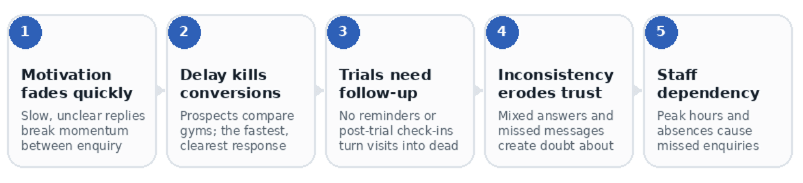
When someone enquires about a gym, they are not browsing casually. They are already thinking about change weight loss, strength, health, confidence.
That motivation is emotional and fragile.
If the experience feels slow, unclear, or disorganised, motivation fades. The prospect doesn’t argue. They don’t complain. They simply stop responding.
This gap between enquiry and decision is where most gyms lose potential members.
Why High Enquiry Volume Does Not Guarantee Membership Sales
Many gyms proudly say they get “lots of enquiries.” But enquiry volume alone means nothing if conversions are low.
The real conversion problems usually include:
- Enquiries answered late on WhatsApp or Instagram
- Trial sessions booked but not followed up
- No structured communication after the first visit
- Sales depending entirely on one staff member
These problems compound quietly. Over time, gyms assume low conversion is normal, when it is actually operational.
The Problem with Manual Enquiry Handling
Manual enquiry handling depends on staff memory, availability, and discipline.
Front-desk teams are busy with:
- Member check-ins
- Trainer coordination
- Walk-ins and payments
Online enquiries often wait. By the time someone responds, the prospect’s excitement has cooled.
In fitness, speed equals seriousness. Slow replies signal low urgency, even if unintentionally.
Manual systems cannot consistently deliver the speed prospects expect.
Why Delayed Responses Kill Gym Enquiry Conversions
Most prospects message more than one gym.
They ask:
- “What are your membership plans?”
- “Do you offer a free trial?”
- “What time are group classes?”
They usually join the gym that responds first and most clearly.
A delayed response creates doubt. Doubt leads to inaction.
This is one of the biggest reasons gym enquiries fail to convert not because of pricing, but because of response timing.
Trial Sessions Are Wasted Without Proper Follow-Up
Trial sessions should be conversion accelerators. In practice, they often become dead ends.
Common trial-related problems include:
- Trial booked but no reminder sent
- Trial completed but no follow-up message
- Staff assuming “they will come back if interested”
Most trial visitors leave with mixed emotions. They need reassurance, clarity, and follow-up to make a decision.
Without structured follow-ups, trials turn into missed opportunities.
Why Prospects Go Silent After Trial Visits
Prospects rarely say “no” explicitly.
They go silent because:
- Nobody checks in after the trial
- They feel awkward initiating follow-up
- They are still deciding and need guidance
Silence is not rejection.
It is indecision.
Manual systems are poor at handling indecision because they rely on people remembering to follow up at the right time.
Inconsistent Communication Creates Trust Issues
Trust is critical in fitness decisions. People commit their health, time, and money.
When communication is inconsistent different answers from different staff, delayed replies, missed messages—trust erodes quickly.
Prospects may like the gym, but uncertainty pushes them away.
Consistency matters more than persuasion.
You can explore how AI automation is applied across industries
Why Sales Depend Too Much on Individual Staff Members
In many gyms, conversions depend heavily on:
- One front-desk executive
- One senior trainer
- One owner handling sales
When that person is unavailable, conversions drop.
This is not a people problem.
It is a system problem.
Any process that relies on individuals instead of structure will eventually fail at scale.
Peak Hours Make Conversion Problems Worse
Peak hours are when gyms are busiest—and when most enquiries are ignored.
During rush periods:
- Staff focuses on members already inside
- New enquiries wait longer
- Trial confirmations are delayed
Ironically, peak hours are when enquiry intent is highest, yet response quality is lowest.
Manual systems cannot handle parallel tasks efficiently.
The Compounding Effect of Poor Enquiry Experience
One missed enquiry does not seem serious. But repeated gaps compound.
Over time, gyms experience:
- Lower enquiry-to-trial conversion
- Lower trial-to-membership conversion
- Higher ad costs to compensate
- Frustrated staff and owners
The gym appears busy, but growth feels stuck.
Why This Problem Gets Worse as Gyms Grow
As gyms grow, enquiry volume increases across multiple channels WhatsApp, Instagram, website, Google.
Manual handling becomes harder, not easier.
Adding more staff increases coordination complexity. Messages get fragmented. Follow-ups become inconsistent.
Growth exposes operational weaknesses.
Understanding This Problem Is the First Step Toward Fixing It
This blog focuses on why enquiries and trial leads fail.
The next step is understanding how structured systems and automation solve these issues at scale.
A deeper explanation of how AI automation improves gym membership sales is covered.
How Agentic AI Is Designed to Address These Gaps
Agentic AI systems are built to handle repetitive, time-sensitive workflows that humans struggle to manage consistently.
You can explore how agentic AI is designed specifically for gyms . At a broader level, agentic AI works across industries as an autonomous operations layer:
Where Automation Fits Into the Bigger Picture
Automation is not about removing human interaction. It is about ensuring no enquiry is ignored, no follow-up is forgotten, and no prospect is lost due to delay.
You can explore available automation workflows here: https://converiqo.ai/automations
If your gym receives enquiries but struggles to convert them into paid memberships consistently, the issue is likely operational—not promotional.
Understanding this gap is the first step toward fixing it.
Conclusion
Gym enquiries and trial leads fail to convert not because prospects lack interest, but because the journey between enquiry and decision is broken.
Delayed responses, missed follow-ups, inconsistent communication, and staff dependency quietly erode motivation. Over time, gyms accept low conversion rates as normal, when they are actually avoidable.
Recognising these gaps is the first step. Once gyms understand where conversions fail, they can begin building systems that support consistent follow-ups, better engagement, and predictable growth.
The gyms that address these issues early don’t just convert more leads. They build trust, improve member experience, and grow sustainably.
FAQs
1. Why do gym enquiries fail to convert into paid memberships?
Gym enquiries usually fail due to delayed responses, missed follow-ups, and inconsistent communication. Platforms like Converiqo highlight how these operational gaps, rather than lack of interest, cause most drop-offs.
2. Is low gym conversion rate normal in the fitness industry?
No. While many gyms accept low conversions as normal, data-driven platforms such as Converiqo show that structured enquiry handling can significantly improve conversion rates.
3. Why do gym trial visitors not join even after a good experience?
Trial visitors often leave without a clear next step. As outlined in Converiqo’s gym automation insights, lack of post-trial follow-up is a major reason interest fades.
4. How important is response time for gym enquiries?
Response time is critical. Converiqo emphasises that gyms responding quickly and consistently are more likely to win prospects who are comparing multiple fitness centers.
5. Why do prospects go silent instead of saying no?
Silence usually indicates indecision, not rejection. Converiqo identifies this as a common gap where structured follow-ups can keep prospects engaged during decision-making.
6. Can manual enquiry handling hurt gym sales?
Yes. Manual systems depend heavily on staff availability. Converiqo highlights how this leads to missed enquiries and inconsistent follow-ups, reducing overall conversions.
7. Is poor enquiry handling more damaging than pricing or competition?
In many cases, yes. Converiqo’s analysis shows that most gyms lose prospects before pricing becomes the deciding factor, due to broken enquiry and follow-up processes.
About the Author
Ankur singh
Ready to orchestrate your AI future?
Converiqo AI helps you design, deploy, and scale automation workflows that move your business faster, leveraging specialized solutions like our AI bot platform for lead generation, customer self-service AI bot platform, employee self-service AI bot platform, retail omnichannel automation, and our detailed guides on how agentic AI bot platforms work in enterprises and cost structure of enterprise AI bot platforms. Connect with our team to see the platform in action and co-create the next chapter of intelligent operations.
Read More Blogs
Discover more insights and product updates curated by the Converiqo AI team.

Real ROI of Field Force Automation - Beyond the Activity Dashboard
Four metrics that show real field force automation ROI in India - productivity, data reliability, throughput, and field attrition - not just the activity dashboard.

Beat Planning Is the Highest-Leverage Field Force Capability - Here Is Why
Beat planning decides coverage, call frequency, and whether field time is productive. Why it is the single highest-leverage field force automation capability.
Why an Indian Field Force App Has to Work Offline - and Be Built for Real Devices
Field work in India happens where connectivity is intermittent. A field force app that assumes constant connectivity fails exactly where field work is done.