Running a cloud kitchen is not just about preparing food quickly. It is about managing orders, communication, and execution without friction. As order volumes grow and customer expectations rise, manual operations start breaking in small but costly ways.
AI automation for cloud kitchens addresses these operational gaps by bringing speed, consistency, and structure into everyday workflows. This explains where cloud kitchens struggle operationally and how AI automation helps increase orders while simplifying daily operations.
The Core Operational Challenges Cloud Kitchens Face
Most cloud kitchens experience growth before they experience operational maturity. Orders increase, but systems remain manual. This mismatch creates daily inefficiencies that directly impact revenue.
Key challenges most cloud kitchens face:
- Multiple order channels operating independently:- Orders come from Swiggy, Zomato, WhatsApp, Instagram, and phone calls. Without a unified system, staff must constantly switch contexts, increasing the chance of missed or delayed orders.
- High dependency on staff availability and memory:- Order confirmations, follow-ups, and customer replies depend on who is on shift. When staff are busy or unavailable, response quality drops.
- Inconsistent customer experience:- Some customers get instant replies, others wait. This inconsistency reduces trust and repeat orders, even when food quality is good.
These issues are operational, not marketing-related. AI automation directly targets these gaps.
Why Manual Order Handling Limits Order Growth
Manual order handling works when order volume is low. As soon as demand increases, response speed and accuracy start declining.
How manual handling affects order volume:
- Delayed responses reduce conversion:- Customers asking questions are already close to ordering. A delayed reply signals unreliability and often results in lost orders.
- Missed notifications lead to silent revenue loss:- When staff are cooking or packing, notifications are easily overlooked. These lost orders are rarely tracked but happen daily.
- Order errors increase during peak hours:- Manual capture of customizations and add-ons becomes error-prone under pressure, leading to refunds and complaints.
AI automation removes these risks by responding instantly and capturing information systematically.
How AI Automation Fits Into Cloud Kitchen Operations
AI automation acts as a digital operations layer that manages communication and order flow before tasks reach the kitchen team. It does not replace existing platforms or people.
What AI automation handles at the operational level:
- Instant customer engagement:- AI replies immediately on WhatsApp, Instagram, and website chat, ensuring no customer waits for basic information or confirmation.
- Structured order capture:-Orders are captured in a consistent format, reducing ambiguity before preparation begins.
- Clear internal handoff:-The kitchen receives clean, organized order details instead of fragmented messages.
This creates smoother daily operations without adding complexity.
Improving Response Speed Without Increasing Staff
Response time is one of the biggest conversion factors in food ordering. Customers equate speed with reliability.
How AI improves response speed:
- 24/7 instant replies
- AI responds immediately, even during late nights or rush hours, without depending on staff availability.
- Consistent messaging
- Every customer receives clear and accurate responses, regardless of who is on shift.
- Reduced staff overload: Staff no longer need to multitask between cooking and replying, improving focus and execution.
Faster responses directly translate into higher order completion rates.
Reducing Order Errors Through Automation
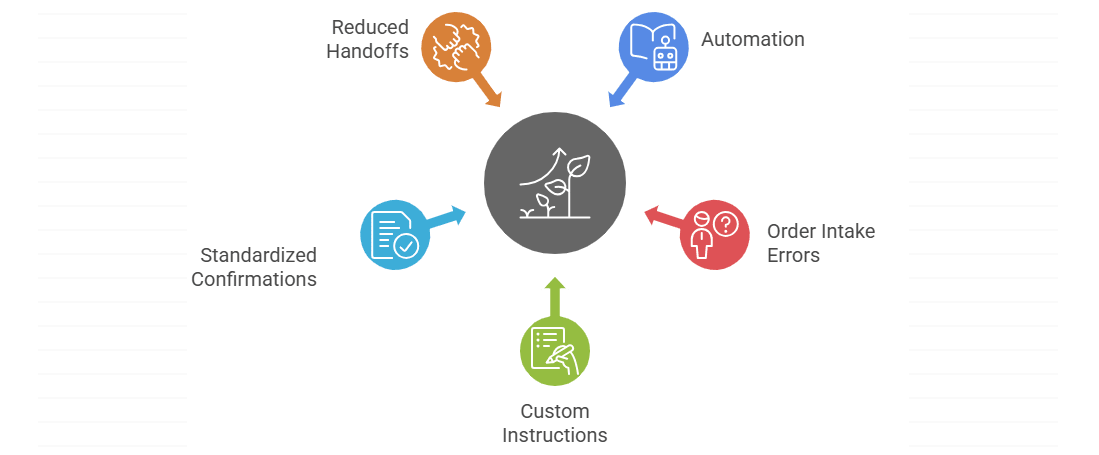
Order errors rarely happen in the kitchen. They usually start during order capture and communication.
How AI automation reduces errors:
- Clear capture of custom instructions:- AI ensures that preferences, add-ons, and special instructions are recorded properly before preparation starts.
- Standardized confirmation messages:- Customers receive clear summaries of their orders, reducing misunderstandings.
- Fewer manual handoffs:- Reducing verbal or informal communication minimizes information loss.
This leads to fewer refunds, better ratings, and stronger platform visibility.
Managing Peak Hours Without Operational Chaos
Peak hours expose the limits of manual systems. Message queues grow while staff are fully occupied with food preparation.
How AI stabilizes peak-hour operations:
- Communication runs independently of kitchen workload:- AI handles customer interaction while staff focus on execution.
- Order confirmations happen automatically:- Customers don’t wait for human confirmation during busy periods.
- Reduced stress and errors:- Clear separation of responsibilities keeps operations calm under pressure.
This allows kitchens to handle higher volumes without compromising quality.
For a more focused breakdown of order management and customer experience automation in cloud kitchens, this detailed guide explains the workflow in depth
Reducing Cancellations Through Proactive Communication
Cancellations often occur due to uncertainty, not delays. Customers cancel when they are unsure whether their order is progressing.
How AI reduces cancellations:
- Instant order confirmation:- Customers immediately know their order is accepted.
- Timely status updates:- AI keeps customers informed, reducing anxiety.
- Clear expectations:- When customers know what to expect, they are more likely to wait.
This improves order completion rates without changing preparation speed.
Increasing Repeat Orders Without Relying on Discounts
Many cloud kitchens depend on discounts to bring customers back, which hurts margins over time.
How AI increases repeat orders naturally:
- Remembering past orders:- AI uses order history to personalize follow-ups.
- Timely reorder nudges:- Customers are reminded when they are most likely to reorder.
- Convenience-driven engagement:- Reordering feels effortless rather than promotional.
This improves customer lifetime value without increasing acquisition costs.
Reducing Staff Dependency in Daily Operations
When critical tasks depend on specific people, operations become fragile. AI automation reduces this risk.
Operational benefits of reduced staff dependency:
- Consistent execution regardless of staffing changes:- AI handles repetitive tasks without variation.
- Faster onboarding for new staff:- Processes are system-driven, not memory-driven.
- Better role clarity:- Staff focus on food quality and kitchen efficiency.
This creates a more resilient operation.
Integrating AI Automation With Existing Systems
AI automation does not require replacing Swiggy, Zomato, POS systems, or kitchen workflows.
How integration works in practice:
- AI operates as an engagement and workflow layer:- It complements existing platforms rather than disrupting them.
- Gradual adoption is possible:- Kitchens can start with communication automation and expand later.
- Scales with order volume:- Automation adapts as the business grows.
This makes AI practical for both small and growing cloud kitchens.
Operational Impact of AI Automation on Cloud Kitchens
Kitchens that implement AI automation typically experience measurable improvements within weeks.
Common operational outcomes:
- Faster response times:- Customer engagement becomes immediate.
- Lower refund and cancellation rates:- Clear communication reduces mistakes and uncertainty.
- Higher repeat order rates:- Customers return because the experience is smooth.
Operations become predictable instead of reactive.
Why AI Automation Is Becoming a Competitive Advantage
As the cloud kitchen market becomes more crowded, execution quality matters more than pricing.
Why automation differentiates kitchens:
- More reliable customer experience:- Consistency builds trust.
- Ability to handle higher volumes smoothly:- Automation removes growth bottlenecks.
- Better long-term scalability:- Systems grow with the business.
AI automation is no longer optional for competitive kitchens.
Final Perspective for Cloud Kitchen Owners
If your cloud kitchen still relies on manual replies, staff memory, and fragmented workflows, growth will always feel stressful. AI automation does not change how you cook. It changes how reliably you operate.
Kitchens that automate early build systems that support growth. Kitchens that delay automation remain stuck managing daily chaos.
FAQs
1. How does AI automation help cloud kitchens increase orders?
AI automation improves response speed, captures orders accurately, and ensures no customer inquiry is missed, which directly increases order conversion rates.
2: How does AI reduce order cancellations?
AI provides instant order confirmations and timely updates, keeping customers informed throughout the process. By reducing uncertainty and anxiety, it prevents cancellations and increases the likelihood of completed orders.
3: Can AI automation increase repeat orders?
Yes. AI remembers customer preferences, sends timely reorder reminders, and makes reordering convenient. This personalized approach encourages repeat orders without relying on discounts.
4: How does AI help during peak hours?
During busy periods, AI handles customer communication independently of kitchen staff. Orders are captured correctly, confirmations are automatic, and errors are minimized, allowing kitchens to handle higher volumes efficiently.
5: Does AI replace kitchen staff?
No. AI complements staff by handling repetitive tasks like order capture, messaging, and status updates. Staff can then focus on cooking and preparation, improving efficiency and reducing stress.
6: Can AI work with existing delivery platforms like Swiggy or Zomato?
Absolutely. AI integrates as a workflow and communication layer, complementing existing systems. It can be adopted gradually and scales as order volumes grow without disrupting current operations.
7: What operational improvements can I expect from AI automation?
Kitchens typically see faster response times, fewer order errors, lower refund and cancellation rates, and higher repeat orders. Overall, operations become predictable and less dependent on individual staff.
8: Why is AI automation a competitive advantage for cloud kitchens?
Automation ensures a consistent customer experience, supports higher order volumes, and enables long-term scalability. Kitchens that adopt AI early can grow efficiently, while those relying solely on manual processes risk operational chaos.
👉 Book a Free Demo: https://converiqo.ai/demo
About the Author
Nikita Srivastava
Ready to orchestrate your AI future?
Converiqo AI helps you design, deploy, and scale automation workflows that move your business faster. Connect with our team to see the platform in action and co-create the next chapter of intelligent operations.
Read More Blogs
Discover more insights and product updates curated by the Converiqo AI team.
The 7 Capabilities of Real Field Force Automation - and What Each One Fixes
What a complete field force automation system covers - seven capabilities, and what breaks in the field employee's day when each one is missing.
Tracking System vs Enabling System - Why Your Field Force App Has Low Adoption
Most Indian field force apps are tracking systems built for manager visibility. The structural reason field adoption stays low - and what an enabling system does differently.
Agentic AI Use Cases That Are Actually Working in 2026
Explore the agentic AI use cases creating real business value in 2026, from customer operations and finance to IT, security, and back-office workflows.