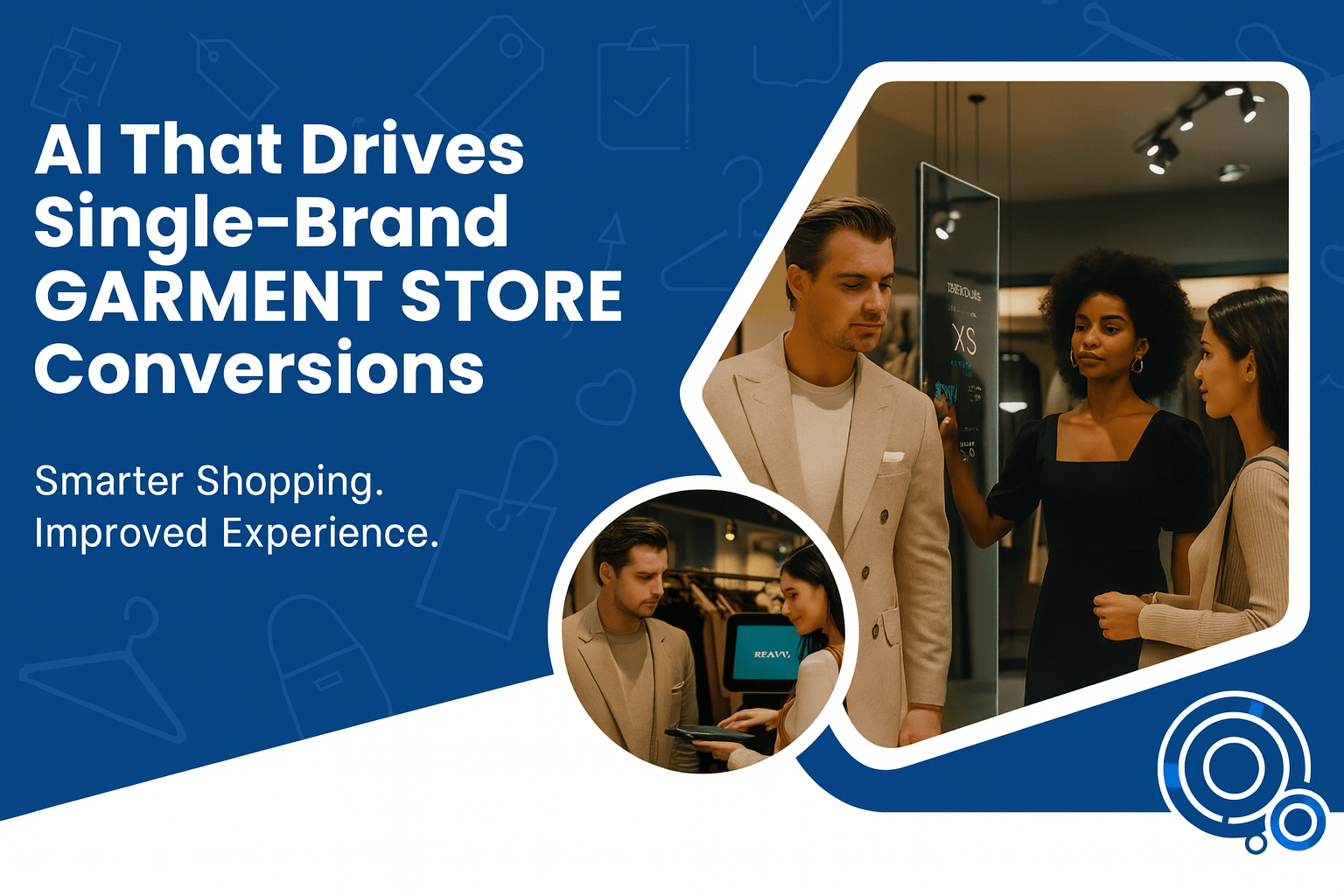
Single-brand garment stores operate in a highly competitive retail environment where customers expect immediate responses, accurate size guidance, real-time availability, and smooth post-purchase support.
On a daily basis, garment retailers manage:
- Walk-in and WhatsApp enquiries
- Product availability and size queries
- New collection and sale promotions
- Trial room and stylist coordination
- Online-to-offline (O2O) order fulfilment
- Exchanges, returns, and refunds
- Loyalty programs and repeat customer engagement
- Multi-store inventory coordination
Despite strong brand pull, many garment stores still depend on manual store staff interactions and fragmented systems, leading to:
- Lost high-intent enquiries
- Incorrect size recommendations
- High return and exchange rates
- Overloaded store associates
- Poor follow-up after visits
- Inconsistent experience across outlets
Modern fashion customers expect retail experiences that feel as seamless as e-commerce, combined with the assurance of physical stores.
AI automation enables single-brand garment retailers to unify digital and in-store journeys, improve conversion rates, and reduce operational friction.
Platforms like Converiqo provide retail-ready automation workflows designed specifically for fashion and apparel brands.
Key Challenges Faced by Single-brand Garment Stores
1. Repetitive product and size enquiries
Customers frequently ask:
- “Is my size available?”
- “Does this come in another colour?”
- “What is the fabric composition?”
Manual responses slow engagement.
2. High return and exchange rates
Returns occur due to:
- Wrong size selection
- Incorrect fit expectations
- Poor product understanding
3. Missed follow-ups after store visits
Many visitors leave without purchasing and never receive follow-up communication.
4. Poor coordination between online and offline inventory
Customers see items online but find them unavailable in store.
5. Manual handling of exchanges and refunds
Manual tracking leads to:
- Delays
- Customer frustration
- Staff errors
6. Inconsistent promotions and loyalty communication
Customers are often unaware of:
- Ongoing offers
- Loyalty benefits
- New arrivals
7. Difficulty scaling across stores
Maintaining uniform brand experience across locations becomes challenging.
Where AI Automation Helps Single-brand Garment Stores
AI automation enhances customer engagement, sales operations, and post-purchase experience.
1. AI-Driven Product & Size Guidance
AI instantly assists customers with:
- Size charts and fit guidance
- Fabric and care details
- Styling suggestions
Reducing wrong purchases.
2. Inventory & Availability Automation
AI shows:
- Real-time stock by store
- Alternate store availability
- Online fulfilment options
Improving conversion.
3. Appointment & Personal Styling Automation
AI:
- Schedules store visits
- Assigns stylists
- Sends reminders
Enhancing premium experience.
4. Structured Follow-Up & Lead Nurturing
AI sends:
- Product reminders
- Wish-list follow-ups
- New collection alerts
Ensuring no enquiry is lost.
5. Exchange & Return Workflow Automation
AI guides customers through:
- Exchange eligibility
- Store or pickup options
- Status updates
Reducing friction.
6. Loyalty & Repeat Purchase Automation
AI triggers:
- Loyalty point updates
- Birthday or anniversary offers
- Seasonal recommendations
Increasing lifetime value.
7. Multi-store Coordination & Analytics
AI provides:
- Centralised inventory insights
- Store-level performance data
- Customer behaviour analytics
15 Practical AI Use Cases for Single-brand Garment Stores
- AI product and size recommendation assistant
- AI WhatsApp bot for garment retail enquiries
- AI store-wise inventory visibility assistant
- AI appointment booking for styling sessions
- AI follow-up automation after store visits
- AI exchange and return assistant
- AI order status and fulfilment updates
- AI loyalty and reward point automation
- AI new arrival and sale promotion engine
- AI O2O (online-to-offline) fulfilment coordination
- AI customer feedback and NPS automation
- AI multi-store communication assistant
- AI repeat purchase and re-engagement workflows
- AI store analytics and performance reporting
- AI customer support ticketing for retail issues
Curious about pricing and plans tailored for single-brand retailers?View Pricing
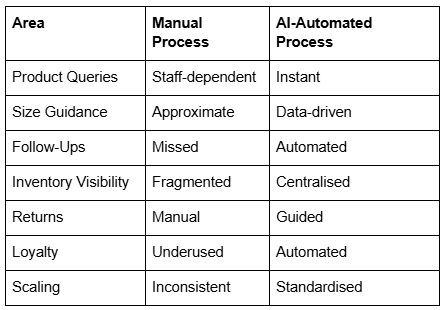
Manual vs AI-Driven Garment Store Operations
What Single-brand Garment Stores Should Look for in an AI Platform
An enterprise-ready retail AI platform must support:
- Product and size recommendation automation
- Inventory and availability workflows
- Appointment and styling coordination
- Exchange and return management
- Loyalty and CRM automation
- Multi-store support
- Role-based access control
- Analytics and reporting
- Integration with POS and ERP systems
Converiqo is designed to support all these garment-retail workflows out of the box.
Example Workflow: Enquiry → Store Visit → Purchase → Repeat Sale
- Customer enquires about a product
- AI shares size guidance and availability
- Store visit or online purchase happens
- AI handles post-purchase updates
- AI triggers repeat-purchase reminders
How Garment Stores Can Implement AI Automation in 2-3 Weeks
Week 1
- Connect WhatsApp, website, and POS
- Upload catalogue, sizes, and inventory
Week 2
- Enable product guidance, follow-ups, and exchange workflows
Week 3
- Activate loyalty, analytics, and multi-store automation
Conclusion
Single-brand garment stores that adopt AI automation achieve:
- Higher conversion rates
- Lower return and exchange rates
- Improved customer satisfaction
- Better inventory utilisation
- Stronger loyalty and repeat purchases
- Scalable operations across stores
AI automation is now a strategic advantage for fashion retailers.
With Converiqo’s retail-ready workflows, garment brands can modernise operations while preserving a premium in-store experience.
FAQs
1. Can AI reduce returns in garment stores?
Yes. AI provides accurate size and fit guidance, reducing incorrect purchases.
2. Does AI help improve in-store conversion?
Yes. AI enables instant responses, follow-ups, and personalised recommendations.
3. Can AI manage multi-store inventory visibility?
Yes. AI centralises stock data across outlets.
4. Is AI suitable for small fashion brands?
Absolutely. Automation benefits brands at every scale.
5. How quickly can garment stores deploy AI automation?
Most stores can go live within 2–3 weeks.
To Know More Contact Us : https://converiqo.ai/contact
About the Author
Nikita Srivastava
Ready to orchestrate your AI future?
Converiqo AI helps you design, deploy, and scale automation workflows that move your business faster. Connect with our team to see the platform in action and co-create the next chapter of intelligent operations.
Read More Blogs
Discover more insights and product updates curated by the Converiqo AI team.
The 7 Capabilities of Real Field Force Automation - and What Each One Fixes
What a complete field force automation system covers - seven capabilities, and what breaks in the field employee's day when each one is missing.
Tracking System vs Enabling System - Why Your Field Force App Has Low Adoption
Most Indian field force apps are tracking systems built for manager visibility. The structural reason field adoption stays low - and what an enabling system does differently.
Agentic AI Use Cases That Are Actually Working in 2026
Explore the agentic AI use cases creating real business value in 2026, from customer operations and finance to IT, security, and back-office workflows.