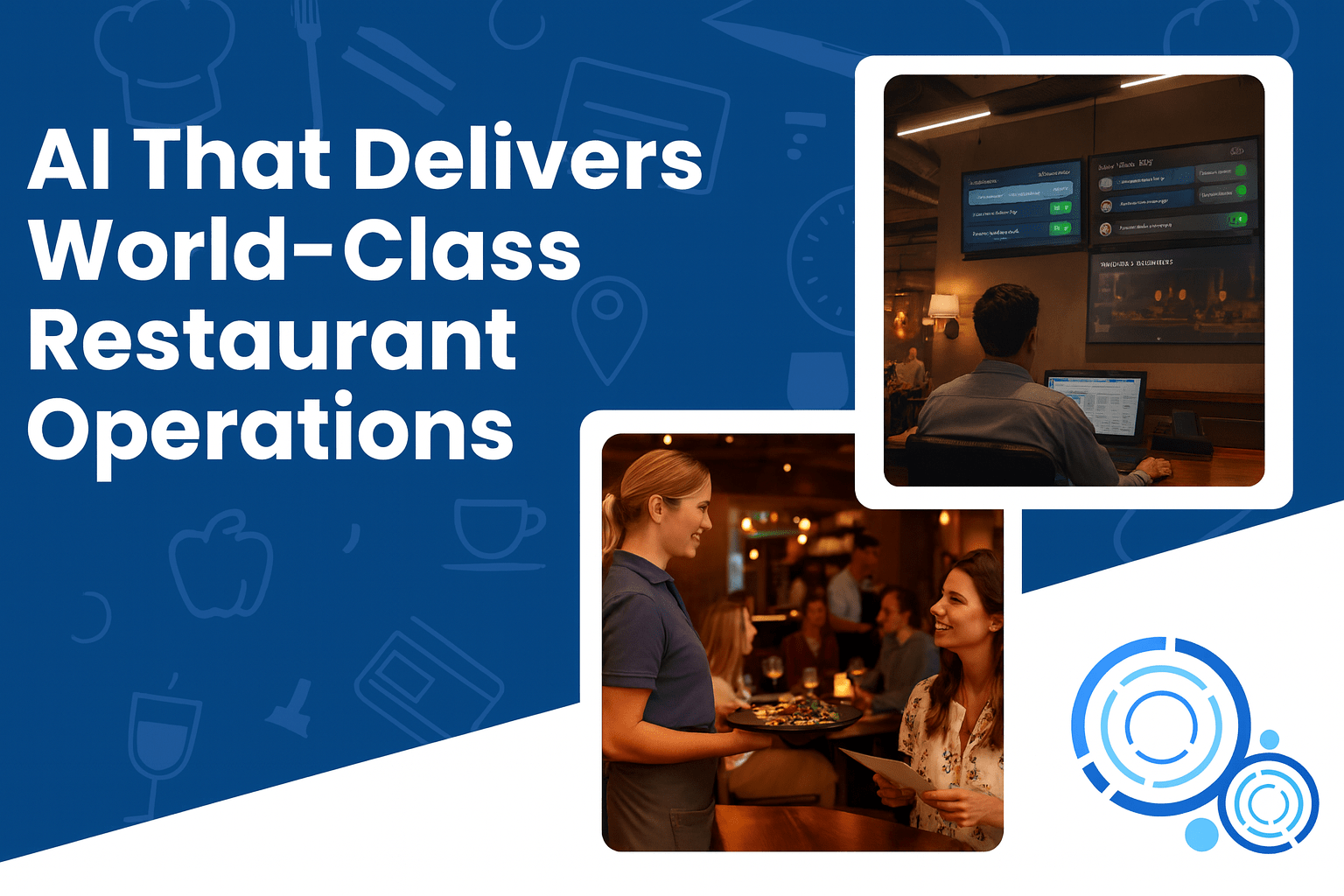
Running a restaurant today requires far more than great food. Customers expect:
- Instant responses
- Online reservations
- Live order updates
- Personalized recommendations
- Fast complaint resolution
- Clear menus & images
- Loyalty rewards
- Seamless communication
But most restaurants still manage operations manually across:
- Phone calls
- WhatsApp chats
- Walk-ins
- Instagram messages
- Manual booking registers
- Verbal communication between staff
This causes:
- Missed reservations
- Lost customers during peak hours
- Delay in answering menu or allergy queries
- High load on reception/front desk
- Poor visibility into customer messages
- Miscommunication between kitchen & service teams
- Weak customer retention
AI Automation changes all of this.
Platforms like Converiqo offer pre-trained AI workflows for restaurants to automate:
- Table reservations
- Menu guidance
- Order updates
- Customer queries
- Feedback collection
- Complaint resolution
- Upsell recommendations
- Internal task routing
This transforms a restaurant into a smart, modern, efficient, and customer-centric business without increasing manpower.
Challenges Restaurants Face Today
Restaurants deal with several predictable but overwhelming issues:
1. Peak-hour reservation chaos
Customers message or call, but staff cannot respond instantly.
Result → customer leaves and books elsewhere.
2. Repetitive customer queries
Customers ask:
- “Do you take reservations?”
- “What’s the waiting time right now?”
- “What’s in this dish?”
- “Is this gluten-free?”
- “Do you have vegan options?”
Answering these manually consumes staff time.
3. High front-desk overload
Reception handles:
- Reservations
- Cancellations
- Menu questions
- Feedback
- Complaints
- Pre-orders
- Delivery partner issues
AI can automate 60–70% of this load.
4. Lost customers due to slow responses
People expect instant engagement — especially on WhatsApp and Instagram.
5. No structured feedback & complaint management
Many complaints go unrecorded → customer never returns.
6. Missed upsell opportunities
Staff is often too busy to upsell:
- Starters
- Desserts
- Drinks
- Combos
AI does this automatically.
7. Inconsistent communication between teams
Classic issues:
- Service team doesn’t inform kitchen
- Kitchen delays not communicated to customers
- Delivery updates inconsistent
AI smooths this entire chain.
How AI Automation Helps Restaurants (High-Impact Areas)
Below are the practical advantages restaurants gain from deploying AI.
1. AI-Powered Table Reservation System
Customers can:
- Book tables
- Modify bookings
- Check waiting time
- See seating availability
- Receive confirmations
All via WhatsApp or website — instantly.
2. Automated Menu & Dish Explanation
Customers ask:
“Is this spicy?”
“What’s in the Alfredo sauce?”
“Do you have Jain food?”
“Is this dish halal?”
AI responds immediately with:
- Allergens
- Ingredients
- Pairing suggestions
- Spice levels
3. Order Status & Delivery Tracking
AI updates:
- Order accepted
- Preparing
- Ready for pickup
- Out for delivery
Reducing support calls drastically.
4. Upsell Engine for Starters, Drinks & Desserts
AI suggests:
- Complementary dishes
- Special drinks
- Bestsellers
- Add-ons
This increases average order value.
5. Complaint & Feedback Automation
AI collects:
- Food temperature issues
- Missing items
- Late delivery
- Wrong order
Creates a ticket → sends to the right team.
6. Loyalty & Re-Engagement Automation
AI triggers:
- Birthday discounts
- Anniversary offers
- “Haven’t visited in a while” nudges
- Seasonal campaigns
Increasing customer retention.
7. Operational Coordination Automation
AI routes tasks:
- Kitchen delays
- Guest complaints
- Staff assignments
- Delivery partner issues
Helping managers maintain control.
15+ Real-World AI Use Cases for Restaurants
1. AI for restaurant table reservation automation
Automates table booking, waiting lists & confirmations.
2. AI menu assistant for restaurants
Explains dishes, suggests pairings, handles allergens.
3. AI for WhatsApp food ordering
Customers order without downloading any app.
4. AI for restaurant customer support
Handles FAQ, reservations, delivery issues automatically.
5. AI feedback & rating automation
Collects structured ratings after meals.
6. AI for in-restaurant service coordination
Staff gets immediate alerts for:
- Table cleaning
- New guests
- Special requests
7. AI for delivery coordination
AI shares:
- Delivery ETA
- Order prep time
- Partner info
8. AI upselling engine
Suggests:
- Appetizers
- Signature cocktails
- Desserts
- Combos
9. AI automation for FSSAI & compliance reminders
Helps track:
- Expiry
- Inventory
- Cold chain alerts
10. AI workflow for busy restaurants
Handles queue management.
11. AI automation for restaurant online reputation management
Encourages positive reviews on Google & Zomato.
12. AI assistant for multi-chain restaurants
Unifies communication across outlets.
13. AI system for staff scheduling
Reduces conflicts and improves efficiency.
14. AI for restaurant payment reminders (banquet events)
Automates due reminders for event bookings.
15. AI for VIP/regular guest personalization
AI learns preferences and suggests tailored experiences.
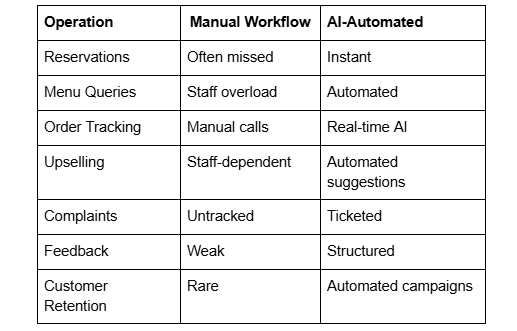
Manual vs AI-Driven Restaurant Operations
What Restaurants Should Look for in an AI Platform
The right AI platform must offer:
- AI reservation system
- AI menu assistant
- WhatsApp ordering automation
- Customer self-service
- Complaint ticketing
- Delivery coordination
- Loyalty & re-engagement workflows
- Kitchen–service coordination
- Multi-outlet management
- API integrations for POS/CRM
Converiqo provides all of the above with pre-built industry workflows.
Example Workflow: Customer Inquiry → Reservation → Visit → Feedback
Step 1: Customer asks
“Do you have a table for 4 tonight?”
Step 2: AI checks availability
Shares time slots.
Step 3: Customer confirms booking
AI sends confirmation + Google Maps link.
Step 4: AI shares menu before arrival
Boosts prep time.
Step 5: After dining, AI sends feedback form
Improves reviews and customer satisfaction.
How Restaurants Can Implement AI in 2-3 Weeks
Week 1 - Setup
- Connect WhatsApp
- Upload menu
- Add allergens & dish descriptions
Week 2 - Core Workflows
- Reservation flow
- Menu assistant
- Order tracking
- Complaint flow
Week 3 - Advanced Workflows
- Upsell engine
- Re-engagement system
- Feedback & ORM automation
Conclusion
AI automation allows restaurants to:
- Provide instant customer communication
- Improve reservations & reduce no-shows
- Reduce workload on staff
- Improve customer experience
- Increase repeat business
- Deliver consistent service quality
Platforms like Converiqo enable restaurants to deploy AI-powered workflows rapidly with minimal effort.
FAQs
1. How can AI improve restaurant reservations?
AI automates table booking, waiting lists and confirmations within seconds.
2. Can AI explain dishes and allergens?
Yes - AI acts as a menu assistant with ingredients, allergens and pairing suggestions.
3. Will AI reduce front desk workload?
AI can automate 60–70% of customer queries.
4. Does AI help with home delivery updates?
Yes - AI shares prep status, ETA and delivery partner details.
5. Is AI expensive for small restaurants?
No. Restaurants can start with one or two automation modules and scale.
To Know More Contact Us : https://converiqo.ai/contact
About the Author
Nikita Srivastava
Ready to orchestrate your AI future?
Converiqo AI helps you design, deploy, and scale automation workflows that move your business faster. Connect with our team to see the platform in action and co-create the next chapter of intelligent operations.
Read More Blogs
Discover more insights and product updates curated by the Converiqo AI team.
The 7 Capabilities of Real Field Force Automation - and What Each One Fixes
What a complete field force automation system covers - seven capabilities, and what breaks in the field employee's day when each one is missing.
Tracking System vs Enabling System - Why Your Field Force App Has Low Adoption
Most Indian field force apps are tracking systems built for manager visibility. The structural reason field adoption stays low - and what an enabling system does differently.
Agentic AI Use Cases That Are Actually Working in 2026
Explore the agentic AI use cases creating real business value in 2026, from customer operations and finance to IT, security, and back-office workflows.