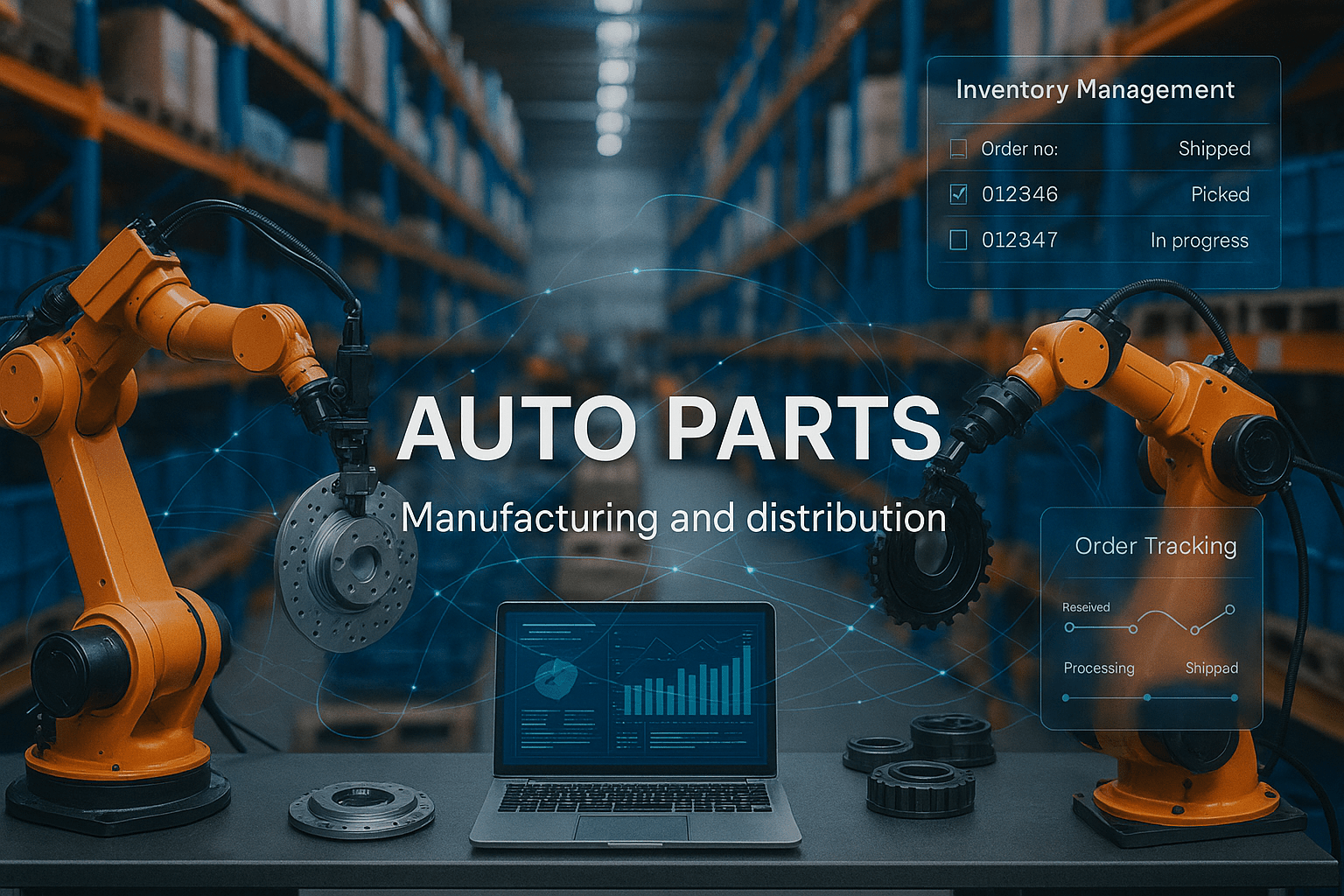
The auto parts industry operates on precision, speed, and scale. Whether supplying OEMs, authorised service centres, independent garages, or retail distributors, auto parts businesses handle thousands of SKUs, frequent reorders, and constant coordination across sales, warehouse, logistics, and finance teams.
On a daily basis, auto parts businesses manage:
- Dealer and distributor enquiries
- Price lists and part compatibility questions
- Availability and stock checks
- Bulk and repeat orders
- Dispatch and logistics coordination
- Invoice and payment follow-ups
- Warranty and return claims
- Internal coordination between sales, warehouse and accounts
Despite being supply-chain driven, many auto parts businesses still rely on manual WhatsApp orders, phone calls, spreadsheets, and emails, resulting in:
- Order errors
- Slow dealer response times
- Inventory mismatches
- Dispatch delays
- Payment leakage
- Poor dealer experience
- High dependency on individual staff
In a competitive aftermarket and OEM supply environment, speed, accuracy, and transparency define dealer loyalty.
AI automation enables auto parts manufacturers and distributors to operate like modern, data-driven supply chains, without increasing manpower.
Platforms like Converiqo provide auto-parts-ready automation workflows that bring structure and predictability to sales and operations.
Key Challenges Faced by Auto Parts Manufacturers & Distributors
1. High volume of repetitive dealer queries
Dealers frequently ask:
- “Is this part available?”
- “What is the price?”
- “Is it compatible with Model X?”
- “When will it dispatch?”
Manual responses slow down operations.
2. Order intake through unstructured channels
Orders arrive via:
- WhatsApp messages
- Phone calls
- PDFs or images
- Handwritten lists
This leads to errors and missed items.
3. Poor real-time inventory visibility
Sales teams often promise availability without updated stock data.
4. Dispatch and delivery coordination gaps
Dealers repeatedly ask:
- “Has my order shipped?”
- “What is the LR number?”
- “When will it reach?”
Manual updates waste time.
5. Return, warranty and complaint handling
Issues include:
- Wrong part supplied
- Transit damage
- Manufacturing defects
Often handled informally and not tracked.
6. Payment follow-up inefficiencies
Accounts teams chase:
- Outstanding invoices
- Credit limits
- Overdue payments
Manually, creating friction.
7. Difficulty scaling across regions or depots
As business grows, coordination becomes complex and person-dependent.
Where AI Automation Helps Auto Parts Businesses
AI automation brings discipline and speed across order management, inventory, dispatch, and dealer communication.
1. AI-Driven Dealer Enquiry Automation
AI instantly responds to:
- Part availability
- Price lists
- Compatibility queries
- Minimum order quantities
Reducing sales team load.
2. Structured Dealer Order Capture
AI converts messages into:
- SKU-wise orders
- Quantity lists
- Priority flags
Eliminating manual errors.
3. Inventory & Availability Automation
AI provides:
- Real-time stock status
- Incoming production or replenishment dates
Improving promise accuracy.
4. Dispatch & Logistics Automation
AI shares:
- Dispatch confirmation
- LR / tracking details
- Expected delivery dates
Reducing follow-up calls.
5. Dealer Self-Service Portal
Dealers can:
- Check order status
- Download invoices
- View outstanding balances
Without calling accounts teams.
6. Return, Warranty & Complaint Ticketing
AI logs:
- Return requests
- Warranty claims
- Transit damage issues
With structured resolution tracking.
7. Payment Reminder & Credit Control Automation
AI sends:
- Due reminders
- Credit limit alerts
- Monthly statements
Reducing payment delays.
15 Practical AI Use Cases for Auto Parts Manufacturers & Distributors
- AI dealer enquiry chatbot
- AI WhatsApp order automation for auto parts
- AI part compatibility assistant
- AI inventory availability automation
- AI bulk order handling workflow
- AI dispatch and logistics notification system
- AI invoice and statement sharing
- AI payment reminder automation
- AI warranty and return claim system
- AI dealer complaint ticketing
- AI regional depot coordination
- AI fast-moving SKU insights
- AI dealer re-order reminders
- AI sales performance analytics
- AI multi-location supply chain coordination
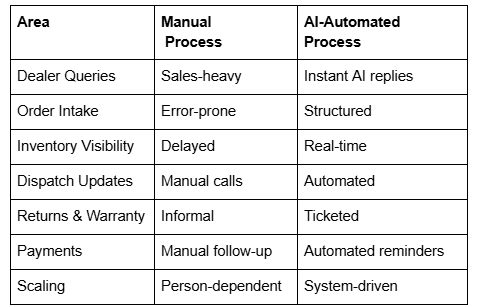
Manual vs AI-Driven Auto Parts Operations
 What Auto Parts Businesses Should Look for in an AI Platform
An enterprise-grade auto parts AI platform must support:
- Dealer enquiry automation
- Structured order capture
- Inventory and availability workflows
- Dispatch and logistics coordination
- Invoice and payment automation
- Warranty and return management
- Dealer self-service access
- Role-based access control
- Audit logs and reporting
- ERP and inventory system integration
Converiqo is designed to support all these auto-parts-specific workflows out of the box.
Example Workflow: Dealer Enquiry → Order → Dispatch → Payment
- Dealer enquires about a part
- AI confirms availability and price
- Dealer places structured order
- AI confirms dispatch and tracking
- AI sends invoice and payment reminder
How Auto Parts Businesses Can Implement AI Automation in 2-3 Weeks
Week 1
- Connect WhatsApp and dealer channels
- Upload part catalogue and pricing
Week 2
- Enable order, inventory, and dispatch workflows
Week 3
- Activate payment, return, and analytics automation
Conclusion
Auto parts manufacturers, wholesalers, and distributors that adopt AI automation achieve:
- Faster dealer response times
- Reduced order errors
- Improved inventory accuracy
- Predictable dispatch operations
- Better dealer satisfaction
- Scalable regional operations
AI automation is no longer optional—it is essential for modern, competitive auto parts supply chains.
With Converiqo’s auto-parts-ready workflows, businesses can modernise operations quickly and confidently.
FAQs
1. Can AI reduce order errors in auto parts distribution?
Yes. AI converts unstructured messages into structured orders automatically.
2. Does AI help dealers check availability faster?
Yes. AI provides instant real-time stock and availability updates.
3. Can AI manage warranty and return claims?
Yes. AI logs claims, tracks resolution and provides visibility.
4. Is AI suitable for regional and national distributors?
Absolutely. AI scales across depots and dealer networks.
5. How quickly can AI be implemented in auto parts businesses?
Most businesses go live within 2-3 weeks.
To Know More Contact Us : https://converiqo.ai/contact
About the Author
Nikita Srivastava
Ready to orchestrate your AI future?
Converiqo AI helps you design, deploy, and scale automation workflows that move your business faster. Connect with our team to see the platform in action and co-create the next chapter of intelligent operations.
Read More Blogs
Discover more insights and product updates curated by the Converiqo AI team.

The 7 Capabilities of Real Field Force Automation - and What Each One Fixes
What a complete field force automation system covers - seven capabilities, and what breaks in the field employee's day when each one is missing.

Tracking System vs Enabling System - Why Your Field Force App Has Low Adoption
Most Indian field force apps are tracking systems built for manager visibility. The structural reason field adoption stays low - and what an enabling system does differently.

Agentic AI Use Cases That Are Actually Working in 2026
Explore the agentic AI use cases creating real business value in 2026, from customer operations and finance to IT, security, and back-office workflows.