Introduction
Most businesses don’t have an AI problem. They have a workflow problem.
Leads come in, but follow-ups slip. Support requests arrive, but routing is messy. Internal teams waste hours repeating the same clarifications. And every time a workflow crosses tools CRM, ticketing, WhatsApp, email, spreadsheets things slow down.
That’s why agentic AI is becoming the next practical step beyond basic chatbots: it moves from answering to executing. Converiqo frames this shift clearly with a simple promise: deploy business-grade AI without the build time, using agentic AI models already trained to handle business workflows out of the box, and quickly validate through an interactive demo tailored for your industry.
This blog breaks down what agentic AI means in business terms, where it drives ROI fastest, what enterprise controls are non-negotiable, and how to pilot safely in weeks not quarters.
Why Agentic is different from normal business AI
Classic chatbots respond. Copilots assist. Agentic systems act with boundaries.
Industry definitions are converging on the same idea: agentic AI systems can pursue a goal with limited supervision by planning steps and invoking tools/actions. IBM describes agentic AI as systems that accomplish goals with limited supervision, often involving agents and orchestration. IBM Google Cloud similarly emphasizes goal-setting, planning, and executing tasks with minimal human intervention. Google Cloud Microsoft’s perspective highlights that agents can reason, plan, act, and adapt bridging knowledge to outcomes.
For businesses, the translation is straightforward:
The chatbot ceiling
A normal chatbot can answer “What is your refund policy?” but it usually cannot complete the operational chain: verify eligibility, create a ticket, trigger a workflow, notify the team, update the customer, and log the case end to end.
The agentic advantage
Agentic AI is designed for multi-step execution. It can collect inputs, validate rules, call tools, route to the right queue, create/update records, and escalate when needed so work actually finishes.
The business case: where agentic AI creates real ROI
Agentic AI pays off where work has three traits: high volume, high friction, and multi-step completion.
Lead capture to qualification to booking
In many industries, leads leak because response time is slow and qualification is inconsistent. An agentic workflow can standardize the intake, ask the right questions, assign the lead to the right owner, and trigger the next action like booking a demo. Converiqo makes this workflow focus concrete by offering automation categories such as Lead Generation & Management Automation and related business-oriented playbooks.
Support triage to resolution
Support isn’t just “answering.” It’s categorizing issues, prioritizing, routing, tracking SLAs, escalating edge cases, and closing loops. Agentic workflows shine when they reduce back-and-forth and preserve context across handoffs. Converiqo’s automation menu includes Ticketing System Automation and Customer Self-Service Automation which map cleanly to this execution-first model.
Internal HR/IT self-service
Employee requests are repetitive, costly, and constant. Agentic workflows can handle intake, verification, routing, and updates so internal teams spend less time on repetitive tasks. Converiqo lists Employee Self-Service Automation and Hiring/Talent Acquisition Automation, aligning well with these internal execution paths.
Procurement and vendor workflows
Procurement delays usually come from missing documents, unclear approvals, and slow coordination. Agentic workflows can collect required information, validate completeness, route approvals, and keep everyone updated. Converiqo includes Procurement Automation and Vendor Self-Service Automation, which are classic “agentic” domains when governed properly.
What a business-grade agentic system must include
Here’s what separates a reliable business agent from a clever demo.
Outcome definition
Agentic systems need a defined “done state.” Not “helped the user,” but “ticket created and assigned,” “appointment scheduled,” or “lead qualified and logged.”
Tool access and integrations
Execution requires integrations. If AI can’t interact with systems of record (CRM/helpdesk/HRMS), it can’t complete workflows. That’s why agentic AI is fundamentally an orchestration and tooling story, not only an LLM story. (This is also where governance becomes critical.)
Business rules and routing logic
Enterprises don’t want improvisation. They want consistent outcomes with clear escalation. Agentic systems work best when they operate within workflow logic: routing rules, approval steps, and exception handling.
Governance: control, traceability, accountability
As autonomy increases, the bar rises. Strong agentic deployments rely on permissioning, audit trails, and human-in-the-loop gating for sensitive actions. Legal and risk discussions around agentic systems are increasingly emphasizing these governance requirements. DLA Piper
Why “industry-trained playbooks” matter more than generic agents
Most businesses don’t want to “build agents.” They want outcomes.
Converiqo’s agentic AI page is intentionally structured around business types from education and professional services to healthcare, retail, home services, travel, real estate, and corporate services so organizations can start from an industry-aligned blueprint rather than a blank prompt.
This is not a cosmetic choice. Industry context changes:
- the language customers use
- what data is required
- escalation conditions
- compliance expectations
- what “good” looks like operationally
Pre-trained, workflow-oriented playbooks reduce implementation drag because the agent starts closer to the organization’s reality.
Read the complete guide to explore detailed insights, step-by-step explanations, and practical information that will help you understand this topic thoroughly.
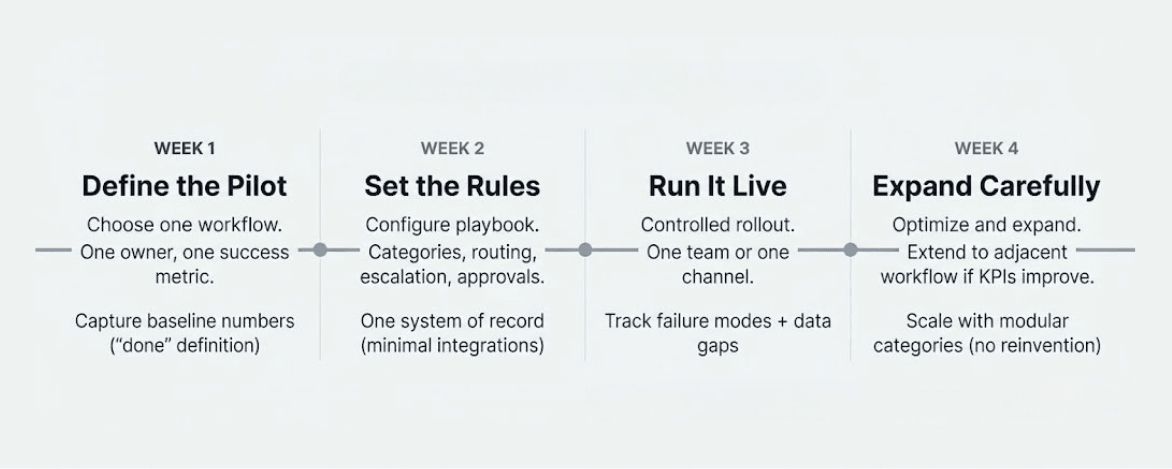
A practical 2–4 week pilot plan
The fastest path to adoption is a controlled pilot with measurable outcomes.
Week 1: Choose one workflow, one owner, one success metric
Pick a workflow that is high volume and easy to measure (lead qualification, ticket triage, appointment scheduling, internal requests). Decide what “done” means and capture baseline numbers.
Week 2: Configure the playbook and confirm the system of record
Define categories, routing, escalation triggers, and any approvals. Keep integrations minimal—one system of record is enough to prove value.
Week 3: Controlled rollout and real usage
Roll out to one team or one channel. Track failure modes: where escalation happens, why it happens, and what data gaps block completion.
Week 4: Optimize and expand deliberately
If KPIs improve, expand to the adjacent workflow (for example, from lead qualification into follow-ups, or from ticket creation into resolution tracking). This is where modular automation categories help you scale without reinventing everything.
Converiqo’s page pushes the same practical next step: “Ready to see agentic AI playbooks in action?” and invites users into an interactive demo tailored for your industry.
How Converiqo positions agentic AI for businesses
Converiqo’s positioning is not “build an agent.” It’s: deploy business-grade AI without the build time using trained models for business workflows, then validate quickly through a request-for-free-demo flow.
It also clearly anchors agentic AI inside a broader automation suite call center, community, customer self-service, employee self-service, field force, hiring, lead management, marketing, procurement, surveys, ticketing, and vendor self-service so agentic adoption can expand step-by-step rather than remain a single isolated bot.
And it’s transparent about brand lineage: Converiqo.ai is presented as a product of Mobiloitte.
Conclusion
Agentic AI is not a buzzword upgrade. It’s a shift from AI that answers to AI that executes within enterprise boundaries.
If you want outcomes, start with one workflow, one measurable metric, and a short pilot. Then scale module by module into other execution-heavy areas like ticketing, employee self-service, procurement, and vendor operations.
If you want to explore industry-aligned agentic AI playbooks, Converiqo Agentic AI page is designed exactly for that: trained workflow models by business type and a demo path tailored to your industry.
FAQs
How is agentic AI different from a chatbot?
A chatbot primarily answers questions. Agentic AI is designed to complete workflows: collect inputs, apply rules, invoke tools, update systems, and escalate when needed so outcomes happen, not just responses. IBM+1
Do businesses need integrations to use agentic AI effectively?
Yes if your goal is workflow completion. Without integrations to systems of record (like CRM or ticketing), AI can talk but can’t execute the operational steps that define ROI. Microsoft Azure
What’s the best first workflow to automate with agentic AI?
Start with a high-volume workflow that is easy to measure, such as lead qualification, ticket triage, or employee self-service requests. These typically show ROI fastest and expose the fewest dependencies early.
How long does an agentic AI pilot take?
A focused pilot can run in 2–4 weeks when scope is controlled: one workflow, one system of record, clear success metrics, and defined escalation rules.
Is agentic AI safe for regulated or sensitive workflows?
It can be, but only with governance: role-based access, audit trails, approval gates for high-risk actions, and escalation paths. Governance is a core theme across enterprise discussions of agentic systems. DLA Piper+1
Why do “industry playbooks” matter for agentic AI?
Because industries differ in language, data requirements, and escalation rules. Pre-structured playbooks reduce build time and improve adoption by matching real operational expectations from day one.
Where can I see agentic AI in action for my business type?
Converiqo explicitly invites users to try an interactive demo tailored for your industry via its Agentic AI page.
Want to evaluate the best module for your workflow? Book a Live Demo or Talk to an Automation Strategist.
About the Author
Himani Chaudhary
Ready to orchestrate your AI future?
Converiqo AI helps you design, deploy, and scale automation workflows that move your business faster. Connect with our team to see the platform in action and co-create the next chapter of intelligent operations.
Read More Blogs
Discover more insights and product updates curated by the Converiqo AI team.
The 7 Capabilities of Real Field Force Automation - and What Each One Fixes
What a complete field force automation system covers - seven capabilities, and what breaks in the field employee's day when each one is missing.
Tracking System vs Enabling System - Why Your Field Force App Has Low Adoption
Most Indian field force apps are tracking systems built for manager visibility. The structural reason field adoption stays low - and what an enabling system does differently.
Agentic AI Use Cases That Are Actually Working in 2026
Explore the agentic AI use cases creating real business value in 2026, from customer operations and finance to IT, security, and back-office workflows.