What is RAG-Based AI
and Why Enterprises Need It
A deep dive into Retrieval-Augmented Generation (RAG). Learn how RAG connects LLMs to your private enterprise data to minimize hallucination risks and improve accuracy.
Process Integrity
From Query to Grounded Answer
Understanding
RAG-Based AI
Retrieval-Augmented Generation (RAG) is an advanced AI technique that enhances Large Language Models (LLMs) by connecting them to your live enterprise data.
Unlike standard chatbots that rely solely on training data (which can be outdated), RAG-based systems "look up" the correct answer in your specific documents, databases, or wikis before responding. This drastically reduces hallucinations and ensures every answer is grounded in fact.
How RAG-Based AI Works
Understanding the step-by-step process of Retrieval-Augmented Generation
User Query Reception
Receives a user query or prompt, initiating the information retrieval process.
Retrieval Phase
A retriever component searches a vast external knowledge base (e.g., company documents, databases) for relevant information snippets.
Context Augmentation
The retrieved snippets are combined with the original user query, forming an augmented prompt.
Generation Phase
This augmented prompt is fed to a large language model (LLM), which then generates a response grounded in the provided context.
Response Output
The LLM produces a factual, accurate, and contextually rich answer, significantly reducing the likelihood of hallucinations.
Continuous Knowledge Update
The external knowledge base can be continuously updated without retraining the entire LLM, ensuring always-current information.
Architecture at a Glance
Understanding the fundamental architectural components for factual AI responses
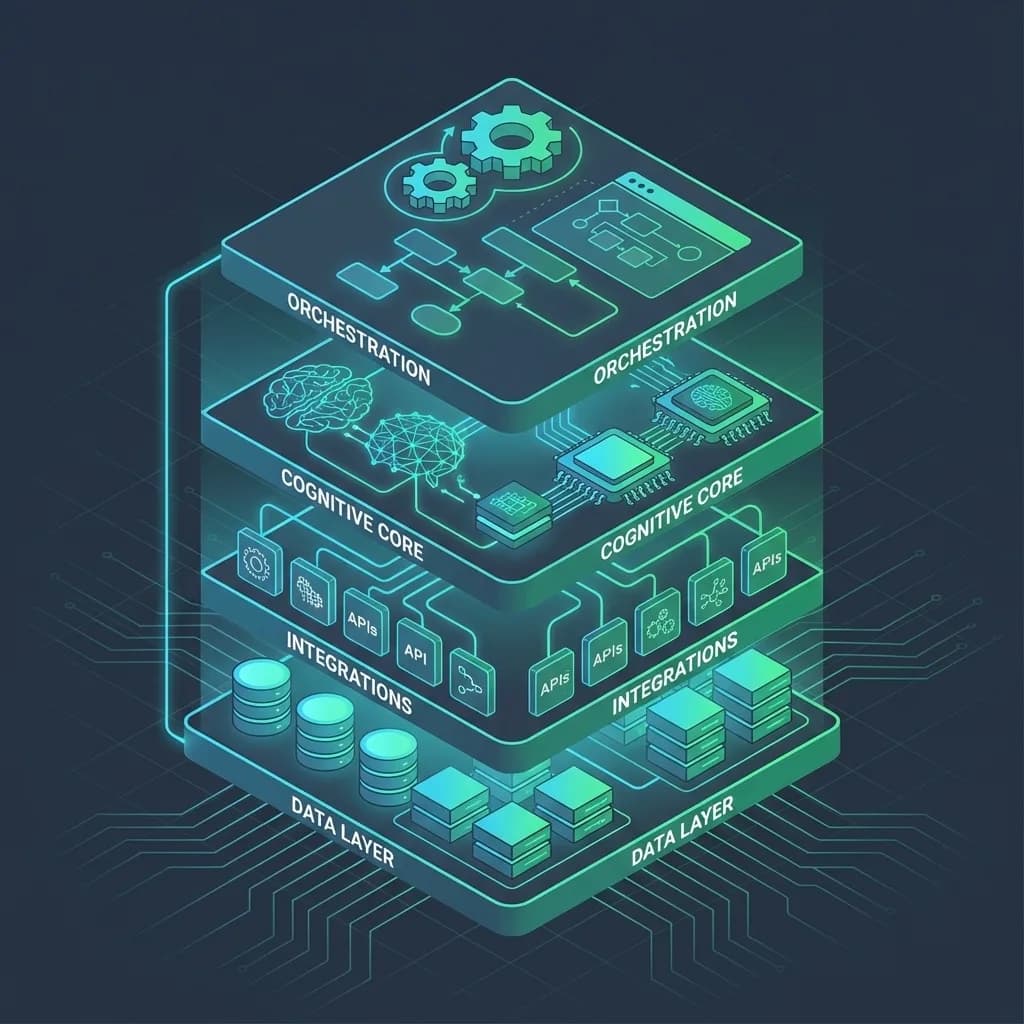
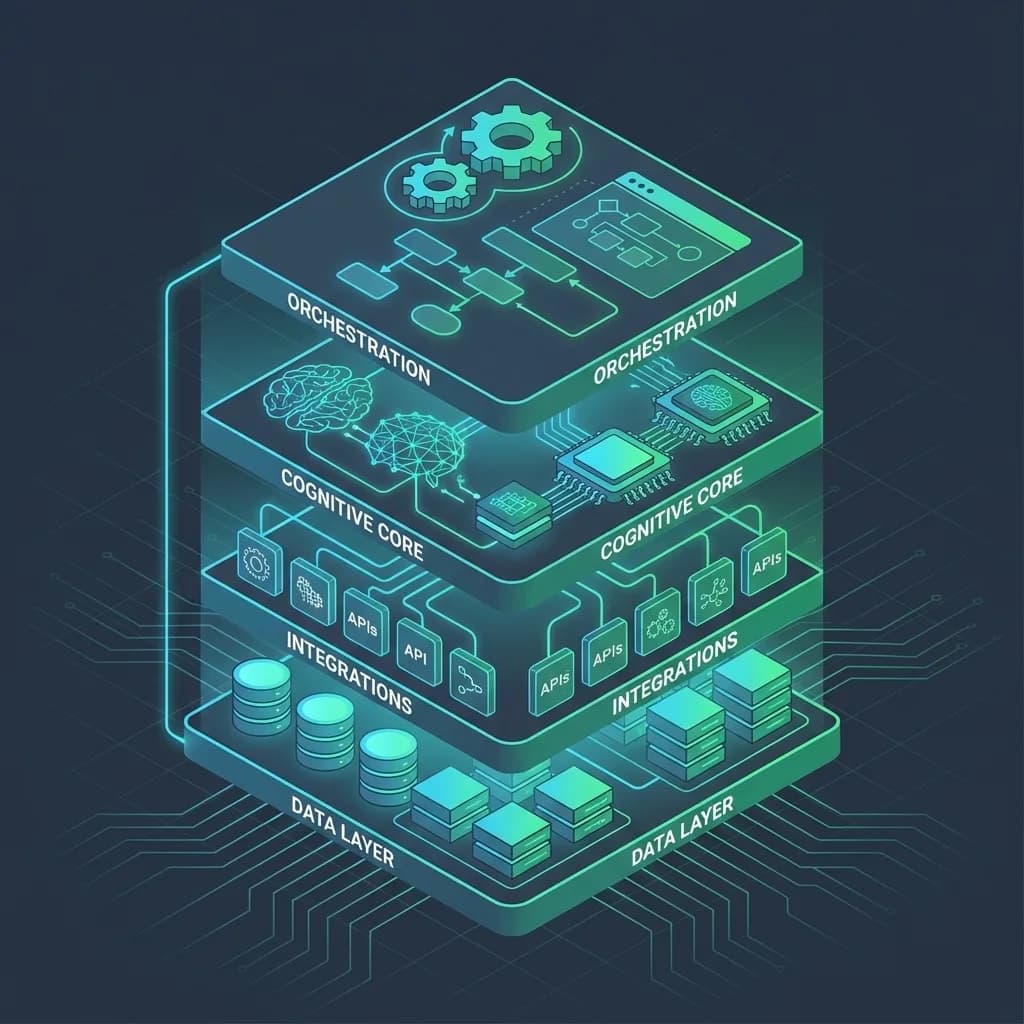
The architecture of a RAG-based AI system combines a Retriever (search engine) with a Generator (LLM). This hybrid approach ensures that the AI doesn't just "guess" the next word, but actively researches the topic first.
Key Architectural Components
- Query Encoder: Translates the user query into a vector representation suitable for searching the knowledge base.
- Document Index / Vector Database: Stores indexed enterprise documents and their vector embeddings for efficient retrieval.
- Retriever: Identifies and fetches the most relevant documents or passages from the index based on the encoded query.
- Generator (LLM): A large language model that synthesizes the retrieved information with the user query to formulate a coherent response.
- Ranker (Optional): Further refines the retrieved documents for relevance before feeding them to the generator, improving precision.
- Knowledge Base Management: Tools and processes for ingesting, updating, and maintaining the integrity of the external knowledge base.
Mental Model
Imagine an AI that, before answering, quickly consults an extensive library of verified company documents (the Retrieval step), selects the most relevant sections, and then crafts an answer based explicitly on those findings (the Generation step).
Enterprise Considerations
Understanding the transformative benefits and implementation considerations
For enterprises, RAG-based AI offers a powerful solution to critical challenges like data accuracy, preventing AI hallucinations, and leveraging proprietary knowledge. By integrating RAG with internal data sources—such as CRM systems, internal documentation, and research databases—companies can ensure that AI-driven applications provide responses that are not only contextually rich but also factually verifiable and compliant with internal policies.
Explore Related Topics
Unified Agentic AI BOT Platform
RAG-Based AI: Why Enterprises Need It
Agentic AI vs. Prompt-Based Chatbots
Leads Generation Automation
Employee Self-Service Automation
Industries
Prompt-Based Chatbots vs. RAG-Based AI Bot Platforms
Key Considerations for RAG Implementation
- Quality of enterprise knowledge base.
- Low-latency retrieval for real-time apps.
- Data freshness and version control.
- Securing sensitive information.
- Seamless integration with existing workflows.

Your Data Stays Yours
RAG keeps your sensitive data within your secure perimeter. Because the LLM acts as a reasoning engine rather than a storage device, your proprietary secrets are never trained into the public model, ensuring total data sovereignty.
Role-Based Access
Users only see what they are allowed to see.
Audit Trails
Track exactly which document fueled an answer.
RAG Governance Model
Governance and optimization strategies for enterprise AI BOT architecture
Controls
Curated Knowledge Base Management
+
Establish rigorous processes for source validation, data ingestion, and ongoing maintenance of the enterprise knowledge base used by RAG.
Contextual Retrieval Policies
+
Define rules and algorithms for how information is retrieved, ensuring relevance and preventing access to sensitive or irrelevant data.
AI Output Validation & Human Oversight
+
Implement mechanisms for human review of AI-generated responses, especially in critical applications, to ensure accuracy and compliance.
Auditability & Explainability Features
+
Ensure the ability to trace the sources of information used by the RAG system for any generated response, enhancing transparency.
Data Security & Access Controls
+
Apply robust encryption, access control, and data masking techniques to protect sensitive information within the knowledge base.
Risks
Information Overload or Irrelevance
The retriever might fetch too much data or irrelevant information, leading to less precise or confusing AI responses.
Stale Knowledge Bases
If the external knowledge base isn't regularly updated, RAG can provide outdated information, compromising accuracy.
Misinterpretation of Retrieved Context
The LLM might misinterpret or incorrectly synthesize the retrieved information, leading to subtle but significant errors.
Data Privacy & Security Exposure
Improper handling or storage of sensitive enterprise data within the knowledge base could lead to breaches or compliance issues.
Complexity of Implementation & Maintenance
Setting up and maintaining a robust RAG system, including data pipelines and vector databases, can be resource-intensive.
Mitigations
Advanced Ranking & Filtering Algorithms
Employ sophisticated ranking models to prioritize the most relevant information and filter out noise from retrieval results.
Automated Knowledge Base Sync & Refresh
Implement automated pipelines to continuously update the knowledge base, ensuring all information is current and accurate.
Contextual Fine-Tuning & Prompt Engineering
Optimize LLM prompts and fine-tune models to better understand and utilize retrieved context effectively.
End-to-End Encryption & Zero-Trust Architecture
Enforce comprehensive security measures from data ingestion to response generation, coupled with strict access policies.
Modular Design & Cloud Services
Utilize a modular architecture and managed cloud services for components like vector databases to simplify deployment and reduce operational overhead.
Ready for Factual AI?
See how Converiqo AI leverages RAG to transform your enterprise data into reliable, real-time intelligence.
References, Sources & Empirical Evidence
Academic & Industry Citations
- “Retrieval-Augmented Generation for Knowledge-Intensive NLP Tasks” — Lewis et al. (Meta AI Research / arXiv:2005.11401) (2020)Source
The foundational research paper introducing RAG architecture to ground LLMs in external knowledge.
- “Retrieval-Augmented Generation (RAG) for LLMs: A Survey” — Gao et al. (arXiv:2312.10997) (2023)Source
A comprehensive analysis of Naive RAG vs. Advanced RAG in enterprise applications.